





Tech
Ch@mobile Is Bringing Creator Culture to Wireless

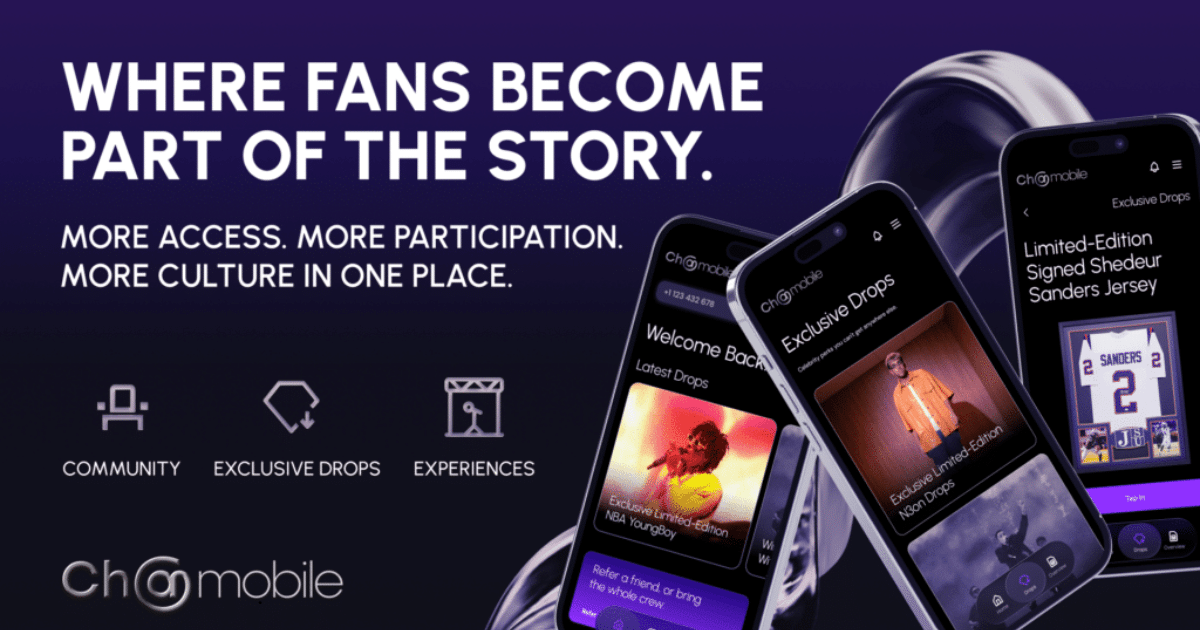
Ch@mobile is launching a creator-led wireless platform that aims to turn mobile plans into fan memberships, giving artists, athletes, and online creators a financial stake in communities built around exclusive access, drops, and real-world experiences.
The Los Angeles-based company runs on T-Mobile’s 5G network through a technology partnership with Compax Venture and launches with strategic partners including YoungBoy Never Broke Again, N3on, Adin Ross, Young Thug/Sp5der, Peso Pluma, Shedeur Sanders, and Live Nation Urban.
Co-founder Bernt Ullmann has spent three decades applying celebrity influence to consumer businesses, from helping scale FUBU International as its president to overseeing licensing and brand deals tied to Jennifer Lopez, Marc Anthony, Nicki Minaj, Adam Levine, and Steven Tyler, among others. With Ch@mobile, he says the same talent-led playbook can apply to telecom, a category he argues has largely competed on price rather than affinity.
“We have positioned Ch@mobile at the crossroads of streaming, music, and pop culture,” Ullmann says. “We’re very much focused on culture and community, and the phone piece of it becomes the delivery system by which you access these communities.”

Telco’s Brand Problem Is a Price Problem
Bernt’s case for Ch@mobile begins with a diagnosis of the wireless industry that most carriers would recognize, and few would argue with.
“If you were to ask anyone in the U.S. if they care about their phone carrier, I’m willing to bet you that 99% are going to say they don’t care at all,” he says. “They have no brand loyalty or affinity.”
In his view, that indifference is structural, not incidental. Carriers have spent years trying to differentiate on features that consumers cannot meaningfully distinguish from one another. The result is a market that competes almost entirely on price.
“When you don’t have a strong standalone brand with inherent brand equity, and you’re forced to just compete on price, you will find yourself in a death spiral race to the bottom,” Bernt says. “There’s always someone a little more desperate, willing to cut their margins. That’s why you see all these promos all the time.”
Celebrity involvement in wireless has largely followed the same pattern. The closest precedent he cites is Ryan Reynolds’s investment in Mint Mobile, where Reynolds functioned primarily as a creative director and strategic investor rather than as an identity anchor for a cultural community.
“The core product was still the same,” Bernt says. “It’s telco.”
How Beats Made Headphones Part of Culture
Bernt points to Beats by Dre as an example of how culture and talent can redefine an otherwise functional product category. At the center of the brand, headphones transitioned from simple electronics into something tied to music, identity, and lifestyle.
“There is nothing like that in telco,” he says. “Before Beats [by Dre], headphones were just technology products. Then they became part of culture and self-expression.”
What he observed in consumer products, and what he previously built in fashion, was a replicable pattern: an undifferentiated category gets a credibility injection from talent with real community loyalty, and a new consumer segment is unlocked. He applied that logic with FUBU International and the emerging urban shopping demographic. He applied it again with the Lopez and Anthony deal and the Hispanic consumer market.
“Whether it was the emergence of a new shopping demographic in the urban space, or the emergence of the Hispanic shopper, this is to me the next generation of how people will interact,” he says.
The difference between those deals and Ch@mobile, in his framing, is that the old model created individual celebrity brands. Ch@mobile is building a portfolio of strategic partners around a shared platform, with all of them holding a vested financial stake in its performance.
Partners, Not Ambassadors
The distinction Bernt draws between Ch@mobile’s relationships with its creators and a traditional brand ambassador arrangement is the most operationally meaningful claim the company makes.
“The brand ambassador is kind of paid for a certain engagement. Typically, it’s a timed thing. There’s some type of monetary value assigned to it, but that’s it,” he explains. “In our case, these guys are with us for the duration. They have a vested financial interest in the success.”
That alignment has practical implications for how the platform develops. Rather than locking in content deliverables, Ch@mobile’s strategic partners are building their communities within the platform. The specific financial structures vary by partner, and Bernt declines to detail individual arrangements, but the stated principle is that creators participate in the platform’s upside rather than simply promote it from the outside. When Bernt met with prospective partners, their primary questions were often less about compensation and more about what the platform could do for their audiences.
“Very often before they try to figure out how much money they can make, they try to figure out how they can be of value or service to their fans,” he says.
The sequencing of how Ch@mobile assembled its launch roster mirrors how Bernt approached flagship store expansion at Donna Karan in the 1990s, where he resisted opening locations in smaller Norwegian cities that would have been easy early wins. “We started with high-profile talent. We took our time, got the right people on board, so other people could feel safe joining,” he says.
Exclusive Drops as the Non-Replicable Layer
Ch@mobile’s content layer, which separates the product from a standard carrier with creator branding, centers on a calendar of exclusive drops and real-world experiences. The platform offers members access to a range of exclusive perks and experiences, including but not limited to presale concert tickets, backstage passes, meet-and-greets, signed merchandise, and digital collectibles tied to its strategic partners.
“The unique drops and experiences, no one else has them,” Bernt says. “That sets us completely apart.”
He distinguishes between Ch@mobile’s access-driven model and what a streaming or social platform provides. The differentiator is not exclusive content alone, but physical and experiential access that has no substitute.
“You don’t need Ch@mobile if you’re only interested in making phone calls,” he says. “And if all you want is to consume content, there are other apps that do that. But the unique drops and experiences, no one else has.”
Complementing the drops is a feature called “Ch@ Back,” a gifting program allowing any member to purchase mobile plan subscriptions for others. Bernt shares that the program has already generated informal competition among strategic partners over who will gift the most subscriptions to fans, with some pledging 100 and others countering with 500.
The longer-term test is whether that calendar sustains engagement past the launch window. Bernt frames the drops not as a one-time acquisition hook but as an ongoing subscription rationale. “Subscribers are not just paying for a phone plan,” he says. “They are staying connected to a community and to a stream of experiences they cannot access anywhere else. If we do our job well, people will stay because they want to be part of the next drop, the next experience, and the next opportunity.”
An Affiliate Layer Below the Headline Roster
Ch@mobile’s go-to-market is not limited to its launch roster. The company is building an affiliate program that lets any creator, regardless of following size, earn by bringing new subscribers onto the platform.
“Someone with 5,000 followers, it doesn’t really matter. There is no minimum cap,” Bernt says. “If you assist in putting someone on the platform, you partake.”
The affiliate structure extends Ch@mobile’s community-building logic downward through the creator stack. Rather than relying entirely on headline partners, the model anticipates that niche creators with high-trust audiences in specific communities may drive conversion that larger, more diffuse accounts cannot.
Bernt notes that the program’s actual top performers remain to be seen. “We may very well find that someone with a low following count is very credible in bringing people on board,” he says.
A Slow Erosion of the Existing Model
If Ch@mobile’s model holds, Bernt believes it signals a directional shift in how telecom, creator monetization, and fan engagement intersect. One that the existing carrier market is structurally unprepared to absorb.
“I think you’re going to see a slow and steady erosion away from the traditional model into something that’s more value-driven,” he says.
The platform’s financial logic extends beyond standard telco margins. Bernt describes the revenue stack in layers: the phone plan as a profitable base, then creator-branded accessories and merchandise, then a platform fee or revenue share on creator commerce conducted inside the app, then brand partnerships as the audience scales. The accessories opportunity is more specific than it sounds. A fan might buy a phone case or charger tied to one of the platform’s strategic partners, products that generate revenue while deepening the community relationship.
“There are large national brands that want to talk to those audiences,” Bernt says. “That opens up marketing opportunities. There are upsell opportunities.”
Ch@mobile describes its direction as an “ownership economy,” a framework in which creators build, control, and monetize their own communities without dependence on platforms that can change their terms, adjust their algorithms, or claim the audience relationship entirely.
On the question of brand integration, Bernt draws a clear line between that model and conventional advertising. The brands that fit, he says, are ones with a natural connection to culture, music, fashion, or streaming. “When the brand integration gives the fan something they actually want, it does not feel like an interruption,” he says. “It feels like part of the experience.”
“We are building the decentralized social network,” Bernt says. “A community of like-minded people for tremendous, unique experiences that you cannot access anywhere else.”
Subscribe to Our Newsletter
Check Out Our Podcast