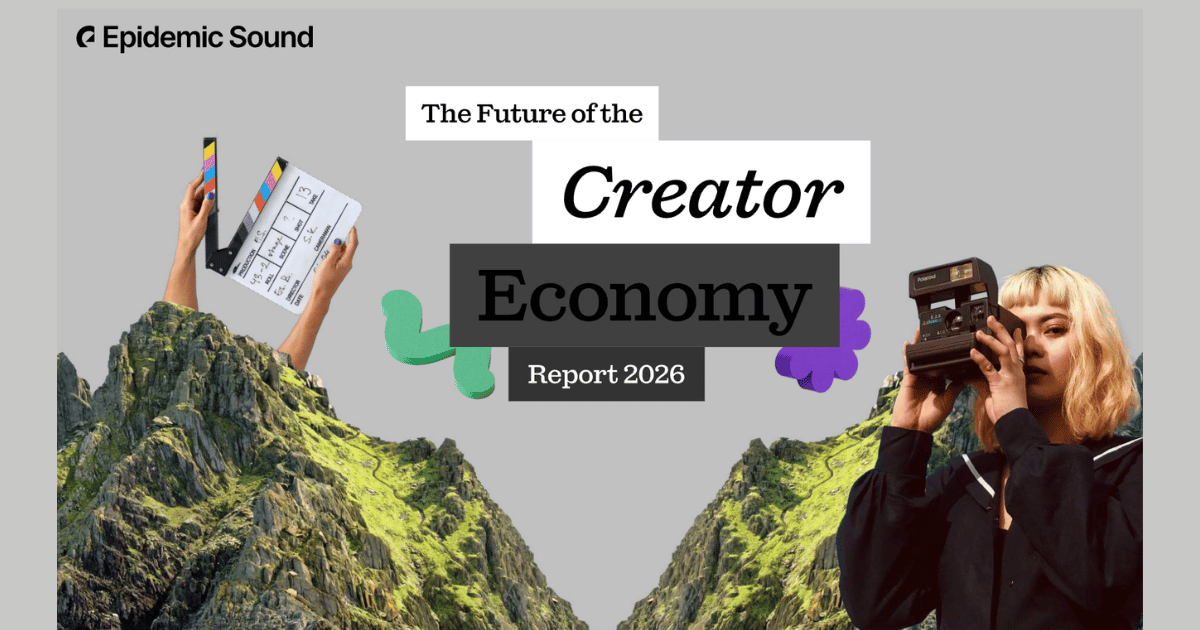
Nearly all content creators now use artificial intelligence tools in their work, while concerns about intellectual property protection and unauthorized content training are mounting, according to new research from audio licensing platform Epidemic Sound.
The company’s fourth annual “Future of the Creator Economy Report” surveyed 3,000 professional content creators aged 18 and older in the United Kingdom and the United States. Sapio Research conducted the online interviews in March and April 2026. The survey found that 94% of creators already use AI tools, 72% expect to increase their usage over the next 12 months, and 89% report feeling some pressure to adopt the technology to remain competitive.
The Creator Economy continues to expand alongside this adoption. The market totaled $250 billion in 2023 and is projected to reach $480 billion in 2027, according to Goldman Sachs.
How Creators Are Using AI
The most common application is enhancing or marketing content, cited by 46% of respondents. Generating ideas or scripts ranked second at 44%, followed by editing or production support at 43%, audience insights or analytics at 33%, and creating fully AI-generated content at 30%.
The report identifies two broad AI use patterns: 57% use workflow AI to support existing processes, while 28% use fully generative AI. Confidence in the technology correlates with audience size. Among creators with more than 500,000 followers, 74% say AI meets their creative expectations, compared with 60% of those with 10,000 or fewer followers.
Josh Saffer, director at Connect Management and manager of creator BrandonB, described AI as handling the repetitive parts of the production process. “Use AI to give yourself more time to be the creative, not less,” Saffer said.
A Generational Divide
Creators aged 18 to 24 express more skepticism toward AI than older cohorts. Only 57% of this group expect to increase their AI use over the next 12 months, compared with 75% of creators aged 35 to 44. Thirteen percent of 18-to-24-year-olds do not use AI at all.
The gap extends to perceived opportunity. Half of younger creators agree AI expands professional opportunities, versus 73% of those aged 35 to 44. On output quality, 49% of the younger cohort say AI meets their expectations, against 69% of the older group. The report suggests this divergence may reflect higher baseline standards among creators who are more accustomed to evaluating digital content.
Human Creativity as a Differentiator
Three-quarters of creators expect human-made content to command a premium in the AI era. The share rises to 81% among those with more than 500,000 followers and stands at 69% among those with 10,000 or fewer.
Sound plays a central role in this distinction. Seventy-nine percent of creators say music directly affects engagement and revenue, 78% say it builds brand identity, 83% say human-made sound produces stronger emotional connection with audiences, and 76% say music selection can determine whether content succeeds or fails.
Epidemic Sound interim CEO Sara Börsvik said the Creator Economy’s best opportunities lie with those who combine AI’s scaling power with the human distinctiveness that keeps their work trusted.
Revenue and Owned Audiences
Creator revenue streams grew across all top categories in 2026. Live streaming ranked as the leading source at 41%, up from 32% in 2025. Fan subscriptions followed at 34% (up from 27% in 2025), with brand partnerships at 33%, ad revenue at 32%, and platform creator funds at 31%, each rising between three and nine percentage points from the prior year.
Seventy-two percent of creators are actively building owned audience channels, including newsletters and Discord communities, rising to 79% among those with more than 500,000 followers. Average annual earnings vary significantly by scale. U.S. creators with 10,000 or fewer followers earn approximately $11,000 per year; those with more than 500,000 average $106,000. In the U.K., the comparable figures are £10,000 and £95,000.
Licensing Gaps Persist
Despite broad AI adoption, creator understanding of intellectual property protection has not kept pace with associated risks. Only 13% of creators cite licensing or IP discipline as a key success driver, yet 73% acknowledge that unclear licensing could limit future business opportunities. Sixty-two percent reported copyright or licensing issues in the previous 24 months, and 53% said those issues had already affected brand deals or commercial opportunities.
Ninety-three percent of creators associate AI with significant risks. The top concern, cited by 44%, is fully AI-generated content released without disclosure. Thirty-seven percent are concerned about their content being used to train AI models without permission, and 33% worry about AI replicating their voice or creative style.
Seventy-five percent of creators say disclosure about AI use in content is essential for audience trust, and 72% say transparency about AI involvement improves content performance.
Image source: Epidemic Sound The full report is available here
David Adler is an entrepreneur and freelance blog post writer who enjoys writing about business, entrepreneurship, travel and the influencer marketing space.

















Nearly all content creators now use artificial intelligence tools in their work, while concerns about intellectual property protection and unauthorized content training are mounting, according to new research from audio licensing platform Epidemic Sound.
The company’s fourth annual “Future of the Creator Economy Report” surveyed 3,000 professional content creators aged 18 and older in the United Kingdom and the United States. Sapio Research conducted the online interviews in March and April 2026. The survey found that 94% of creators already use AI tools, 72% expect to increase their usage over the next 12 months, and 89% report feeling some pressure to adopt the technology to remain competitive.
The Creator Economy continues to expand alongside this adoption. The market totaled $250 billion in 2023 and is projected to reach $480 billion in 2027, according to Goldman Sachs.
How Creators Are Using AI
The most common application is enhancing or marketing content, cited by 46% of respondents. Generating ideas or scripts ranked second at 44%, followed by editing or production support at 43%, audience insights or analytics at 33%, and creating fully AI-generated content at 30%.
The report identifies two broad AI use patterns: 57% use workflow AI to support existing processes, while 28% use fully generative AI. Confidence in the technology correlates with audience size. Among creators with more than 500,000 followers, 74% say AI meets their creative expectations, compared with 60% of those with 10,000 or fewer followers.
Josh Saffer, director at Connect Management and manager of creator BrandonB, described AI as handling the repetitive parts of the production process. “Use AI to give yourself more time to be the creative, not less,” Saffer said.
A Generational Divide
Creators aged 18 to 24 express more skepticism toward AI than older cohorts. Only 57% of this group expect to increase their AI use over the next 12 months, compared with 75% of creators aged 35 to 44. Thirteen percent of 18-to-24-year-olds do not use AI at all.
The gap extends to perceived opportunity. Half of younger creators agree AI expands professional opportunities, versus 73% of those aged 35 to 44. On output quality, 49% of the younger cohort say AI meets their expectations, against 69% of the older group. The report suggests this divergence may reflect higher baseline standards among creators who are more accustomed to evaluating digital content.
Human Creativity as a Differentiator
Three-quarters of creators expect human-made content to command a premium in the AI era. The share rises to 81% among those with more than 500,000 followers and stands at 69% among those with 10,000 or fewer.
Sound plays a central role in this distinction. Seventy-nine percent of creators say music directly affects engagement and revenue, 78% say it builds brand identity, 83% say human-made sound produces stronger emotional connection with audiences, and 76% say music selection can determine whether content succeeds or fails.
Epidemic Sound interim CEO Sara Börsvik said the Creator Economy’s best opportunities lie with those who combine AI’s scaling power with the human distinctiveness that keeps their work trusted.
Revenue and Owned Audiences
Creator revenue streams grew across all top categories in 2026. Live streaming ranked as the leading source at 41%, up from 32% in 2025. Fan subscriptions followed at 34% (up from 27% in 2025), with brand partnerships at 33%, ad revenue at 32%, and platform creator funds at 31%, each rising between three and nine percentage points from the prior year.
Seventy-two percent of creators are actively building owned audience channels, including newsletters and Discord communities, rising to 79% among those with more than 500,000 followers. Average annual earnings vary significantly by scale. U.S. creators with 10,000 or fewer followers earn approximately $11,000 per year; those with more than 500,000 average $106,000. In the U.K., the comparable figures are £10,000 and £95,000.
Licensing Gaps Persist
Despite broad AI adoption, creator understanding of intellectual property protection has not kept pace with associated risks. Only 13% of creators cite licensing or IP discipline as a key success driver, yet 73% acknowledge that unclear licensing could limit future business opportunities. Sixty-two percent reported copyright or licensing issues in the previous 24 months, and 53% said those issues had already affected brand deals or commercial opportunities.
Ninety-three percent of creators associate AI with significant risks. The top concern, cited by 44%, is fully AI-generated content released without disclosure. Thirty-seven percent are concerned about their content being used to train AI models without permission, and 33% worry about AI replicating their voice or creative style.
Seventy-five percent of creators say disclosure about AI use in content is essential for audience trust, and 72% say transparency about AI involvement improves content performance.
Image source: Epidemic Sound
The full report is available here
Subscribe to Our Newsletter
Check Out Our Podcast