







Strategy
Social Commerce Won’t Scale the Way Brands Expect – Deloitte’s Dennis Ortiz Says Start With Creators

For years, the promise of social commerce in the U.S. has trailed its reality. Brands have watched China’s live-commerce ecosystem generate billions in real-time transactions and assumed the same infrastructure would materialize on platforms like YouTube and Instagram. Dennis Ortiz, a partner at Monitor Deloitte and one of the firm’s leading voices on Creator Economy strategy, thinks that assumption is the first mistake.
Dennis has spent 16 years advising technology, media, and telecommunications companies at Deloitte, where he co-leads the firm’s Creator Economy offering with Deloitte Digital. His client portfolio spans the major advertising platforms, giving him an unusually direct view of how platforms are positioning themselves as commerce infrastructure. The picture, he argues, is more complicated than most brands realize.
“When you talk to outsiders, the Creator Economy tends to be this separate thing,” Dennis says, “when in actuality it has infiltrated and converged with some traditional areas that we as consumers intersect with.”
That convergence now extends into retail, entertainment, and financial services. But it has not yet produced the seamless, in-platform purchasing experience that the social commerce narrative has long predicted, and the reason is structural.
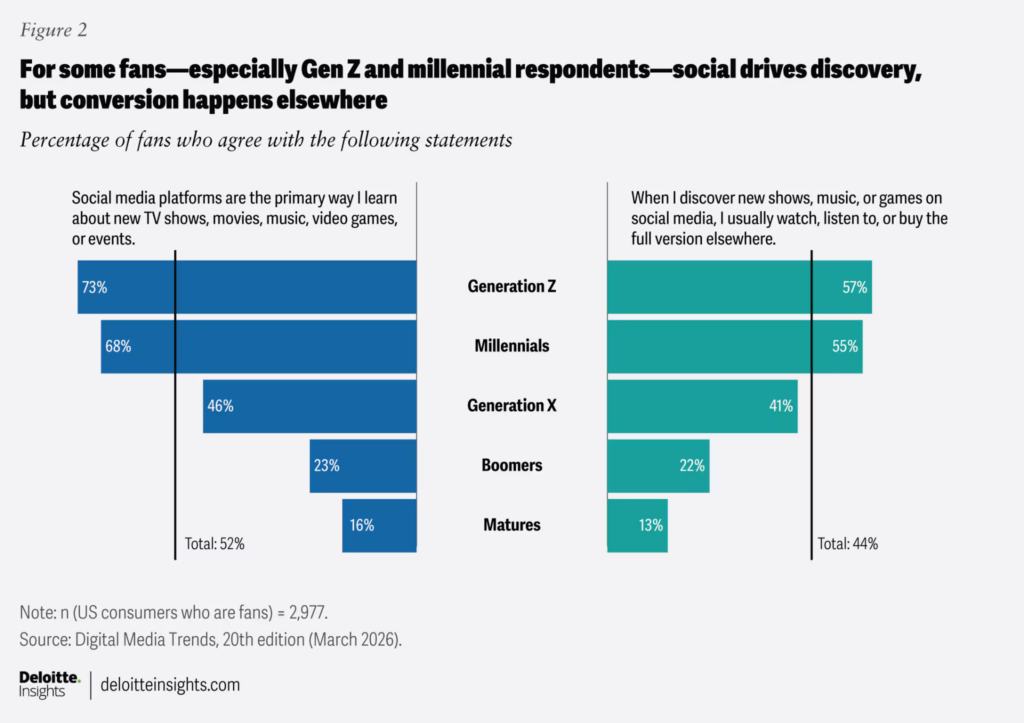
Deloitte’s “2026 Digital Media Trends” survey, based on 3,575 U.S. consumers, provides a statistical backdrop to Dennis’s thesis. About 70% of Gen Z and millennials say they have seen a product on social media and then gone to a retailer’s website to complete the purchase. Only 49% of the same cohort report buying directly on social platforms. Social is driving purchase intent. It is not yet closing the sale.
Why Full-Funnel Social Commerce Requires Infrastructure Platforms Don’t Want to Build
The gap between social discovery and social transaction has a clear explanation for Dennis. Commerce requires fulfillment, customer service, inventory management, and return processing. None of the major U.S. ad platforms, with the exception of Amazon, are built for that.
“I don’t think it’ll evolve to the extent that has been speculated about,” he says. “The advertising side of the business is very separate from the product side, and creators sit within the product side. They’re not on the advertising side.”
Dennis points to TikTok Shop as the closest approximation of a true end-to-end social commerce model in the West, largely because ByteDance built TikTok with commerce infrastructure baked in from the start. The other major platforms are pushing transactions off-platform by design, not by accident.
“Some of them are also heavily invested in AI and data centers,” he notes. “Shifting the dollars they’re getting from advertising into fulfillment, and inventory is just not a priority. I don’t think we’re going to see that dollar shift happen anytime soon.”
The Attribution Gap Is Real. Brands Are Misreading It.
The fact that consumers are not converting inside social platforms does not diminish social’s commercial role. It changes where that role sits in the funnel. Consumers across all generations are being influenced on social at a rate of roughly 53%, per Deloitte’s data. The influence is real. The attribution, for many brands, remains a black box.
“Social commerce, or commerce on a platform, should not be treated just as a transactional opportunity or a single channel,” Dennis says. “You need to think of it as a full-funnel commerce ecosystem. You’ve got to optimize not only for impressions and engagement, but also for creator partnerships, community building, and conversion.”
The mobile device, in his view, is the mechanism making this shift permanent. Consumers between Gen X and Gen Z engage with six to seven platforms daily. That volume of touchpoints means most shopping journeys now begin on a social feed. Brands that treat social only as a transactional channel, rather than a discovery and trust-building layer, are underinvesting in the part of the funnel that actually moves people.
Two Mistakes That Will Cost Brands in the Next Three Years
Dennis identifies two recurring errors in how brands are currently operating on social commerce. The first is structural: treating it as a media channel instead of a commerce system. The second is relational: over-scripting creator partnerships.
“The brands that are actually going to do well in this space are those operating like a creator and not just an advertiser,” he says. “Producing native content, platform-specific content, rather than just pushing one message out. How do you tailor it to a short-form video versus a long-form video versus a static picture?”
On the creator partnership side, Dennis draws on his former life as a brand manager at a major consumer packaged goods company, where Nielsen data provided a reliable feedback loop between advertising and in-store sales. That equivalent does not exist in the Creator Economy. “There is no fundamental measurement system that gives a brand the confidence that a creator is going to drive X amount of sales,” he says. “It is a leap of trust.”
According to Dennis, that measurement gap is part of why brands default to control, over-scripting content, and treating partnerships as one-off campaigns. But over-scripting defeats the purpose. “That’s the reason these creators have such loyal followings,” he says. “They’re able to produce things in a very believable way, true to who they are. Brands need to be comfortable giving that liberty.”

Creator First, Platform Second: A Framework for Brand Strategy
Given the uncertainty around which platforms will build out full-funnel commerce, Dennis argues that brands should organize their strategy around creators rather than channels. The logic is grounded in trust data. Deloitte’s survey finds that 34% of consumers trust brands that partner with creators, and the same share trust creator endorsements over brand-produced advertising.
“As a brand, you should probably be thinking less about which specific platform and more about which specific creators you should be partnering with,” Dennis says. “Creators that have continuous engagement of their following, that have the trust of their following, that align with your own brand values. Then follow them on what platforms they’re on.”
That argument also applies to campaign duration. Deloitte’s research finds that 65% of Gen Z engage with their creator communities throughout the year, not just around a single piece of content. Dennis uses this to make the case for long-term creator relationships: “You should think about longer-term partnerships to get that stickiness, to get the engagement, the believability, and not just the virality of a one-time moment.”
His practical framework for a CMO building a social commerce strategy from scratch involves three steps: building a creator and community engine organized around brand-aligned creators, investing in short-form video and in-platform conversion tools, and defining measurement criteria before the campaign launches rather than after.
The CMO Composition Problem Is Bigger Than It Looks
Beyond strategy, Dennis sees a talent gap inside brand marketing teams that compounds the social commerce challenge. In his view, many CMOs today are not digital natives. They built their careers on channels, like linear television, print, and in-store promotions, where measurement was standardized, and the feedback loops were established.
“Their trust of social commerce, their trust of measurement, their trust of channels is very different,” Dennis says. “If I were a CMO, I would think about the composition and experiences of my team. Should I skew more toward adding digital natives who understand the platforms better? Because that is also where ad dollars are shifting.”
It is a structural argument as much as a talent one. As Deloitte’s research shows, 33% of consumers say they feel a stronger personal connection to social media creators than to TV personalities or actors. Ad dollar allocation has not caught up to that behavioral reality, and Dennis suggests the composition of the teams making those allocation decisions is part of the reason.
Agentic Commerce and the Next Shift Brands Cannot Afford to Ignore
Looking at the next 12 months, Dennis does not point to a new platform or content format. He points to agentic commerce: the use of AI agents to actively automate purchase decisions, evaluate options, personalize recommendations, and potentially negotiate pricing on behalf of consumers. It has not been fully implemented yet, but the foundational investments are visible.
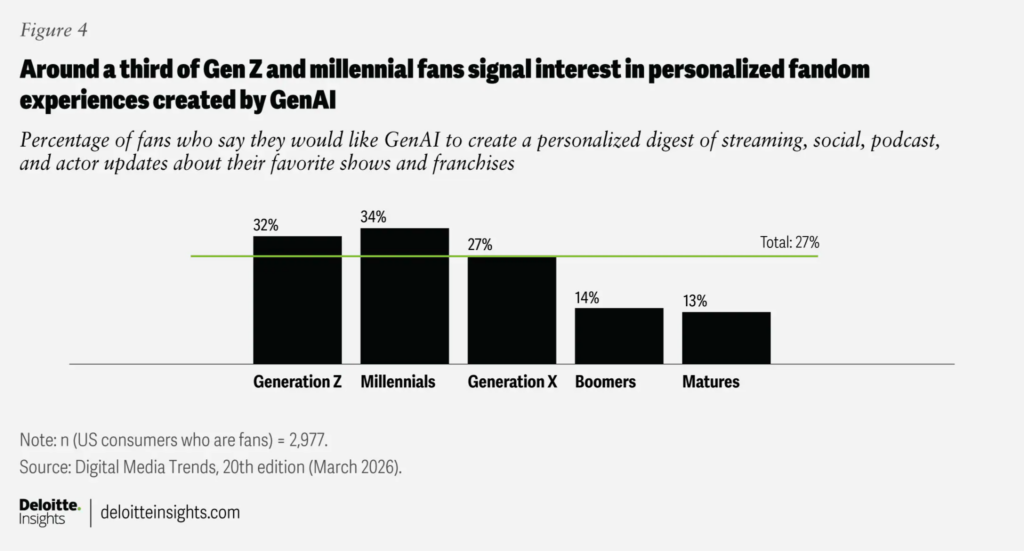
“Identifying commerce through agentic behavior could actually change my outlook on social commerce in the U.S.,” Dennis says. “There’s still room to be made about actively automating purchase decisions on behalf of consumers, doing all the research associated with that, evaluating options, personalization of recommendations, and even the negotiation of a price. Those things haven’t happened yet.”
He sees AI’s clearest near-term impact not in commerce but in advertising optimization. Major platforms have spent heavily on AI-driven personalization over the past two years, and the results are measurable: advertisers are spending more because returns have improved. That flywheel is already compressing the performance gap between creator-led and traditional media.
The broader trajectory Dennis tracks is one of sector convergence. The Creator Economy is reshaping entertainment, retail, and, increasingly, financial services and sports. “We’re seeing it already in certain spaces, and we haven’t seen the full potential yet,” he says. “But we know it’s going to happen.”
The structural issue Dennis closes on is one he believes platforms, brands, and even industry observers rarely discuss directly. Individual creators are operating as small businesses within a system designed for enterprise advertisers. Payment terms of 30 to 60 days are standard in brand deals, but the creators on the other end often need capital in days.
“If creators were paid more consistently and fairly for their content, given the level of effort, I think we would probably be in a better place,” Dennis says. “They’re treated as enterprises or businesses when they’re not. And that’s not how you encourage people to drive the creativity and content that all of the advertisers and platforms want.”
Subscribe to Our Newsletter
Check Out Our Podcast