




Strategy
Brandon Smithwrick Left Corporate to Build Content Systems. B2B Brands Are Paying Attention.

By the time Brandon Smithwrick had matched his corporate salary through creator work, he was still holding a director-level job. He left five months after launching his newsletter anyway. The system, he reasoned, had made the decision for him.
“Content to Commas,” the weekly strategy newsletter Brandon launched in March 2025 from Brooklyn, is built around a Saturday playbook structure aimed at founders and entrepreneurs who are already working on weekends. The argument embedded in every issue is that content only works when the infrastructure behind it is intentional. By August 2025, that argument had become Brandon’s full-time profession.
Brandon spent more than a decade building content operations for brands with institutional backing, leading creative and content teams at Kickstarter, where the work spanned brand activations at Tribeca, Sundance, and Comic-Con alongside social and editorial strategy. He held content leadership roles at Squarespace and Ralph Lauren before that. What he learned across those roles shaped the thesis he now publishes and sells.
“It was all about creating that system that just worked behind the scenes,” he says. Named a Forbes 30 Under 30 honoree in marketing and advertising, Brandon now operates as a full-time creator and consultant, working with brand partners including Amazon Business, HubSpot, Canva, AG1, Spotify, and Perplexity, while publishing across LinkedIn, Instagram, Threads, YouTube, and the newsletter.
This year, by his own count, more than 900 posts have gone out across those surfaces.
The Playbook Over the Post
The Saturday newsletter format was not Brandon’s first instinct. He had been encouraged to launch a podcast when he started, but settled on a written newsletter instead after testing tone, cadence, and format in the early months.
“I just imagined there are so many entrepreneurs and founders, even creators, working on the weekends or preparing, scheduling their content, batching,” he says. “That Saturday playbook helps you throughout your entire week.”
The newsletter has expanded beyond its original target. Brandon built it with small business owners and founders in mind, people who need to produce content without a dedicated marketing team. That audience remains core, but Brandon says his readership now includes CMOs and marketing executives from companies including HubSpot and Google.
“Content lives in one feed,” he says. “There’s no big feed for Instagram and Nike and then one feed for Joe’s Pizza. You are competing against everyone.”
The volume of his own output is partly a function of the repurposing logic he teaches. A YouTube video produces clips distributed across Shorts, Reels, TikTok, LinkedIn, and Facebook Reels. A newsletter issue becomes five to ten Threads posts. “I really try to just maximize all the content I’m creating,” he says. “I don’t leave anything unturned.”

Where AI Belongs in the Stack
Brandon has built AI tooling for repurposing and embedded his methodology into Claude skills designed to feel, he says, like working with him one-on-one. The principle guiding what he automates and what he doesn’t is what he calls “cognitive offloading”: let the machine handle what doesn’t define your creative identity.
He uses a journalist as his example. “Don’t make an AI avatar of yourself that’s going to interview people for you,” he says. “That loses your whole essence.”
For him, the line falls at talking-head video. Once a newsletter is written, AI identifies material and reformats it for each platform. “I made the original idea,” he explains. “Now I need you to find the five clickable, savable moments within this newsletter and help me rephrase it for this channel.”
His practical observation from a recent speaking engagement is that most of the audience had not reached that level of use. “Most people don’t even use Claude skills. Most people are not using AI agents. People are just using AI as a chatbot,” he says. The distance between casual AI use and systematic AI deployment, he argues, is the largest operational opportunity currently available to creators and brands.
The B2B Creator Arbitrage
Coming out of Cannes Lions, Brandon says B2B creator presence and brand demand were growing faster than most marketers currently recognize.
“Most brands are familiar with the B2C creators, the lifestyle creators, the comedy creators, and that’s been their traditional go-to,” he says. “But there is such a massive wave of knowledge creators, of B2B creators, of business creators that people are really leaning into.”
His argument for why B2B creators convert at higher rates than their B2C counterparts is about the audience contract. A comedy creator’s audience expects entertainment; a brand integration disrupts the expectation. A knowledge creator’s audience expects recommendations; a partnership extends them.
“With B2B creators, because they’re so used to coming from a business standpoint, they build that relationship first,” he says. “The conversion is often higher than B2C counterparts.”
He connects this to a shift he sees building: as the current generation becomes less oriented toward traditional employment, the creators who advise from a business standpoint will hold disproportionate pull over purchase decisions. “There’s going to be a generation of people who are just working for themselves,” he says. “The creators who can advise from a business standpoint are going to drive so much demand for your brand.”
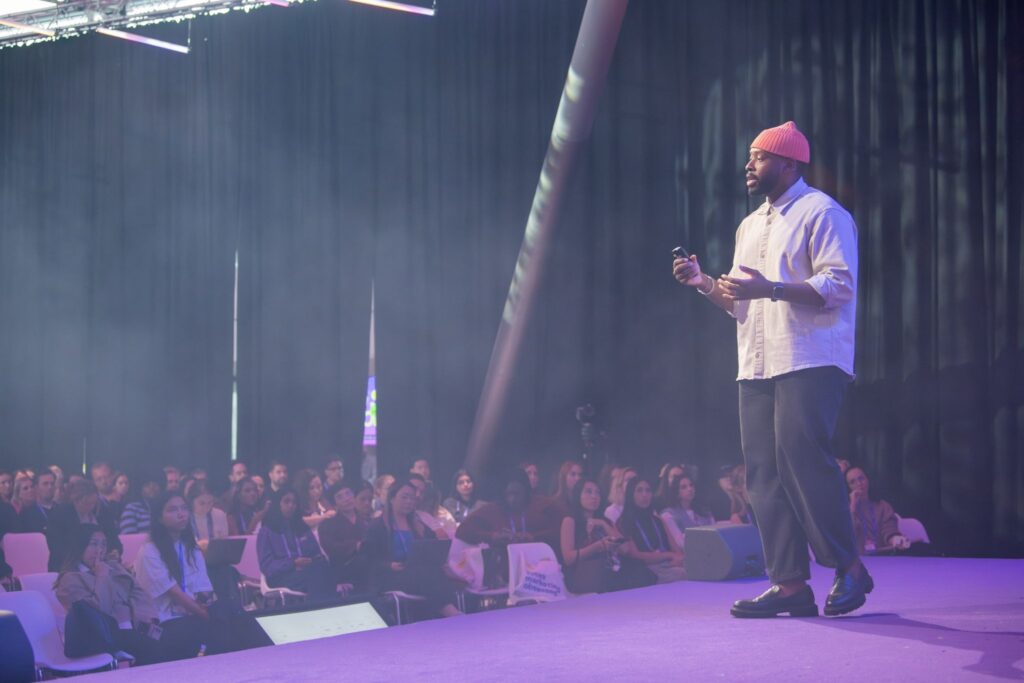
Photo: Brandon Smithwrick at SEMrush Spotlight AMS 2025
Revenue, Red Flags, and the Reactive Brand
Brand deals generate the majority of Brandon’s income. He is direct about this. “They’re like this huge lump sum of cash,” he says. His consulting practice, however, is what he treats as the demand funnel. The case studies it produces publicly demonstrate the methodology and create inbound interest in the newsletter and further consulting work. “The more work I can show you, the more it helps the funnel overall,” he says.
The red flag he watches for in inbound brand pitches is an AI-generated website, which he describes as a site that was “vibe coded” end-to-end. “Who knows how legitimate your business is when you spun it up,” he says.
He applies similarly structured criteria to social content decisions and sees a persistent version of the opposite problem in well-resourced brands: reactive posting without any architecture behind it. He points to a recent wave of brands piling onto a reality television trend as the clearest example. “All the brands seeing something, just reacting in real time. What did this do for the third brand?” The pile-on, he argues, produced more noise than leverage. “If it did nothing for your brand, it just added critiques more than praise,” he says.
Creator Leverage and the Next Product
The question of who holds power in the brand-creator relationship, Brandon argues, has already been answered. The evidence he points to is behavioral: the brands growing fastest are those with a recognizable person behind them, whether a founder, CEO, or creator. “People still see brands as these corporate entities,” he says. “But when I look at brands on the rise, it is because there’s a person, a creator, who they kind of relate to and bring that relatability.”
What he wants to build through “Content to Commas” and his consulting practice is the production side of that equation. The near-term focus is on AI-powered content systems that brands and creators can run without full-time tool management. “Unless your job requires you to learn about the different nuances of these new AI tools, you are just not going to be able to keep up,” he says.
The opportunity, in his view, is not replacing creativity with automation. It is building the infrastructure that allows creativity to compound.
Subscribe to Our Newsletter
Check Out Our Podcast