







Tech
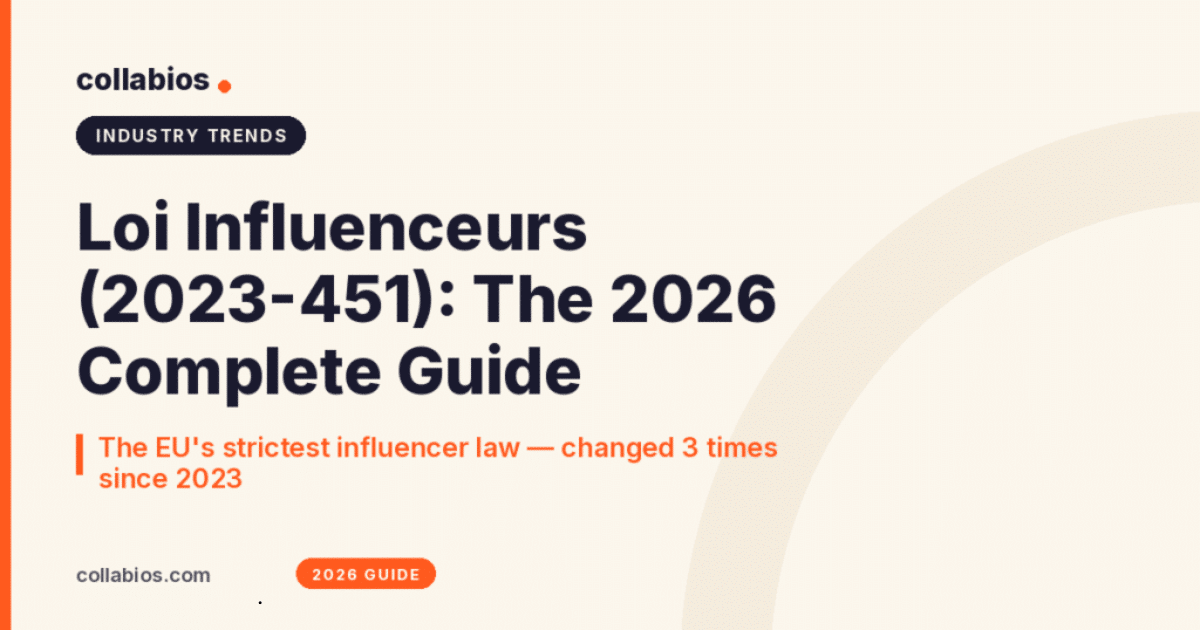
Collabios Built a European Creator Marketplace Around the Laws Most Brands Haven’t Read

When a European influencer campaign violates local disclosure law, the fine usually lands on the brand. Most companies entering European creator markets assume their agency covered the compliance piece. Ghassen Daoud built Collabios knowing they probably didn’t.
Collabios is a creator marketplace registered in Estonia and operated remotely, designed for European markets rather than the U.S.-centered platforms that have historically dominated the category. Ghassen’s entry point into the space was not Influencer Marketing, but e-commerce: running a direct-to-consumer jewelry business targeting Spain, he found that the tools available for finding European creators were poorly suited to any market outside English-speaking countries.
“The majority of the marketplaces were targeting the United States with a very low target to European creators,” he says.
That gap led to two simultaneous building priorities. The first was a discoverable, bookable directory of European creators. The second, which now functions as Collabios’s differentiator, was a suite of free compliance tools mapped to the national laws now governing Influencer Marketing in France and Italy. Both pieces operate on the same logic: the European Creator Economy is under-built, and regulatory complexity is part of what has kept competitors away.
“I don’t advise going blindly,” Ghassen says, adding that if a brand wants to enter multiple European countries, they should spend at least an hour or two researching the regulatory requirements of each country before launching campaigns there.

A Continent the Platforms Mapped Poorly
The commercial insight behind Collabios grew from a pattern Ghassen kept encountering while running e-commerce campaigns. U.S.-targeted inventory attracted intense competition and rising CPMs, while the European market had less of both. “Why is everyone targeting the USA with expensive CPM and expensive ads while the European market is twice as big and has purchasing power?” he says.
His first instinct was to build for the MENA (Middle East and North Africa) region, closer to his base in Tunisia. Research pushed him toward Europe instead, where dedicated creator infrastructure was similarly absent. France, Italy, and Spain became the initial focus markets, not as a replication of a general marketplace but as an attempt to go deep into regional specifics, including the legal environments brands operating there must navigate.
The platform’s creator onboarding process reflects that specificity. Sign-up runs eleven to twelve steps, building out a complete profile before a creator is listed as bookable. The process collects niche, portfolio videos, cover photos, and Stripe Connect banking information. The friction is deliberate. “We want creators who sign up to have a profile that is complete, that is visually attractive,” Ghassen says. A complete profile also functions as a shareable link, which Collabios treats as an outbound distribution asset.
Mapping Laws Clause by Clause
France’s Influencer Marketing law and a parallel Italian framework impose disclosure and content requirements that carry notable penalties, in France reaching hundreds of thousands of euros for violations, Ghassen notes. Both laws are recent enough that enforcement precedents are still forming. Many platforms operating in these markets have not built compliance capabilities into their core products.
Collabios built question-by-question compliance checkers for both national frameworks, available free and without a sign-up. A user works through a structured checklist and receives a report indicating whether their arrangement meets legal requirements. A separate rate estimation tool gives creators a baseline for what to charge based on audience size and deliverable type. The suite runs to eight or nine tools.
The decision to make compliance tools free is transparent in its intent. “It’s okay to give things for free to get a return,” Ghassen says. Tool traffic builds platform visibility at a stage where the marketplace is still establishing liquidity. His longer-term plan is to embed compliance checks directly into the booking workflow, so potential violations surface before deals close rather than after.
Compliance Is a Creator Problem Too
The default framing in brand marketing places compliance responsibility with the legal team, and in its absence, with the agency running the campaign. Ghassen disputes both positions.

On agencies, his point is direct. “If the agency messes up, I think they won’t pay the fine. The brand will,” he says. For smaller e-commerce operators running influencer campaigns without dedicated legal support, that exposure is unmanaged by design. The law, as Ghassen frames it, does not recognize ignorance as a defense.
His position on creators is the more contrarian one. Because creators deliver commercial content across multiple brand relationships, consistently, as a primary livelihood, he argues they carry the largest compliance obligation of any party in the arrangement. “I think creators, because they do this for a living, deliver content for a living. I think they have the bigger responsibility,” he says. The framing inverts the standard expectation that brands set the compliance terms and creators execute them. For Ghassen, the more durable view is that creators who treat disclosure requirements as optional accumulate risk that will compound as enforcement intensifies.
The Case Against Subscription Pricing
According to Ghassen, the dominant model among Influencer Marketing platforms charges brands for access: database subscriptions, monthly licensing fees, or minimum campaign commitments. Collabios charges nothing until a deal closes.
Ghassen describes the commission-only structure as the model most naturally aligned with outcomes. The platform takes a percentage on successful transactions only. Brands that run campaigns infrequently avoid paying for infrastructure they are not actively using. Creators list at no cost and earn when brands book them. “We only get a commission on successful deals,” he says. “Brands don’t need to pay any kind of subscription. Everything is free unless there is a successful order.”
He frames the three-party arrangement through the lens of shared outcomes, drawing the comparison to Upwork. “With this kind of marketplace, it’s a success for everyone,” he says. “Brands with good collaborations will sell their products more. Creators will also make a lot of money on successful orders. And also the platform. It’s a three-win situation.”
The structure means Collabios’s revenue is directly tied to the quality of the matches it facilitates, a discipline that subscription models can soften.
More Regulation Is Coming
France and Italy are not the end of European influencer regulation. Ghassen reads them as the front of a pattern. “France historically leads in this kind of stuff,” he says. “If right now in Europe we have a very small number of countries having regulations about this, maybe in a couple of years we can definitely have more countries.”
Whether those national frameworks will converge into a single EU standard is a question he answers skeptically. Even if the EU develops shared rules, he argues, Influencer Marketing is a global industry, and each major region will develop its own regulatory approach. “The idea of unified is not the future outcome,” he says.
For brands, fragmentation is a permanent planning constraint, not a temporary condition to wait out. For Collabios, each new national law is another compliance tool to build.
Building for What AI Will Surface Next
As European enforcement infrastructure develops, Ghassen expects creator discovery itself to shift in a way that changes how platforms need to compete. His own experience searching for Spanish influencers on Google produced thin results.
He expects the next generation of that search to route through large language models. “In the future, people will just ask ChatGPT or Claude or Gemini,” he says. “Brands need to work on their aspect of appearing in large models’ responses.”
For creators, that means structuring profiles and public content to be citable by AI systems, not just indexed by traditional search engines. For a marketplace like Collabios, it means building creator data in formats that AI-native queries can surface, an architecture decision that differs from the SEO-optimized playbook most directories currently use.
The business Ghassen is building, a compliance layer and a bookable creator directory operating together on a commission-only model, is a bet that the European influencer market is ready for the infrastructure it has largely lacked. The angle is still unusual in a category that competes primarily on database size and discovery features.
Ghassen’s reading of the regulatory environment suggests that the window will not stay quiet for long. “The law doesn’t protect the people that don’t know it,” he says. “And that’s the situation most brands are in right now.”
Subscribe to Our Newsletter
Check Out Our Podcast