







Tech
Former Talent Manager Builds Software to Cut Creator Research Time Without Replacing Managers

James Dever spent four years working inside Influencer Marketing, from talent management to running campaigns directly on the brand side, before deciding the industry needed a different kind of visibility into content itself. His answer is Solira, software that reads a creator’s video library frame by frame, rather than just the caption or bio text.
Solira is built for talent managers, the people who negotiate and source brand deals on behalf of creators, arguing that the job’s core limitation has never been effort, but visibility into what a creator has actually posted. “The reason we’re the best people to build this is that we’ve seen every single end of the industry,” James says.
That claim rests on his own path through the business. James managed a personal finance creator, Casper Capital, building brand pitches by hand. He would list competitors’ sponsors, find each brand’s marketing contact on LinkedIn, and draft a script explaining how Casper Capital could integrate into that brand, a process he says took three to four hours per pitch. He then worked inside a talent agency, watching the same manual, memory-dependent process repeat across every roster before building the product he says he wished had existed in both roles.
Solira launched in 2025 and is based in Santa Monica, California. Today, roughly a dozen talent agencies, including Jake Rosen Entertainment, The Sociable Society and UnderCurrent, have signed on, and James says about 150 talent managers now use the product day to day.

Photo: Solira founders James Dever (CEO) and Liam Cummings (CTO)
Solira Reads Video Instead Of Bios
Solira’s core function is a computer vision system the company calls “Solira Vision,” which analyzes a creator’s content frame by frame. “What if ChatGPT could see that twenty videos ago you had a can of Coke in the background,” James says, describing the gap he set out to close.
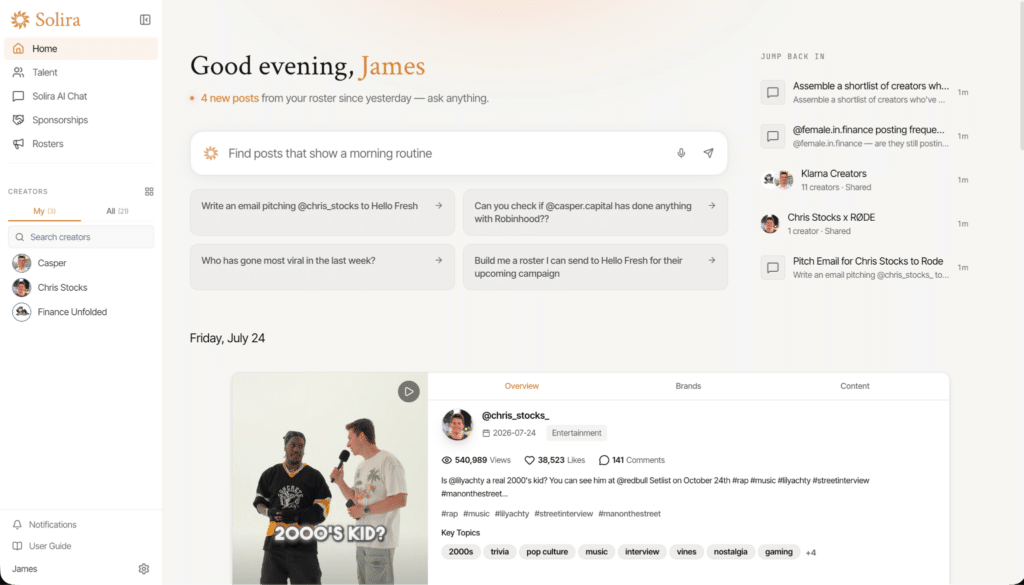
Onboarding a creator does not require the creator to authenticate or connect an account. A manager enters a public handle across Instagram, TikTok, YouTube or Facebook, and Solira consumes the creator’s full library of video, captions and on-screen text to build what James calls a fingerprint of that creator’s content.
Every visual detection Solira makes, such as an identified brand or product, carries a visible confidence score. “This is 70% confidence that’s a Patagonia hat, or this is 95% confidence that’s a Coca-Cola can,” James says. Below a certain threshold, he notes, managers are expected to verify the result themselves rather than treat it as fact.
Agencies Use It To Build Rosters And Draft Outreach
The most common use of Solira, according to James, is assembling a creator roster against a brand brief. A manager can ask which of a hundred creators best fits a brand like Alo Yoga, and Solira returns a ranked list with the visual evidence behind each match, a process James says used to take at least an hour.
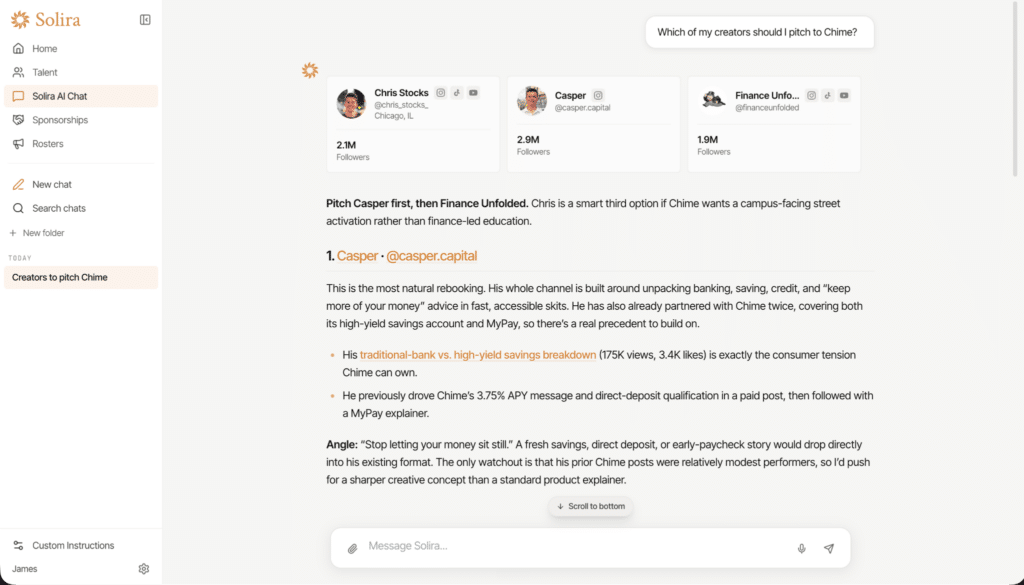
He notes that smaller and solo-run agencies use the tool differently, generating batches of outreach pitches to multiple brands at once rather than building rosters. “Solira will put together ten pitches for their creator for ten different brands in a minute,” James says, though he adds that managers still edit and send each one individually.
A third use case is what James calls “general creator intelligence,” answering the kind of specific questions managers used to have to text creators directly to resolve, from pet breeds to hometowns. One early agency client saw a 25% increase in pitching efficiency after adopting Solira, according to James.
Public Data Means Any Creator Can Be Added
Because Solira pulls only publicly available content for creators who have not authenticated their accounts, a talent agency can technically add a creator’s handle to the system even if that agency does not represent them. James says this is possible because the data itself (video and captions already visible on a public profile) is publicly available.
In practice, James says, agencies use Solira exclusively for their own represented roster, and the company has not built it as a scouting tool for unrepresented talent. He adds that none of the content Solira analyzes is used to train outside AI models.
James Says The Product Will Not Replace Talent Managers
James positions Solira against Influencer Marketing agencies rather than talent management firms, arguing that the sourcing and outreach work those agencies perform is what Solira automates, not the representation work a talent manager does. He emphasizes that Solira’s routing model depends on talent managers remaining in place, since brands are matched to creators through their existing manager rather than around them.
That distinction matters to James personally. “I am, like, one of the biggest haters of AI,” he says, arguing that AI should absorb repetitive research and drafting work, not the relationship building that happens at conferences or over years of contact with a brand’s marketing team.
He points to a scenario where a manager forgets a real email exchange because an AI tool sent it on their behalf as the point where automation starts to hurt rather than help the industry.
James Is Betting Influencer Spend Is About To Scale
James’s next step for Solira is expanding its brand-facing offering to connect brands directly with the right creators through their talent managers who use Solira, with the goal of bringing those talent agencies more brand opportunities. He frames it as extending Solira’s existing routing model rather than changing it, since brands would still reach creators through their managers rather than bypassing them.
James ties that ambition to the scale of the underlying market. He cites Influencer Marketing spend growing at roughly 26% year over year and estimates it still represents only about 3% of a roughly trillion-dollar global advertising market.
For James, the constraint on that growth is operational rather than a lack of demand. “If you can spend a hundred thousand dollars or a million dollars on a campaign by clicking one button in Solira, then more and more money will move into the Influencer Marketing space,” he says.
Subscribe to Our Newsletter
Check Out Our Podcast