


Strategy
Scripps Is Bringing YouTube Creators to TV With One Test: Can Each Show Be Reused Across Its Networks?

The E.W. Scripps Company was founded in 1878 and built its business on local journalism. In October, its free streaming channel, Scripps Sports Network, began airing a series from two YouTube creators known for sports rankings and trivia games. Adam Harman, who oversees content acquisition and programming strategy at Scripps, holds creator shows to the same test as any program he buys, asking whether each one can be rerun, recut and spread across the company’s networks.
That test starts from what Adam sees at home. Some members of his household turn to creators such as Mark Rober first, on par with a live football game or a new streaming movie.
“Consumer habits have changed, and I think most companies are recognizing that and realizing that good content is good content,” Adam says. “If you’re not adapting, you are behind the curve.”
Adapting is familiar ground for him. Before joining Scripps in December 2024, Adam was a vice president at A&E for more than a decade, after programming roles at Hallmark Channel and at NBCUniversal’s Style Network during the rise of reality TV. “A lot of the ways I’m thinking about the creator content today is not dissimilar to that moment in reality TV,” he says.
He now runs acquisitions and original programming for the Cincinnati-based company’s national networks, including ION, Bounce, Grit and Laff, plus several free ad-supported streaming (FAST) channels. Scripps Sports Network, launched in March as a free 24/7 channel, targets sports fans, and Adam says it is built around men’s and women’s sports that “have not been given the opportunity to succeed,” from women’s professional baseball to volleyball. Creator formats are part of how he plans to fill its schedule.
Creator Formats Are Getting Easier to Air on TV
Fitting those formats into a linear lineup has not always been simple. Content made for YouTube can lack a consistent format or episode length, Adam notes.
Two changes are easing that, in his view. Creator production quality keeps improving, and networks are getting more creative about telling stories outside the standard half-hour or hour clock. “The barriers to entry are starting to break down,” he says.
That shifts the burden onto networks. “If you are not recognizing really good talent, really good formats, really good hooks that consume people, you’re doing it wrong,” Adam argues. In his framing, creators compete for the same viewers a network schedule is trying to hold. Competing for those viewers still has to make financial sense.
Creator Shows Are Modeled Like Any Acquisition
That financial test does not set creators against sports rights. “We model it just the same as we model anything else,” Adam says. Scripps is not passing on a live sports league to scale up originals, or the reverse, he adds.
What he weighs is utility and repeatability. Adam prefers programming Scripps can keep using for a month, a year or even 10 years over a show about last Saturday’s football game, which quickly loses its value. “If you’re going to spend money on something, how do you make that money back and run it as a business?” he asks.
The size of the deal does not change that logic. “Whether it’s a smaller video podcast investment or buying a new procedural show for ION from one of the major studios, the principles of the business remain the same,” Adam says.
They also set the pace of spending. “We’re still in the really early innings here,” he says. “If it’s working, the volume will grow, as will the investment.”
“The Makeshift Project” shows how a creator act clears that bar.
Makeshift’s Format Stretches and Shrinks Around Live Sports
“The Makeshift Project,” a YouTube channel and podcast hosted by lifelong friends Zach Misischia and Brian Conforth, draws an audience of more than 6.5 million, according to Scripps. Adam found the duo on Instagram, months before the network launched. He reached out after seeing that more than 10 people from different stages of his life followed them, across ages, backgrounds, and locations.
“You could really see the data in front of you, that these guys were a draw for a lot of different people and had built an audience,” he says, while acknowledging the small sample.
Their Scripps series, “Total Replay with the Makeshift Project,” airs as a 30-minute episode on Wednesday nights, with an hour-long version on the “Scripps Sports” YouTube channel the next day. “If we sat here for four hours, I probably would say the word utility 400 times,” Adam says. “I really love formats that you can treat like an accordion where it’s a really good hour, but for some audiences it moves a little bit quicker as a half hour.”
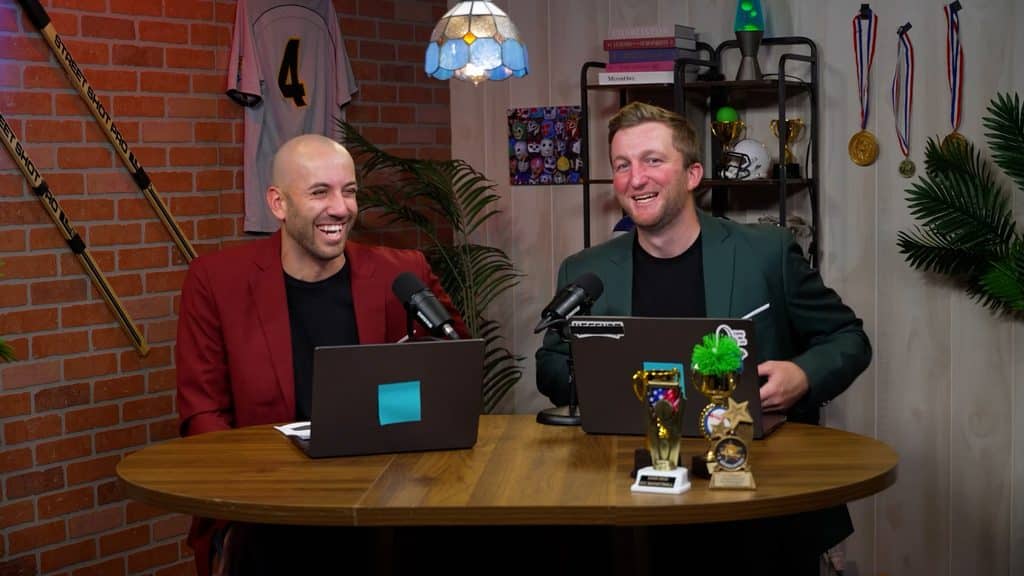
Photo: “Total Replay” hosts Zach Misischia & Brian Conforth
Live sports make that flexibility practical. A volleyball broadcast scheduled for five sets can end in a three-set sweep, and a soccer match can run long on a rain delay or extra time. Makeshift’s ranking lists, games and interviews can be cut into segments as short as a quarter hour to cover the difference, Adam explains.
Two weeks in, he reports “really nice growth” and says growth and repeat viewing tell him more than a premiere does. “Typically a show’s best lead-in is itself,” he says. That repeat value also lets one show run on more than one Scripps channel.
One Creator Show Can Serve Several Scripps Channels
Makeshift content also airs on “Laff,” Scripps’ comedy channel, and on local stations. “They bring humor, they bring levity, and so their format’s not out of place on that channel,” Adam says.
“Beyond the Curve,” hosted by Olympic champion Sanya Richards-Ross, followed the same logic. Beyond Scripps Sports Network and YouTube, Adam placed it on “Bounce,” which he describes as Scripps’ African American channel, and its FAST counterpart “Bounce XL,” where her profile matches the audience targets.
The fit has limits. Sanya’s show may not suit “Laff,” and Makeshift may not suit “Bounce,” Adam notes, and he has yet to find a format that bridges sports and westerns. “Some combination of channels in the portfolio brings value to me and to our channels, and I think ultimately brings value to the talent,” he says. One deal can reach several distinct audiences. That reach is part of what Scripps can offer creators, who now have other options.
The Creator Keeps the Brand Even When Scripps Owns the Show
Those options include going straight to viewers. Creators can reach consumers directly in ways entertainment talent never could, Adam argues, so networks face a tougher contest for talent than when they could simply find a reality star. “I think we have to be much more open-minded and creative with how we structure a deal or how we work with talent,” he says.
Like studio packages, Scripps’ creator deals are mostly bespoke, with rights, term, and ownership varying deal by deal. For Makeshift, Scripps licensed episodes from the creators’ YouTube library for a set window, choosing ones with consistent running times, and the creators kept full ownership. Scripps owns the original spin-off, which it makes in partnership with them.
“We may own the show, but it’s their brand, they built it,” Adam says. He wants each side’s goals stated at the start. “I think honesty is the most important piece of it,” he says.
Brand money is part of that math. Because Scripps’ channels are free and ad-supported, Adam favors integrations that feel organic, and a pitch he heard for a daytime talk show planned for next year included the host’s brand relationships as a way to offset rising costs. “Brand funding is an important part of how original content is being created right now,” he says.
Scripps Is Lining Up Creator Partners for 2027
Scripps is done launching shows for 2026, and Adam’s priority now is partnerships and talent for 2027. “The streamers have done a really good job of getting ahead of it,” he says. “The networks are growing and coming next.”
He is looking in two directions. One is recognizable talent with untold stories, such as Suzy Kolber, whose show “The Originals” drew a wave of press after her years at ESPN, by his account. The other is creators with small followings but a strong hook, like fitness creator Anatoly, whose videos Adam says he rewatches even when he knows what is coming. Both point back to the same test: content viewers return to.
Adam sees a matching opening for creators, who can find network partners instead of relying only on direct-to-consumer reach. “It’s more work, but I think it can be so much more rewarding for everyone,” he says.
Subscribe to Our Newsletter
Check Out Our Podcast