
Strategy
Boston’s Museum of Science Puts Creators at the Center of Its Global Ambitions

The Museum of Science used its first SciCom Summit on November 2 to put other people’s channels at the center of its strategy. The invite-only gathering in Boston brought science creators and scientists into the museum’s new Bloomberg Public Science Common, on the bet that a museum reaches the world by convening the people who already reach it.
That bet started with a mandate from museum president Tim Ritchie to inspire a love of science in everyone, according to Mike Jenkins, the museum’s Co-Chief Marketing and Digital Officer. He and Co-Chief Alexis Rapo, who came from AOL and Disney, respectively, were brought in to turn the institution into a media company with an in-house studio.
“In order to reach the world and inspire love of science, we do have to step out of the light and say, ‘How do we shine it on everybody else?’” Mike says.
The 196-year-old institution built the summit around that question. Mike argues that few institutions carry the standing to convene the field, and that the museum’s place among Boston’s biotech companies makes it a megaphone for in-person conversations that then travel online.
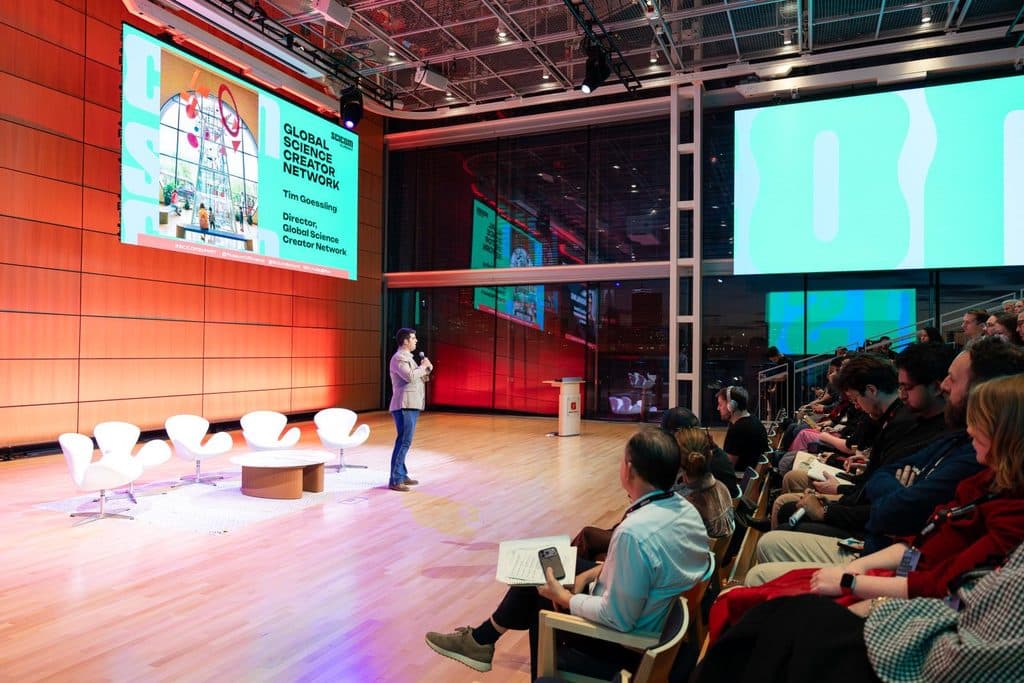
Tim Goessling, who previously ran partnerships at Rooster Teeth and Epic Gardening, joined this year as Director of Creator Network Development to take that strategy beyond Boston. His audience is science creators of every size and the scientists who need them.
Creators Now Introduce Audiences to Science
Scientists once reached the public through journals. “You would write a science journal, and it would be published in a science journal, and that would be your research,” Tim says. Today, in his view, that first introduction happens in a feed. “Today’s scroll or YouTube thumbnail is basically the new library or the newspaper marketplace,” he says.
Tim describes creators who start with a video about a favorite animal and, two years later, produce deep dives on evolution. He learned science from public television, while his children learn it from “MinuteEarth.”
Mike draws the institutional consequence. “It used to be that you would go to a place like a museum to go and learn and find out information. That’s not the case,” he says. An exhibit that takes one to three years to build, he argues, can’t stay current with science that changes this fast.
That leaves museums a physical role. Mike sees the museum as the hands-on version of what audiences learn online, where creators can stage their work in person.
The Museum Chose to Be a Footnote
That in-person role came with a condition Mike returns to across several answers: that the museum stays out of the spotlight. “We can be a footnote in there, powered by us and other people. And it’s really important that we do it that way, because otherwise it would seem not authentic,” he says. The concern, in his telling, was that the effort could look like a way to sell tickets.
The model is already drawing partners. According to Mike, a United Nations representative scheduled to attend the summit told the museum the organization has thousands of scientists and information to distribute but lacks the means to do it well, and saw the network as a possible channel.
Tim works the same arrangement from the research side. His proposed pitch to universities such as Harvard and MIT, as he describes it, is matchmaking. A lab with a breakthrough on electricity hears that the museum has five creators who could help get the word out.
In both directions, the museum’s value rests on who it convenes, which made the guest list the summit’s central decision.
An Invite List Built for New Connections
Tim sets SciCom against large-scale creator events such as VidCon. This first edition was invite-only. “We have spent a lot of time really curating the audience and who we want to have in the room with us,” Tim says.
The museum sorts its creators into four clusters, according to Tim, covering space and astronomy, animals and life sciences, physics and engineering along with the maker community, and medicine, chemistry and general science. Selection followed a stated order. “First, we trusted their science; second, that we feel like they were comfortable speaking on the topics that we wanted them to talk about,” he says, with diversity and scale as the third test.
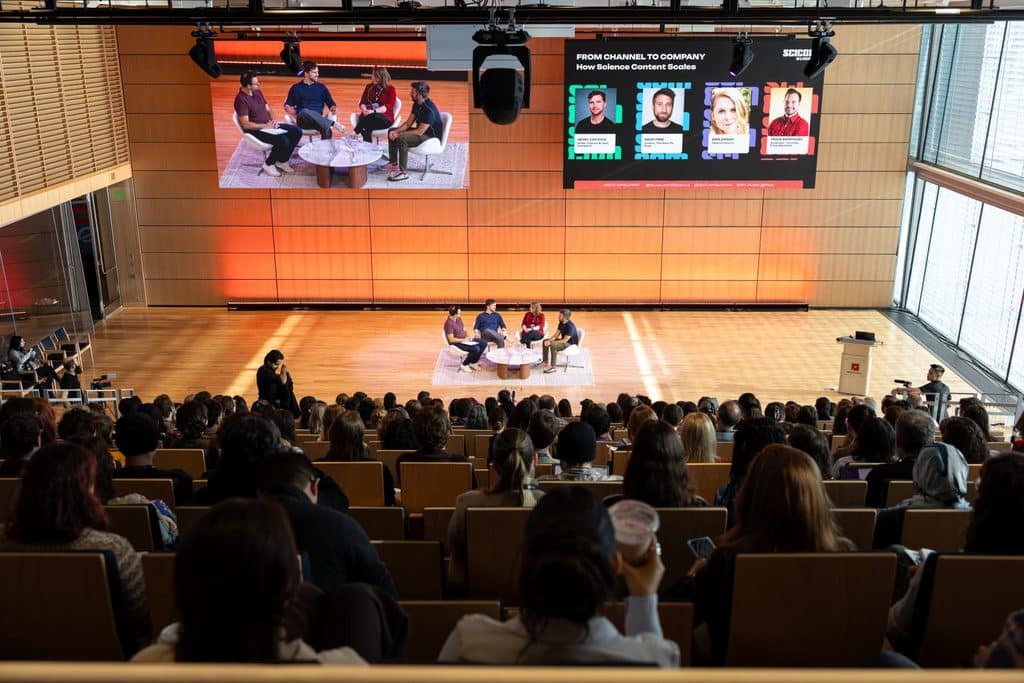
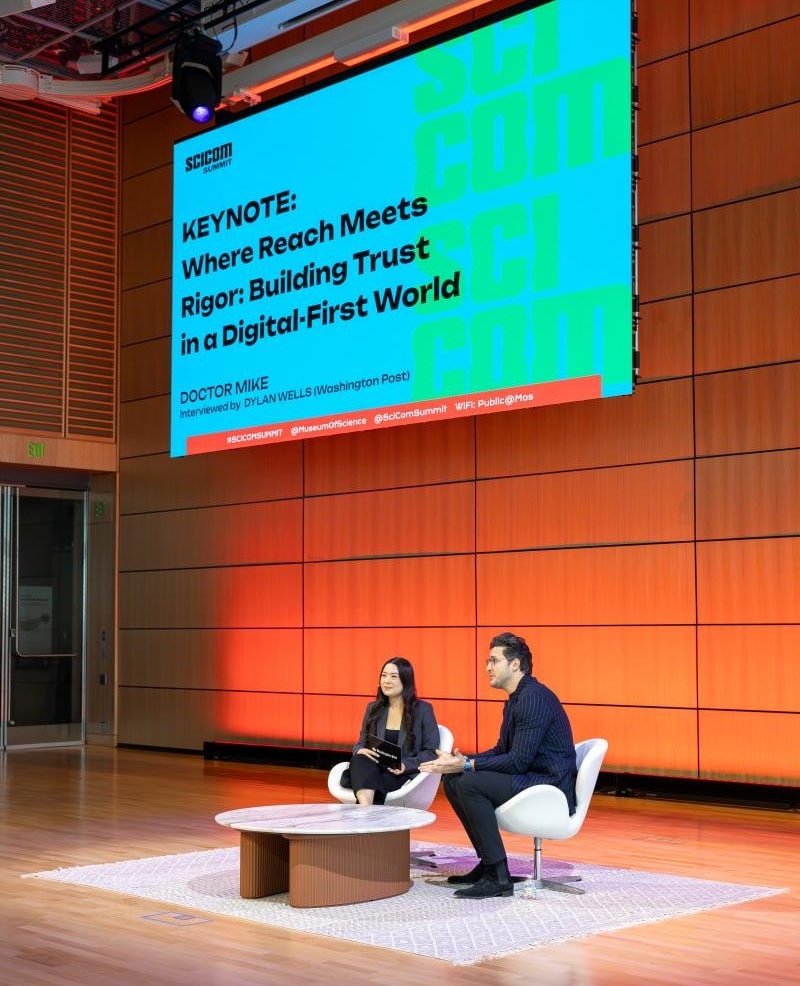
Mike says the museum invited a handful of creators directly and opened an application for the rest, in a space that holds 300 to 500 people. Speakers included Veritasium’s Henry van Dyck and Gavin Free of The Slow Mo Guys, with Doctor Mike for a keynote.
Tim’s personal metric was whether creators doing strong work on trust in science would meet each other for the first time. Some had already asked him about specific attendees with collaboration ideas in hand, he said. The program itself centered on a pressure every science creator carries.
Reach Has to Answer to Accuracy
Tim describes three to four program pillars, including elevating trust in science in today’s media ecosystem and balancing reach and engagement with credibility. The second is where he locates the specific burden on science creators.
“Everything in the Creator Economy now is like, what’s your hook? What’s your thumbnail? What’s your title? How are you getting somebody to click?” Tim says. “Science creators go through that, like every creator, but for them, they always have to keep in mind that what they’re saying is true.”
That requirement means more work. “It takes a little bit extra work, I would say, than a standard creator,” Tim says of the creators the museum supports. Keeping those creators credible also shaped how the museum pays them.
Paying Creators for What They Already Make
Five years ago, according to Mike, the museum decided not to treat creators as influencers. He argues many brands do exactly that. “They’re like, ‘Hey, pass your clout and your community and your influence on to me and then let me give you money for that,’” Mike says. The result, in his view, is a creator saying something they wouldn’t normally say, in a voice that isn’t theirs.
The museum asks creators what they would already publish on their own channels, then runs that content on its channels if it fits the topics it wants to cover. “We’ll pay you for being part of this because we know that you need to make a living,” Mike says, describing the pitch.
Some creators initially asked what the museum wanted them to make, he noted. Creator Chloé Savard, once she understood the model, asked how many more pieces of content the museum wanted.
“The failing of some institutions is they try to pollute the model and turn creators into influencers for their own benefit,” Mike says, adding that audiences can usually tell. The same creator-first logic shapes how the museum measures its network.
Small Channels Are the Network’s Test
The network runs on four parts: development, community, content, and in-person experiences. Development is the one Tim singles out. “We have creators coming that are like 5,000 followers, but they’re no less passionate than someone that’s coming that has 15 million, 25 million followers,” he says.
Success, by Tim’s measure, means those smaller creators keep making strong content while their audiences grow and engage. A second measure sits with institutions, which he says need to keep embracing creators. “This isn’t necessarily about pure economy. This is about trust in science,” Tim says.
Both measures place the payoff in growth the museum does not own, which matches the footnote role Mike described.
The Network Moves Beyond the Summit
The museum plans to hold the summit every year, but most of the network’s work is meant to happen between editions, through SciCom meetups at industry conferences, Discord communities and connections to stories such as NASA announcements. Tim also floats versions of the summit in other cities under the same powered-by model.
Tim expects attendees to leave with 10 new video ideas, from an event small enough for people to connect. The museum, working alone, can only get so far.
“If we can connect all the science communicators with each other to tell bigger stories and reach more audiences, that has a flywheel in it that can actually change the world,” Mike says.
Subscribe to Our Newsletter
Check Out Our Podcast