





Strategy
How Vita Coco Turned a Fan-Led Cultural Moment Into a Brand Partnership Without Forcing the Brief

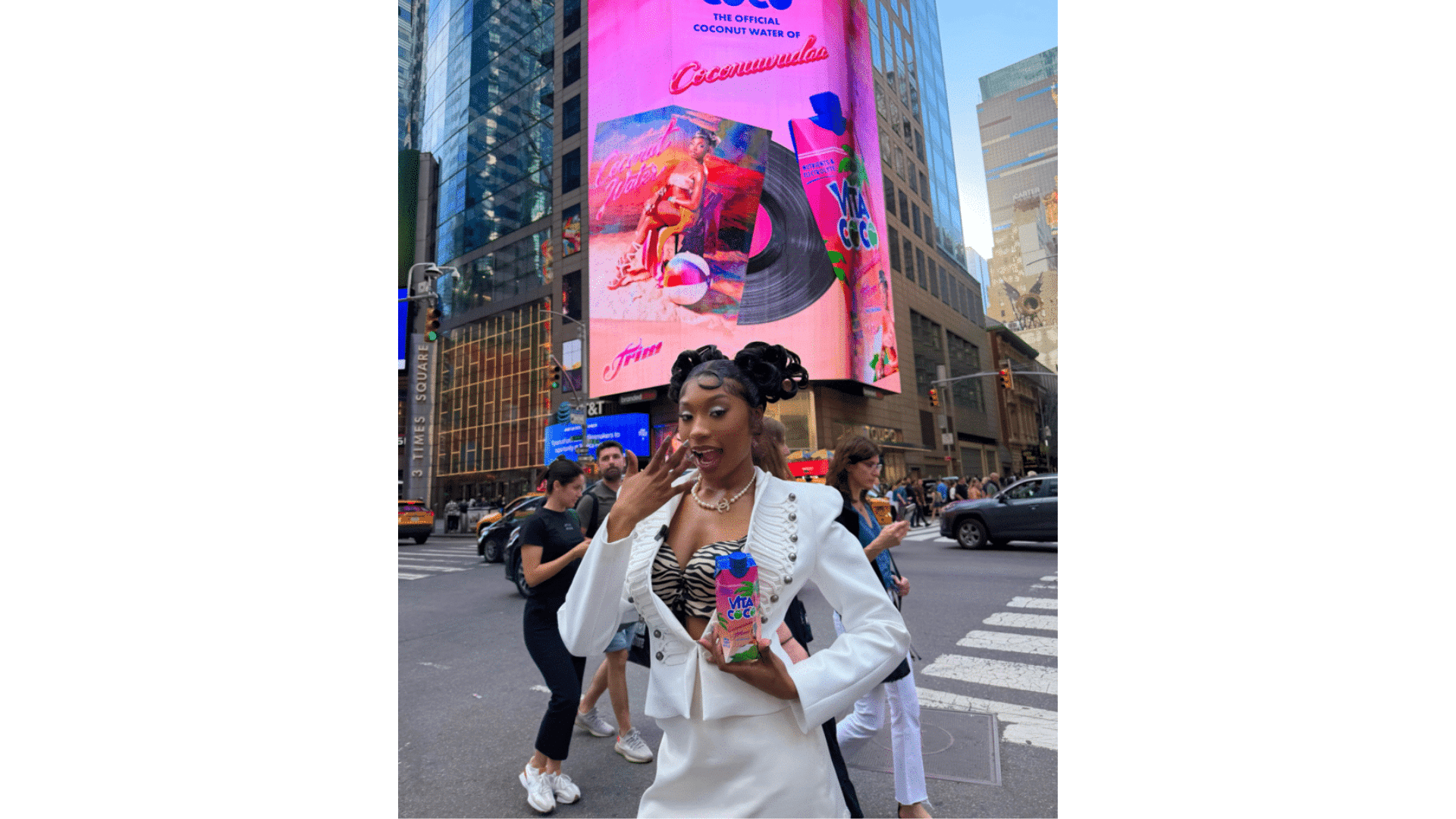
When Charleston rapper Trim posted a sneak peek of her song “Coconut Water” on TikTok in February, Vita Coco’s social team left a comment the same day. The comment collected nearly 2,000 likes. Less than four months later, a Vita Coco billboard went live in Times Square.
Jane Prior, Vita Coco’s Chief Marketing Officer, is more interested in what made it possible than what it produced. “The biggest signal was the larger cultural conversation Trim was driving around her song,” Jane says. “Fans were already embracing the song across social media and organically connecting Vita Coco to the moment. We knew this was an opportunity to join a conversation that was already happening.”
Jane has been at Vita Coco for 17 years and has served as CMO since 2019. Before joining the company, she was Director of Marketing for the New York Red Bulls and spent four years as Manager of Marketing and Communications at Maxim Sports Marketing. Her thesis about creator partnerships has remained consistent: the brief should come from the audience before the brand arrives.
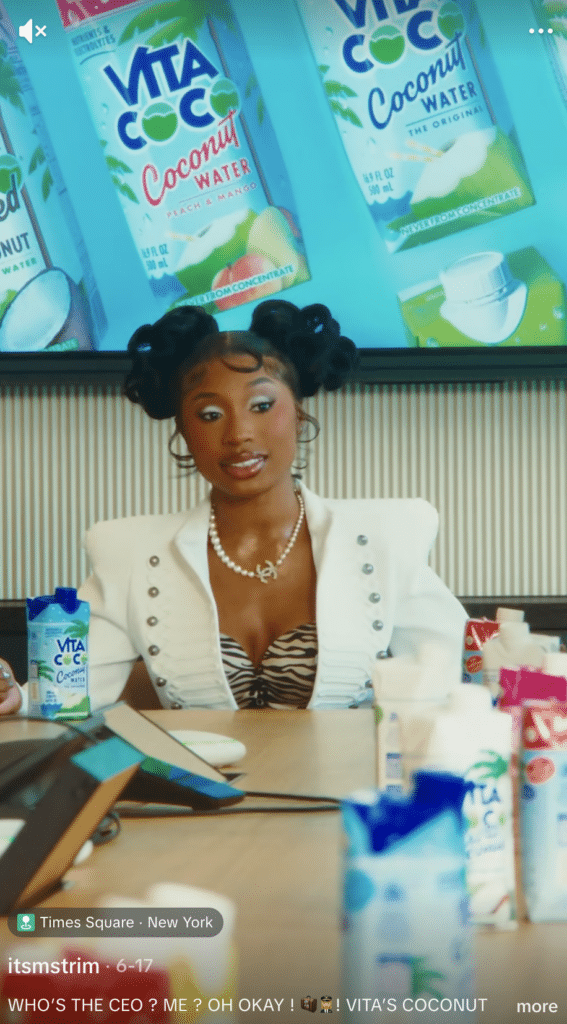
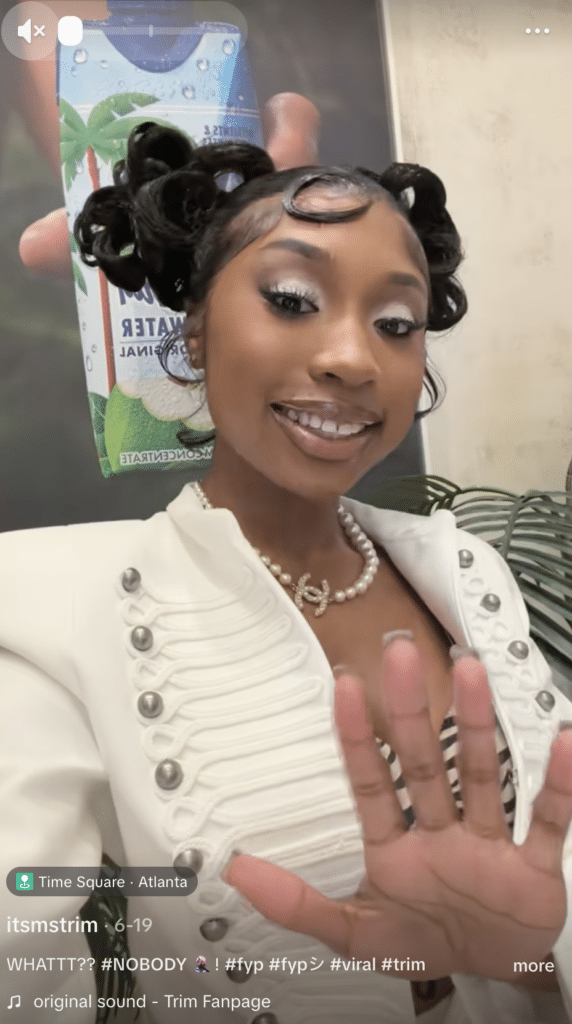
The Trim partnership, officially launched in early June, included a 24-hour Times Square billboard, a Vita Coco office visit in New York, and cross-platform content featuring Trim as an on-camera collaborator. It was Trim’s first official brand deal. The campaign drew fire-emoji commentary from SZA, a response from the Grammys account, and a viral reaction from the account “@artistswithoutautotune,” calling it “fans bullying a brand into the most obvious marketing decision imaginable.”
The Signal Came From the Comments Section, Not a Media Report
Vita Coco’s social team did not identify Trim through a talent database or a PR pitch. They found her the same way her audience did, in real time on TikTok, before the song was released.
Their social team’s February comment on the sneak peek sparked an online conversation around a potential “Vita Coco x Trim” collab.
That engagement was itself a signal. “One of the strongest indicators that a partnership has potential is when audiences are already making the connection themselves,” Jane says. By the time Trim’s full track was released in early May, Vita Coco had already connected with her team by phone and scoped the shape of the partnership. The billboard went live on June 9, one month after the official song release.
Jane frames the origin this way: “It felt less like creating a partnership and more like responding to a moment that audiences had already created and invited us into.”
The Infrastructure Behind the Speed
Jane describes that kind of speed as organizational, not opportunistic. “The most important thing is building always-on monitoring so you don’t miss potentially viral moments as they emerge,” she says. “Just as important is making sure the social team deeply understands the brand persona and has a clear, streamlined approval process in place. Speed matters in these moments, so the infrastructure has to support quick decision-making without losing alignment on the brand.”
The Trim campaign is the third time Vita Coco has operated this way. The company’s activations with Romeo Bingham and Adam Doleac preceded it, each rooted in organic music-driven momentum, and each originating with creators and their communities rather than with a brand brief. Jane describes the approach not as a creative formula but as an organizational capability.
“What stays consistent is listening closely, moving quickly, and respecting what made the moment resonate in the first place,” she says.
The Hardest Decision Was Knowing What Not to Do
Trim’s music video had already positioned her as a coconut water saleswoman before any brand deal existed. The song’s catchphrase came from Trim, not a brief. When Vita Coco arrived, the creative world had already been built.
“We just needed to decide what was the best way for Vita Coco to be integrated so we were adding value to the story and the world Trim had created,” Jane says.
That meant restraint on the brand side. “One thing we were very intentional about not doing was centering the brand in a way that detracted from Trim or her moment,” Jane explains. “Because the song was already called ‘Coconut Water,’ we didn’t feel the need to layer on excessive Vita Coco branding. Instead, we wanted the brand to feel like a natural extension of the story rather than the focus of it.”
For brands facing similar moments, Jane identifies the most common mistake as a process failure, not a creative one: “Overcomplicating the partnership with overly scripted briefs. If the partnership came about because of an organic creator moment, brands should find ways to integrate authentically.”
The Content That Wasn’t on the Brief
When Trim’s team arrived at Vita Coco’s New York headquarters, the general shape of the visit had been planned. The details that defined it had not.
Trim’s team, energized by the fact that this was her first official brand deal, brought ideas that became the campaign’s most-shared content. The mockumentary-style post and the Miranda Priestly entrance trend, both standout pieces from the activation, originated from Trim’s side, not from Vita Coco’s creative direction.
Vita Coco founder Mike Kirban joined the shoot, with his involvement coordinated the day before filming. “Mike knew about Trim from his kids and came with so many fun ideas to film on the day,” Jane says. “Mike is very selective about the content he is featured in, so the fact that he wanted to be involved also signaled we were onto something great.”
The result was content that read as largely unscripted, because much of it was.
What the Numbers Reveal, and What They Can’t
In the first three days after launch, official Vita Coco content generated 2.2 million TikTok views at a 14.3% engagement rate, 1.8 million impressions on X, and 750,000 Instagram views at a 9.2% engagement rate, according to Jane. Total official content has since reached 8.7 million views with 568,000 engagements. User-generated content extended the reach further, producing 20.6 million views on TikTok and 2.5 million on Instagram.
Jane frames the business impact with care. She declines to attribute specific commercial movement to the Trim campaign but positions cultural relevance as a direct driver of both category and brand health. “Culturally relevant moments like this help fuel both category growth and brand momentum,” she says.
The gap she most wants to close is attribution. “One metric I wish we had better visibility into is tracking comments from people who say they ‘found us’ through Trim’s content,” Jane says. “It would be incredibly valuable to have a better way to connect that initial discovery to first-time buyers.” She notes that earlier activations, particularly the Romeo Bingham partnership, generated a meaningful volume of people publicly crediting the creator with introducing them to the brand.
Building the Capability Before the Moment Arrives
Three music-driven partnerships in sequence raise a question: when does a pattern become a strategy, and what does that strategy require of brands that haven’t built it yet?
Jane’s answer is organizational rather than creative. The moment belongs to the creator and the community that formed around it. The brand’s contribution is to have the infrastructure in place to recognize the moment, move quickly, and then resist the instinct to take it over.
“Consumers are very good at recognizing when something is authentic versus manufactured,” she says. “We believe some of the strongest brand moments happen when you identify an existing cultural conversation and contribute meaningfully rather than trying to create one entirely from scratch.”
What that requires is not a larger activation budget. It is an always-on listening operation, a content team with brand clarity and fast approval paths, and the organizational discipline to treat “what do we add to this?” as a more important question than “how do we make this ours?”
“The playbook,” Jane concludes, “is less about the tactic and more about building the capability.”
Subscribe to Our Newsletter
Check Out Our Podcast