


Strategy
Vita Coco Bet on a TikTok Creator Instead of a Super Bowl Ad and Hit a Four-Year Search High

Every February, brands spend millions on 30-second Super Bowl spots designed to generate buzz that fades by Monday. Vita Coco‘s marketing team spent that budget differently this year, and the results surprised even them.
Instead of buying airtime, the coconut water brand partnered with Romeo Bingham, a TikTok creator whose musical jingles had been gaining traction online. Bingham’s Vita Coco jingle accumulated nearly 250 million total impressions across channels, Google searches for the brand hit a four-year high the week the jingle launched, and more than 8,000 users on TikTok created their own videos using the audio, according to the company.
Jane Prior, Vita Coco’s Chief Marketing Officer, is direct about what drove the decision. “This moment wasn’t about buying attention,” she says. “It was about rewarding creativity, backing talent early, and showing up in a way that felt authentic.”
Jane has led the brand’s marketing since 2014, helping it grow from early-stage challenger to a mainstream grocery staple. Her background spans Red Bull’s U.S. marketing operation and more than a decade building Vita Coco’s presence before “Creator Economy” was a recognized category.
Spotting the Signal
The story starts not with a campaign brief, but with a comment section.
Bingham had posted a jingle about Dr Pepper, another beverage brand, that was spreading quickly on TikTok. Vita Coco’s social team noticed the video, left a comment, and that comment collected over 100,000 likes. For Jane, the signal was clear enough.
“We are big on reactive guerrilla-style marketing,” she says. The team moved quickly, bringing Bingham on as a paid partner before other brands had registered the opportunity. Vita Coco became the first brand to enter a paid partnership with him.
The timing mattered more than the strategy. At the time, Bingham’s channel was still growing. Leaning in early allowed Vita Coco to shape a collaboration that felt organic rather than transactional, and to support what Jane describes as a small creator whose talent had not yet been institutionalized by larger brand deals.
Moving at Internet Speed
What allowed the partnership to happen quickly was internal structure, not just instinct.
Jane describes a deliberately flat organization where the social team has direct access to leadership. “We operate with a relatively flat structure, which keeps communication open and allows us to move quickly when opportunities arise,” she says. The team also maintains an always-on monitoring function, watching for trending creators and brand-adjacent content before it peaks.
Jane notes that Vita Coco’s content team has more than doubled in size in recent years, with dedicated roles for community management and real-time trend detection. These team members do not wait for a brief. They operate on standing authority to comment on content, engage with emerging creators, and escalate opportunities to leadership with minimal friction.
The question of when to act versus wait comes down to behavioral data. Jane says the team focuses on what audiences are doing, not just watching. “If audiences are creating content, sharing it widely, and even showing purchase intent, that’s a signal to lean in,” she says.
In Bingham’s case, the comments section told the story. Hundreds of users were writing that they were driving to the store to buy Vita Coco because of the jingle. “The comments proved this was a case where we wanted to add fuel to the fire,” Jane says.

What the Numbers Actually Said
The case for creator investment often hinges on soft metrics. This one did not.
Bingham’s following grew to 1.2 million. The Vita Coco jingle surpassed 34.5 million views on the creator’s own channel, with total cross-platform impressions, including Vita Coco’s channels and user-generated content, reaching nearly 250 million, according to Jane.
Jane says the metric that carried the most internal weight was purchase intent, something a traditional television ad rarely surfaces in real time. “Comments like ‘I literally bought Vita Coco for the first time today’ were particularly telling,” she says. “Being able to see comments and understand user purchase intent in real time was an added advantage.”
The brand’s sales team reported that consumers approached store staff, recognized their Vita Coco shirts, and sang the jingle back to them. “That kind of real-world recognition is a strong sign the moment truly broke through,” Jane says.
Proximity Over Presence at the Super Bowl
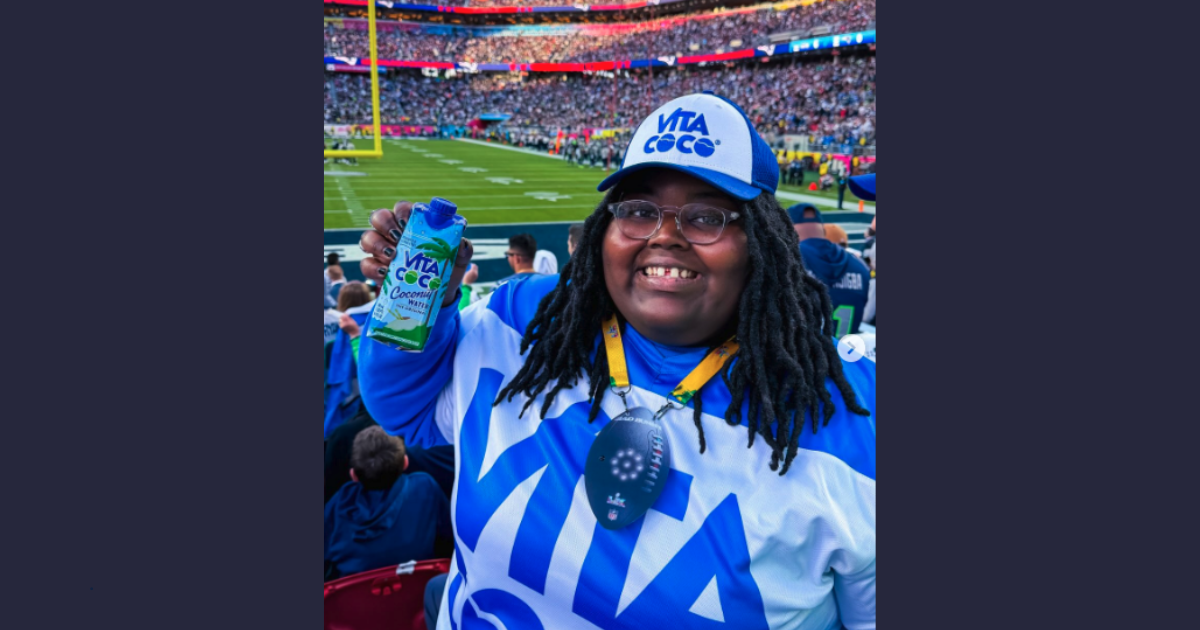
Rather than buying a commercial slot, Vita Coco sent Bingham and six guests to the Super Bowl, outfitting them in custom “Delicioso” jerseys.
The content Bingham produced on game day generated a reported 20.6 million impressions on its own. More important to Jane, it extended a cultural moment rather than a manufactured one.
“Our philosophy has always been to find creative ways to hack big cultural moments,” she says. “Our North Star is making a TikTok perform like a Super Bowl commercial.”
That framing inverts the conventional logic of tentpole marketing. For most large brands, a Super Bowl spot represents the apex of the media plan, a concentrated, expensive bet on mass attention. Jane argues that participating in the broader cultural conversation surrounding the event can deliver comparable or greater impact, particularly for brands that cannot justify the cost of a network spot on the basis of awareness alone.
“The Super Bowl is no longer just a TV event,” she says. “It’s a real-time cultural phenomenon across social media. Brands that partner with creators can join the conversation in ways that feel authentic and socially relevant, rather than simply interrupting the broadcast.”
Rethinking Where Cultural Impact Comes From
The question Jane returns to is not whether creators can compete with television reach. It is whether that comparison still produces useful decisions.
“The biggest misconception is that cultural impact only comes from big, one-time moments like a TV spot,” she says. “In reality, it often comes from consistently showing up where consumers are and creating buzz across owned, earned, and paid channels.”
Jane’s advice to CMOs still defending traditional media budgets is to reframe the output being measured. A broadcast spot offers reach and some degree of brand recall. A creator partnership, she argues, can deliver reach, real-time sentiment data, purchase intent signals, and user-generated content simultaneously. “Creators are often closer to emerging trends and audiences, which helps brands show up in ways that feel timely and native rather than planned months in advance,” she says.
Jane is careful not to overstate the replicability of a breakout campaign. “Not every moment is going to hit like a Super Bowl ad,” she says. “But when you participate authentically and build engagement with fans over time, those smaller moments compound, and every now and then, that approach also unlocks a breakout win.”
Building for the Next One
Vita Coco is not treating the Bingham partnership as a one-time experiment.
Jane says the brand will continue to place early bets on emerging creators before their audiences peak and to monitor for reactive moments worth amplifying. The content team expansion she has overseen over the past several years was designed precisely for this kind of perpetual readiness. Reactive marketing, once considered a tactic for nimble startups, is now a core strategic function at Vita Coco.
“It’s definitely evolving from a tactic into a strategic pillar,” Jane says. “We’re building teams that are nimble and that feel empowered to act in real time.”
The broader pattern Jane is describing reflects a shift happening across the industry, away from manufactured tentpole moments and toward agile creator partnerships calibrated to where audiences already are. In her view, the infrastructure required is organizational as much as it is budgetary: flat hierarchies, empowered social teams, and a clear framework for distinguishing cultural signal from noise.
Bingham’s jingle represented what Jane calls “lightning in a bottle,” something even a well-resourced marketing team cannot reliably engineer. But the capacity to recognize it, move on it, and amplify it at scale can be built deliberately.
“Stay nimble, lean into authentic moments, and partner with emerging creators when culture hands you something great,” she concludes.
Subscribe to Our Newsletter
Check Out Our Podcast