





Tech
POP.STORE CEO Gautam Goswami: Creator Commerce Has a Customer Problem

Creators can have millions of followers and still lack what most businesses consider basic infrastructure: a customer list. Gautam Goswami, CEO of POP.STORE, believes that gap explains why many creators struggle to convert attention into sustainable revenue.
One creator on POP.STORE has 200,000 followers and 1.8 million email addresses. She generates more than $100 million in annual sales at a 40% margin. For Gautam, the contrast between audience size and owned customer data captures the operating problem he believes still defines much of the Creator Economy.
“Tell me one business in the world that runs without knowing their customer,” Gautam says. “Creators. They have a lot of followers. They have no idea who those followers are. The only way to reach them is the algorithm.”
Gautam’s career has largely centered on operational turnarounds and underperforming businesses. As a Principal and strategic adviser at Permira, a major European private equity firm, he was routinely dispatched to portfolio companies that were struggling. He says he later helped lead TeamViewer through what became Europe’s largest IPO of 2019. The pattern continued when he entered the Creator Economy through CommentSold, an American live-selling platform in which Permira had invested. There, he says, the same operational question kept resurfacing: creators were building audiences, but not the customer infrastructure needed to turn that attention into a business.
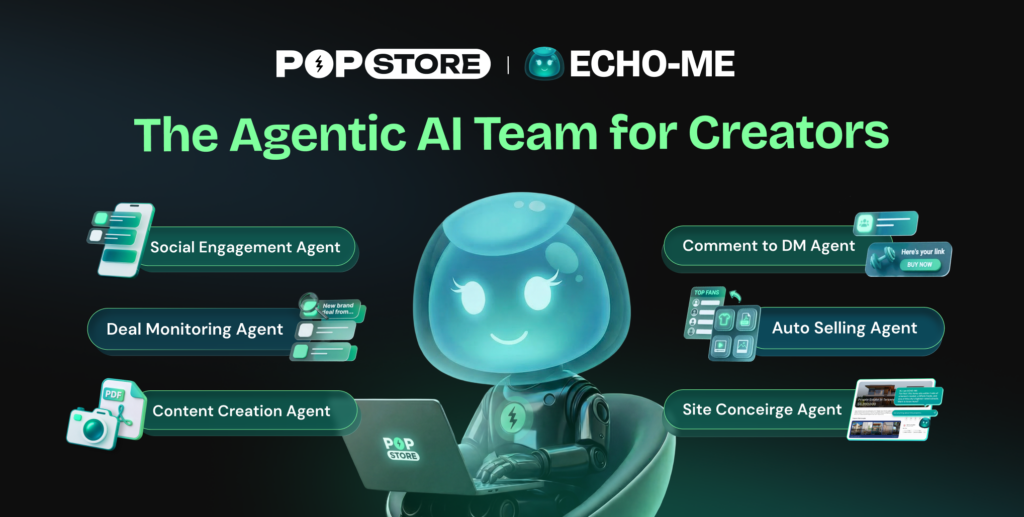
That insight became POP.STORE, an AI-powered creator commerce platform launched inside CommentSold and built on ECHO-ME AI, a proprietary agentic AI framework Gautam describes as the infrastructure layer beneath the product. Based in Los Angeles, the platform is designed to bring creator commerce, audience engagement, and sales into one environment.
Follower Count Is Not a Customer List
The creator with 200,000 followers is central to Gautam’s argument because her business is not built around reach alone. Her 1.8 million email addresses were accumulated over years of moving shoppers off social platforms and into a database she controls.
“Followers come and go,” Gautam says. “But once you have someone’s email address and phone number, you own that relationship. You can consistently sell to them.”
That distinction is where Gautam sees a structural weakness in creator commerce. Retailers, telecom companies, and software platforms organize around customer data. Many creators organize around platform visibility. The difference matters when algorithms change, engagement patterns shift, or a platform limits access to an audience a creator spent years building.
“I would never be able to sleep if I didn’t know how many customers I have,” Gautam says. “I have 20,000 creators using my platform. I know everybody’s email address and phone number. That’s how businesses work.”
When Reach Becomes a Mispricing Problem
The audience ownership problem has a brand-side counterpart. Gautam argues that Influencer Marketing still often prices creators around visible reach, even when the more valuable signal is whether a creator can identify who is likely to buy.
“Brands are still looking at follower size,” he says. “Follower size doesn’t matter anymore. A creator with 50,000 followers can be much more effective than one with 10 million, because that creator has the exact audience the brand needs.”
He says that mismatch is visible at the highest end of the market, including at industry events, where brands court creators with large audiences even when the commercial return is unclear.
“If you go to Cannes Lions, you will see brands flying 10-million-follower creators there in business class and not really getting anything from them,” he says.
POP.STORE’s answer is audience segmentation data. The platform classifies followers into four categories, follower, fan, admirer, or fanatic, and layers purchase-intent signals on top based on comment patterns and engagement behavior accumulated over time. One creator with 2 million followers, Gautam says, has 58,000 identified as having active purchase intent. That subset, in his view, is the number that should matter most to brands.
The Brand Deal Sitting Unread in a Creator’s Spam Folder
The audience data problem is partly a consequence of a more fundamental operational failure: creators at scale are unreachable. Their direct message inboxes are effectively closed, buried under spam, follower messages, and unsolicited pitches.
“If you try to DM a big creator and say, ‘Net Influencer wants to interview you,’ I guarantee they will not respond,” Gautam says. “Not because they don’t want to. You just will never reach them.”
POP.STORE’s brand monitoring agent continuously scans a creator’s inbox across request folders, spam folders, and standard messages. It first qualifies the sender, checking account size, verification status, and brand affiliation, then evaluates the message for intent, filtering harassment and low-value outreach before assessing whether a commercial offer is present and whether its terms meet the creator’s preset criteria. Legitimate opportunities surface on a dashboard and trigger an SMS and email alert. The system also drafts a proposed response, calibrated to the creator’s voice through an ongoing learning process that infers communication preferences from actual behavior rather than onboarding surveys.
“If we tell a creator to answer 25 questions so we can learn their voice, they will not do it,” Gautam says. “So we learn slowly. A follower asks what breed their dog is. They answer. Now we know. Every response teaches us more.”
The Systemized Creator Beats the Viral Creator
Gautam is blunt about what separates creators who build sustainable businesses from those who don’t. The distinction, in his view, has little to do with content quality or platform reach and everything to do with operational discipline.
“The most successful generation of creators won’t be the most viral,” he says. “They’ll be the most systemized.” A systemized creator, in his definition, is someone with a clear target audience, a consistent content strategy, and direct ownership of the customer relationship. “Consistency and targeting. That’s all they need.”
The 90/10 rule he cites is unsparing; 90% of creators make no meaningful income. The gap is not talent. It is operational. His critique extends to creators who build audiences on third-party platforms without retaining the customer relationship. A creator generating notable monthly revenue on a subscription platform may find, six months later, that the platform has marketed competing creators to their audience and their income has evaporated.
“The platform markets other creators to your followers, and they move on,” Gautam says. “But you never got the customer. There is no shortcut. Start selling one PDF today. You will sell five next month, then ten, then fifty, and suddenly you have a business.”
Within a Decade, Most Creators Won’t Be Making Their Own Content
Gautam’s longest-range prediction is also his most disruptive. Within ten years, he argues, the most successful creators will deploy AI digital twins to replicate their presence across multiple platforms simultaneously, freeing human attention for strategy and idea generation rather than production.
“Real creators will not be creating content anymore,” he says. “They will let their digital twins create the content. While the digital twin is filming in Belize, recording a podcast, and doing an interview, the creator is thinking about the next idea.” That capability already has a partial prototype inside POP.STORE’s fashion feature, which generates AI-modeled images of creators wearing any product from a brand catalog using a stored digital twin profile built from uploaded photographs and body measurements.
Gautam resists the industry’s standard framing of AI as a productivity tool. He calls it a human replacement technology, not an enhancement, and takes issue with the term itself. “AI is not artificial,” he says. “One brain that can reason across psychology, medicine, engineering, and art at the same time is not artificial. It is universal. We should start calling it universal intelligence.”
The implication for creators, he argues, is binary. Those who learn to leverage the technology multiply their value. Those who resist will find competitors built on the same tools eroding their audience from below.
“If you adopt the technology and say, ‘I’m going to use AI to replicate myself in ten places,’ your business, your thought process, your creativity, that’s what wins,” he says. “If you deny it, it’s a headwind. Simple.”
Subscribe to Our Newsletter
Check Out Our Podcast