





Tech
After Vimeo Price Hikes, Livid Courts Creators and Small Businesses Weighing Alternatives

When Bending Spoons acquired Vimeo in late 2025, some small business customers received notices of price increases as steep as 2,400%.
For Nic Taylor, Head of Product and Growth at Livid, the shift looked familiar. He and several colleagues had helped build StreamYard, a browser-based live streaming platform that Bending Spoons acquired in 2024. Within months, staff were cut, and prices increased.
The experience shaped Livid, a Delaware-based, ad-free video hosting service launched in January 2026, backed by $10 million from StreamYard co-founders Geige Vandentop and Dan Briggs. The investment gives the startup a direct link to the video infrastructure market it is now trying to re-enter, this time with a product aimed at individuals and small businesses rather than enterprise customers.
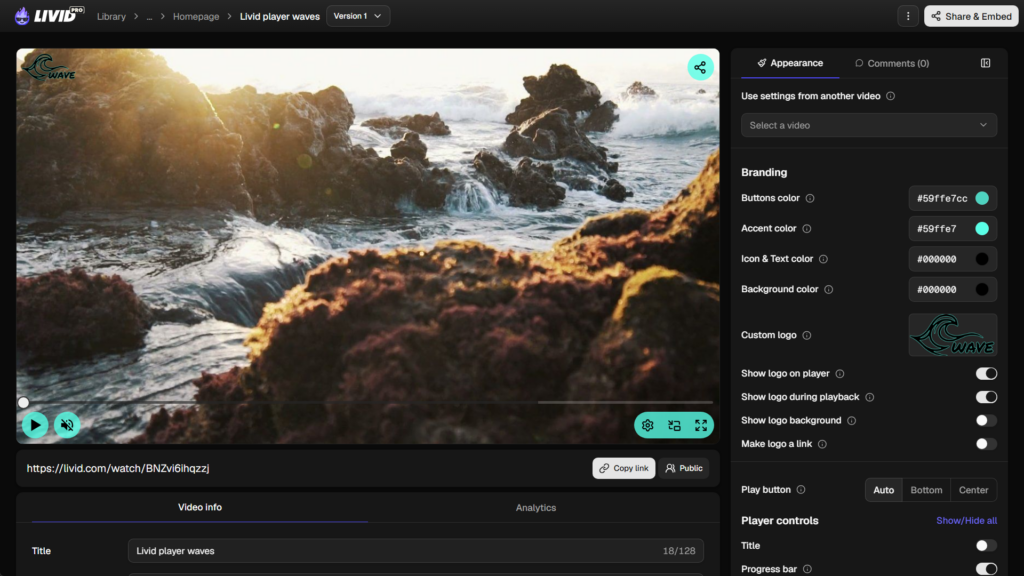
Nic’s pitch rests on a simple claim: businesses that use video for marketing, training, paid courses, and subscriber content need more control than free platforms provide, but cannot always absorb enterprise-tier pricing.
“We are here basically to make their lives as easy as possible if they want to leave Vimeo,” Nic says.
There are currently just under 2.2 million websites hosting video from Vimeo, according to Nic, spanning filmmakers, fitness coaches, course creators, and businesses that use video as a marketing or training asset. Livid is betting that many of them now see video hosting less as a back-office tool and more as infrastructure they cannot afford to lose control over.
YouTube Solves the Wrong Problem for Most Businesses
The default response for any small business evaluating video hosting is YouTube. It is free, has global reach, and is owned by Google. For promotional content, Nic acknowledges, that calculation is often right. The problem comes when businesses use YouTube for something other than promotion.
“YouTube is designed to encourage people to watch more and more videos on YouTube,” Nic explains. When a business embeds a YouTube video on its website, the platform’s recommendation engine activates the moment the video ends, redirecting viewers elsewhere. For a fitness coach who spent hours producing a class walkthrough, or a software company running a product demo, that redirection actively works against them.
There is a second, less visible cost. YouTube is owned by Google, which also operates Gemini. According to Nic, this means videos hosted publicly on YouTube are indexed and available for AI training. “If your goal is to make sure that you’ve got a high degree of control over who sees that video, you’re much better off paying for hosting on Livid or somewhere else,” Nic says.
He adds that such a control gap becomes notable for businesses with gated content. A creator offering paid video libraries to subscribers cannot safely host that content on YouTube without risking that viewers are either pulled off-platform or that the content is exposed beyond its intended audience.
Platform Lock-In Is a Feature, Not a Bug
From Nic’s perspective, Vimeo’s price shock exposed something that had been building quietly for years: many businesses had no realistic exit strategy from the platforms they depended on. Moving thousands of hosted videos, updating every embed code across a website, and preserving privacy settings manually is not a weekend project.
“For some users who have been there for 15 years, that could be thousands and thousands of videos,” Nic says. Some of the businesses he has spoken with have stored more than seven terabytes of content and more than 4,000 videos, all embedded across their sites. Extracting and re-embedding that content without a tool would take weeks.
Livid responded with L.O.V.E. (Livid One-Click Video Exporter), a free one-click video exporter that connects directly to a Vimeo account, copies all files and folder structures, and migrates privacy settings, including unlisted videos and password-protected content. A companion WordPress plugin then scans the site and replaces every Vimeo embed with the equivalent Livid link, condensing what would otherwise be a months-long migration.
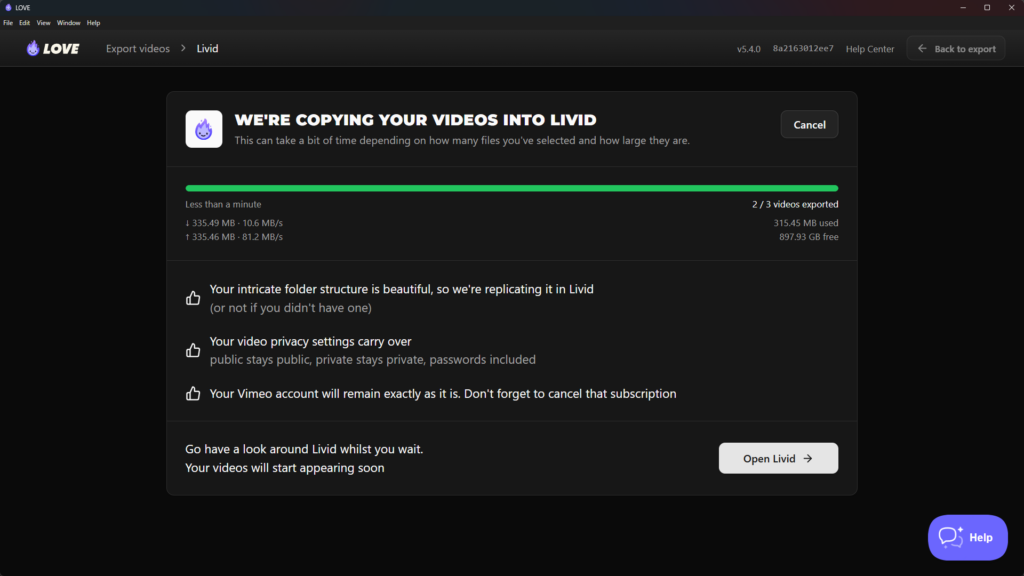
“People should not feel trapped by crazy price rises of massive corporate companies,” Nic says. Notably, Livid offers L.O.V.E. to users who never convert to paid customers. The logic is reputational rather than transactional: an industry willing to help people leave deserves more trust than one that makes leaving prohibitively hard.
The AI Features Nobody Actually Wanted
The video hosting market has, like most of the software industry, oriented much of its recent development around artificial intelligence. Vimeo added AI-powered editing tools, chaptering features, and automated summaries. Nic says those additions may have contributed to the platform’s strategic drift without meaningfully serving the customers who were paying for it.
“I’m yet to talk to anyone who has told me that the reason they are using Vimeo is for those features,” Nic says. What users consistently ask for instead is control, specifically the ability to restrict where their video plays, integrate with their existing workflows, and fit with their branding.
Livid has made the counter-bet: no “superfluous” AI in the product and no AI in support. All customer service is handled by humans, available across the full work week. “We keep it really simple, it’s really straightforward, it’s really fast,” Nic says.
That restraint extends to data handling. When Bending Spoons acquired a previous platform, it updated its terms of service to permit AI training on user content. Vimeo users feared the same would follow.
Livid’s position is that paid users are the actual customers, which creates a different incentive structure. “On a paid service, you are the customer. We have a vested interest in making sure your video is only seen where you want,” Nic says.

Free Platforms Are Getting Harder to Depend On
Nic believes that the broader question for small businesses is not simply whether to pay for hosting, but when the cost of free platforms begins to outweigh the savings. He draws a distinction based on intent. If video is primarily promotional and a business does not mind how it is distributed or who indexes it, free platforms remain workable. The calculation shifts the moment content has independent value.
“The moment it starts to evolve, whereby the value within that content itself starts to increase, and the way they want that content accessed changes, that’s when the choice of platform becomes really key,” Nic says.
According to Nic, platforms like YouTube and TikTok are also becoming more saturated as publishing tools, making organic reach harder to sustain. He does not expect those platforms to diminish, but argues that relying on them exclusively is a fragile strategy. Businesses need to know whether they can leave a platform easily.
The advice Nic offers is direct: audit the platforms your business depends on, read the terms of service updates, and ask whether you have an exit plan.
Built Small, Priced to Stay
Livid’s operating model reflects the StreamYard experience directly. Nic argues that a lean, well-architected codebase can serve millions of users without the cost structure that forces corporate platforms into recurring price escalations. At its peak, he says, StreamYard was run by roughly 15 people.
“We have enough expertise, the knowledge, we have a very well-designed code base whereby we can scale this business and ensure that millions of users are served incredibly well without having to increase costs,” he says.
The company is deliberately avoiding enterprise customers, a segment Nic says requires feature complexity and sales overhead that would distort the product roadmap. Instead, Livid is focused on the middle market: the filmmakers, coaches, course creators, and small businesses.
Livid’s pricing commitment mirrors what StreamYard maintained throughout its independent run: stable rates that do not change based on how the company values a given customer segment. “Any moat that we create should be one that’s based on us being a very positive business,” Nic says.
Platform Trust Is Now a Business Decision
The Vimeo situation illustrates a broader dynamic that Nic expects will recur. Platform consolidation driven by acquisitions tends to follow a predictable sequence: fire existing staff, raise prices on customers who cannot easily leave, and redirect development toward the revenue segment with the highest margins. For small businesses, he adds, that sequence rarely ends in their favor.
Nic sees the next three to five years as a period in which businesses that have treated video as an afterthought will need to develop actual infrastructure strategies. “Just relying on the idea of creating a video, placing it on YouTube, and thinking that you’ll get some big traction,” he says, “is now harder than it has been.”
For Livid, the market opportunity is structural. The company is not competing on features or AI capabilities. It is competing on trust, stability, and the premise that a platform’s job is to serve the customer paying for it.
“Our mission is simple,” Nic states. “Be the friendliest video hosting company in the world. There’s no catch, no ulterior motive.”
Subscribe to Our Newsletter
Check Out Our Podcast