






Tech
Workweek Built a Platform to Show What B2B Creator Trust Is Actually Worth

A campaign that registered as a 0.03x return on clicks turned out to be 8x when measured against CRM data across the full buying cycle. For Adam Ryan, co-founder and CEO of Workweek, that discrepancy isn’t a story about bad creative or weak targeting. It’s the clearest illustration of why B2B creator advertising has been structurally undervalued for years.
Workweek is an Austin-based media technology company founded in 2021 that builds professional communities, which it calls operator networks, for practitioners in five verticals: healthcare, banking and fintech, marketing, HR, and e-commerce. Membership is identity-verified rather than subscription-based. Applicants are assessed on their professional credentials, not their willingness to pay, a model Adam describes as charging for identity rather than access.
“Our whole company motto is who, not how many,” Adam says. “A lot of companies have focused on how many people join, and they’ve created their incentives around that, and ultimately it created a more negative experience for most of their creators and their advertisers.”
This month, Workweek publicly launched the Partner Platform, its B2B advertising product, after 18 months in beta. The platform connects newsletter sponsorships to CRM-level attribution, enabling vendors to track which accounts in their pipeline were exposed to a creator-led campaign and how that exposure affected deal velocity and win rates.
The Most Experienced Practitioners Are the Least Likely to Share Publicly
Workweek’s founding thesis traces back to a question Adam says wasn’t being asked in 2021: why did the Creator Economy have no B2B equivalent? Consumer brands had multiplied by attaching to creator audiences. B2B had not.
His answer centers on what he calls the “experience paradox.” The most valuable practitioners in any industry, those with decades of operational depth, are also the most reluctant to publish. The risk-reward calculus looks different for someone who has already built a career. Going viral offers limited upside; saying something professionally costly offers real downside. So the loudest B2B voices tend to be the most junior.
“The most active and loudest voices out there were typically people with one or two years of experience,” Adam says. “And the people who were the quietest were those with 20-30 years of experience, the best people to hear from.”
Workweek’s operator networks were built to change that equation. By vetting on professional identity rather than charging subscription fees, and by building community infrastructure, including event tooling, feeds, and direct messaging, the company created an environment where senior practitioners could engage with verified peers. The identity data accumulated through that process became the technical foundation for the Partner Platform.

Long Sales Cycles Make Click-Based Attribution Nearly Useless
In Adam’s view, the fundamental problem with B2B creator advertising is time. A medical device company selling an MRI machine to a hospital may be running a three-year sales process. Enterprise software contracts can take 12 to 18 months to close. In that window, a newsletter sponsorship may have shaped a buyer’s thinking months before any purchase decision is recorded.
“There’s always been a gap in the data of what really influenced that decision,” Adam says. “Creators were the people suffering in that place.”
The conventional attribution path, clicks to form fills to pipeline entry, captures only a fraction of actual engagement. “You’re really getting maybe a 3 to 5% snapshot of what’s happening,” Adam notes.
The 0.03x campaign illustrates the distortion. Measured on clicks, the numbers looked weak. Measured against CRM data over the full buying cycle, the same campaign returned 8x. The difference, Adam argues, came from format. Workweek’s newsletter ads run 100 to 150 words, not banner ads. Readers who engaged with the content absorbed information that later influenced decisions without ever clicking.
“It wasn’t clicks that were influencing deals,” he says. “It was the actual impressions of the ads themselves.”
Newsletter CTR Benchmarks Are Inflated. Most Clicks Are Bots.
There is a second layer to the measurement problem, and Adam is direct about it. Most click data in newsletter advertising is inflated by automated scanning.
Security software routinely crawls incoming emails and triggers link clicks. As newsletter adoption has grown, so has automated bot activity. The result is that open rates and click-through rates reported by standard email platforms are systematically overstated. The industry average data match rate for newsletter advertisers runs around 35%, according to Adam. Roughly two-thirds of reported engagement goes unverified.
“Those benchmarks, if I’m a marketer, I take them with a pretty huge grain of salt,” Adam says. “It’s wrong. And it’s not that anyone did anything wrong themselves. It’s a consequence of no one being able to be accountable.”
Workweek has open-sourced its own engagement measurement algorithm, applying filtering rules that flag patterns consistent with bot activity, including five clicks within six seconds. The difference between its reported numbers and standard platform outputs is, Adam acknowledges, substantial. He frames it as a maturation problem for a channel that has been absorbing more advertising dollars than its measurement infrastructure can support.
An 80% Identity Match Rate Turns Newsletter Ads Into Pipeline Intelligence
The Partner Platform’s attribution capability rests on Workweek’s identity graph, built over three years of community membership data. The platform now identifies roughly 80% of newsletter subscribers and their employers, up from an industry baseline of around 35% when the company started. It can match that audience against an advertiser’s account list at a roughly 70% rate.
When an ad runs, and a subscriber or a colleague at their company later engages in a brand’s CRM, Workweek writes that connection back at the account level, not the individual level. “I’m not in their CRM as Adam,” he says. “I’m in their CRM as Workweek. That’s how these companies measure anyway.”
During the beta period, the commercial outcomes were measurable. According to Workweek data, win rates among engaged accounts were up roughly 15%, and sales cycles were approximately 10% shorter, measured against accounts the platform didn’t reach.
Even in closed-lost deals, the pattern shifted: fewer accounts went dark, and more losses were attributed to timing or budget rather than a lack of engagement.
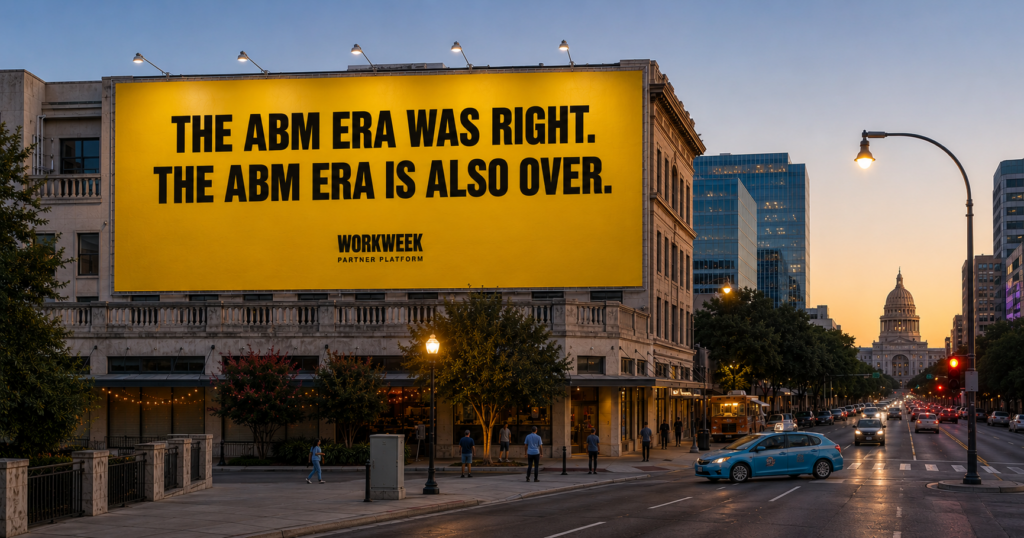
Workweek signaled the platform’s significance with a pointed billboard claim circulated at launch: “The ABM (Account-Based Marketing) era was right. The ABM era is also over.” The argument implicit in that framing is that account-based marketing correctly identified the unit of B2B decision-making. What it couldn’t deliver was continuous visibility into which accounts were engaging with content long before a sales conversation began. The Partner Platform, in Workweek’s telling, picks up where ABM’s tracking capabilities end.
Adam draws a direct analogy to what Facebook’s performance transparency did for consumer advertising. When marketers could see what their spend was actually producing, budgets followed. He argues the same structural shift is possible in B2B, where creator content currently accounts for 3 to 5% of most marketing budgets.
“B2B advertising is a $40 billion a year market, and it hasn’t grown relatively,” he says. “If we look at what happened to consumer advertising when Facebook brought transparency around performance, people started spending a lot more money because marketers had more confidence.”
Better Measurement Should Raise Creator Pay. The Risk Is What Creators Chase Instead.
For B2B creators, better attribution carries two implications. The first is that provable performance should translate into higher pay. “They should start making a lot more money, but not out of feel-good and relationships,” Adam says. “Because they’re driving performance.”
The second implication is more complicated. Once measurement becomes granular enough to show which content converts, creators face pressure to optimize for the scoreboard rather than the editorial credibility that made them effective in the first place.
Adam’s advice to established creators is to resist that pull. “Don’t change,” he says. “It’s like looking at the scoreboard and being like, don’t change what you did to make that scoreboard what it was. If you optimize for the scoreboard, you’re losing what got you there.”
“There are thousands and thousands of people that could be creating content every single day to move their industry forward, but they need feedback,” Adam says. “They need to know what’s working, what’s not working.”
Lowering the Barrier, Raising the Reward
Workweek does not intend to limit the Partner Platform to its own networks. Adam sees the identity graph and attribution infrastructure as eventually applicable across the B2B Creator Economy, though he is careful about sequencing. “We recognize that we’ve been in beta for 18 months,” he says. “We still have a lot more to do to prove and learn.”
His 12-month benchmark is less about revenue targets than ecosystem expansion. The goal is to lower the barrier for practitioners to create content while raising the confidence for marketers to fund it, so that B2B creator budgets can shift meaningfully from their current 3 to 5% of marketing spend.
“A year from now, we hope there’s a lot more B2B creators out there, because we’re starting to solve that problem,” Adam says.
Subscribe to Our Newsletter
Check Out Our Podcast




