




Strategy
RockWater’s ‘Night Before VidCon’ Goes Official as Creator Economy M&A Exits the Hype Cycle

The Creator Economy has no shortage of conferences, panels, and pitch competitions. What it still lacks, according to RockWater founder Chris Erwin, is a room where deals actually close.
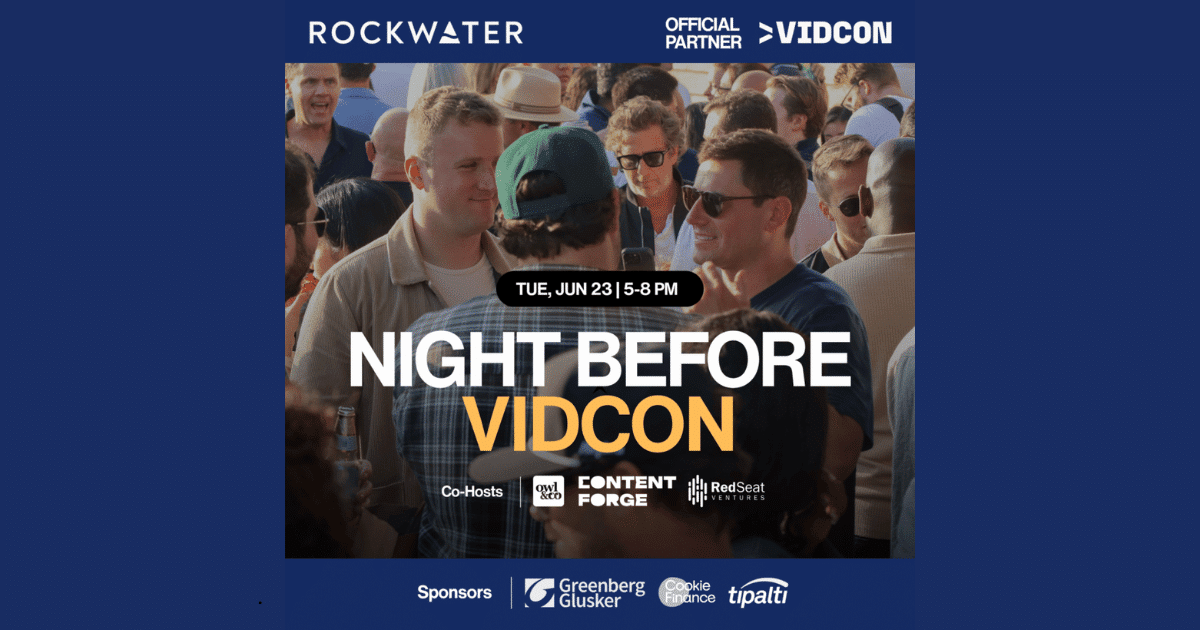
On June 23, RockWater’s “Night Before VidCon” will bring more than 200 founders, executives, and investors to a Santa Monica rooftop for three hours of unscheduled conversation. This year marks the first time VidCon has designated an official partner for its Tuesday evening pre-event in Los Angeles, and it chose RockWater. For Chris, the distinction matters less as a credential than as a signal: the Creator Economy is industrializing, and the deals powering that growth still depend on someone filling the right room.
Chris is the founder of RockWater, an M&A and strategy advisory firm he launched in 2017, focused exclusively on the Creator Economy and social and audio agencies. Over nearly a decade, the firm has advised on transactions including the sale of Long Haul Management to Wasserman, Feedfeed to People Inc., Click Management to Gamesquare, Mini Katana to Reality Marble, Lionize to gen.video, and Bottle Rocket Management to Night. Before RockWater, he served as COO of Big Frame through its acquisition by AwesomenessTV and DreamWorks Animation.

“This industry is maturing and industrializing,” Chris says. “There’s a lot more buyers entering the mix. They want to put capital to work. They’re going from being tire kickers to actually having a thesis and wanting to get deals done.”
The Night Before VidCon, co-hosted with Owl & Co., Content Forge, and Red Seat Ventures and sponsored by law firm Greenberg Glusker, financial platform Cookie Finance, and payments infrastructure company Tipalti, has grown from roughly 30 to 40 attendees at its first iteration to more than 200 this year. The event runs from 5 to 8 p.m. at the Expert Dojo rooftop in Santa Monica.
The Creator Economy’s Sophomore Year Has Arrived
Chris uses the phrase “sophomore year” to describe where the Creator Economy stands in 2026. After a contraction period from 2022 to 2024, he says, 2025 began a new growth cycle. The current phase is defined by segmentation: buyers and sellers are starting to understand that agencies, publishers, and technology companies operate on distinct KPI frameworks, carry different risk profiles, and command different valuations.
“We’re going from a world where there was a lot of vibes and a lot of hype to more of an extreme focus on looking at these businesses truly as companies that are generating revenue, generating profit, solving real problems,” he says.
That shift carries practical implications for how deals get structured. At a recent panel at the London Podcast Show, Chris joined investors from Electrify and Red Seat Ventures to discuss how capital allocators are approaching creator businesses. The conversation, he says, reflected an industry finally developing common frameworks for evaluation across business models.
“We’re starting to see that kind of really start to flesh out in the capital markets,” he says.
Deal Volume Is Up. Closing Is Still the Hard Part.
Despite rising buyer interest, Chris’s assessment of the current M&A market is candid. The gap between what sellers expect to receive and what buyers are willing to pay has not closed at the rate he anticipated entering 2026.
“We thought going into this year that the bid-ask spread between buyer and seller expectations was going to really close in a meaningful way,” he says. “I would say that there’s still a gap there.”
The obstacle, in his view, is educational rather than financial. Buyers are still learning how to interrogate creator-adjacent businesses: what growth metrics matter, what synergies are realistic, and how to structure deals that incentivize founders after close.
“We’re spending a lot of time educating both sides of the market on what the market-clearing prices are and how to do good and fair deals where both sides win,” he says. “That’s really what pushes the deal forward.”
A major share of Chris’s current focus goes to direct buyer education and coaching founders on how to present their businesses strategically before approaching a sale.
A Digital Industry Where Deals Still Require a Handshake
The central premise of the “Night Before VidCon” is counterintuitive for an industry that lives online: the most consequential conversations still happen in person.
“We operate in a very digital native industry,” Chris says. “But the in-person conversations are what really drive the deals and the partnerships that move this industry forward.”
At last year’s event, he received follow-up messages from attendees announcing partnerships between technology companies and publishers, between publishers and talent, and between brands and creators. RockWater has used the event to introduce clients in active sale processes to prospective buyers informally before any formal diligence begins. Some attendees have left with executive hiring leads, with new chief revenue officers and CEOs placed through introductions made at the rooftop.
“All of a sudden, you can be at the bar, and you’re like, ‘Oh, here are five people that I’ve been trying to get a hold of for the past 12 months,’” he says.
The event has no panels, no programming, and no scheduled speakers. Three hours, open bar, and access to a curated room. Attendance requires an application and approval; competing M&A and corporate strategy advisory firms are excluded by design.

Photo: VidCon 2025
Co-Hosts That Map the Industry’s Convergence
The three co-hosts for 2026 were carefully chosen, and their backgrounds trace the major storylines in Creator Economy dealmaking.
Owl & Co. is led by Hernan Lopez, who previously founded Wondery, the podcast network that sold for approximately $300 million, and has since built a data analytics and strategy firm for modern media companies. Content Forge was founded by Isaac Medeiros, whose Mini Katana business RockWater helped sell in 2025. He has since built an audience development agency focused on social and online growth. His co-host role reflects a pattern Chris highlights: relationships with founders that extend across multiple stages of their careers, from advisory client to transaction to ongoing partner.
Red Seat Ventures built a model around helping talent and personalities develop direct-to-fan relationships before being acquired by Fox. For Chris, that acquisition carries a specific signal about where traditional media is investing its attention.
“Fox is investing in creators faster than any other traditional media company I see out there,” he says. “To have Red Seat Ventures and its parent company in the room wanting to be a part of these creator conversations just shows, again, this is the future of where media is headed.”
The Sponsor Mix as an Industry Barometer
The event’s three sponsors reveal as much about where creator businesses stand operationally as the co-hosts do strategically.
Greenberg Glusker, a Los Angeles-based law firm, has built a Creator Economy practice representing high-profile talent across content deals, merchandise, live tours, and consumer products. Cookie Finance was built to provide financial management for creator-operated businesses: bookkeeping, taxes, and business formation for founders encountering institutional scale for the first time. Tipalti provides AI-powered payments infrastructure, simplifying the compliance-intensive process of paying influencers and creators at volume.
“There’s a lot of first-time founders and creators that are coming into wealth really quickly,” Chris says. “How do you manage your books, how do you manage your taxes, and keep all of that straight, with a team that understands how to speak the language of the creator space?”
For Chris, the presence of legal, financial, and payments infrastructure providers at a Creator Economy event is not incidental. It reflects an industry that has grown complex enough to require the same professional scaffolding as any other sector.
Building the Room, Then Listening to It
The VidCon official partnership emerged the way Chris says most productive industry relationships do: slowly, through years of shared purpose and informal dialogue. Chris has been attending and speaking at VidCon since roughly 2012, when he was at Big Frame, an early YouTube company. He says VidCon came to him with a shared interest in serving premium operators and founders more deeply, and the formal partnership grew from there. The conference is now routing its top creators and speakers to the Tuesday evening event, deepening the quality of the room rather than simply expanding its size.
The growth from roughly 30 attendees to more than 200 over eight years mirrors the Creator Economy’s own expansion. Chris keeps his success benchmark simple.
“I want them to walk away with just incredible excitement for where this industry is headed,” he says, “where they are hearing new ideas and meeting new people, learning about business models they didn’t even know existed, and walking away invigorated for how much growth and how much potential there is in this space.”
As for what makes a successful night, his standard is direct. “Just make one new connection,” he says. “You just met one new person. That is a total win.”
Those interested in attending can apply here. To get real-time event updates and hear about ticket promotions, you can sign up for RockWater’s newsletter or follow Chris on LinkedIn. Attendance requires approval.
Subscribe to Our Newsletter
Check Out Our Podcast