





Tech
Kit Founder Nathan Barry: As AI Pushes Creators to Work Alone, Connection Becomes the Edge

As artificial intelligence makes it cheaper and easier for creators to produce content alone, Kit founder Nathan Barry is betting that the next advantage will come from something harder to automate: human connection.
Nathan, a designer, author, and creator before becoming a software founder, launched Kit (formerly ConvertKit) in Boise, Idaho, in 2013 after selling more than $150,000 worth of design books through an email list and blog. At a time when social media was widely treated as the future of audience building, he reached a different conclusion.
“Email is driving the vast majority of these sales,” Nathan recalls thinking in late 2012. “And that just did not make sense to me based on what I had heard.”
Thirteen years later, Kit reports serving more than 650,000 creators globally, including Justin Welsh, Nisha Vora, Mandy Moore, and James Clear, as well as celebrities like Dua Lipa. It has stayed bootstrapped through multiple industry cycles, watched the Creator Economy move from investor punchline to mainstream category, and now, with AI flooding platforms with content produced in isolation, Nathan is making what may be his most counterintuitive investment: physical spaces.
The Hub-and-Spoke Theory of Audience Ownership
Nathan’s original insight has not changed much. Social platforms are exceptional at distribution. Email is what creators own.
“The algorithms don’t reward followers in the same way they used to,” Nathan says. “If I have 10,000 followers and my content is good, maybe 5,000 of those followers will see it. If it’s mediocre, maybe 500.”
That reality makes email not simply a complement to social media but a structural necessity. Nathan describes the model as hub-and-spoke: the email list is the hub, and every social platform is a spoke that feeds it. On a social platform, a creator knows an audience exists. On Kit, they know who is in it, what they purchased, what they clicked, and what they ignored. “If they buy this product but not that product, you know that you could talk to them differently,” Nathan explains. “You get to follow up with them on your schedule.”
Kit operationalizes this across three pillars: grow, earn, and automate. Its recommendations product, which allows creators to automatically cross-promote each other’s newsletters, now drives roughly 40% of all subscriber growth on the platform. Ryan Holiday’s “Daily Stoic” newsletter has added approximately 350,000 subscribers through peer recommendations alone, according to Nathan. The earn side spans digital products, coaching, paid newsletters, and a brand sponsorship network that Kit manages on creators’ behalf.
Nathan’s goal for Kit is not to maximize time spent inside the platform. “We’re not like, ‘How do we get you to spend as much time in Kit as possible,’” he says. “We’re like, ‘How do we get you to spend as much time in your workshop as possible making your thing?’”
Bootstrapped as a Strategy
When Kit was growing from four to six digits in monthly revenue in a single year, Nathan briefly tried to raise venture capital. Investors told him the Creator Economy was too small a market.
“They were like, ‘This can’t be a $100 million-a-year company,’” Nathan recalls. “‘What’s the path for how you’re going to expand from this cute little niche?’”
He did not close a round. Nathan frames that outcome as one of the best things that happened to the company. “Kit’s investors are our customers,” he says, a formulation he has used since a 2014 blog post that announced Kit had raised $3 million from a large group of angel investors, meaning 3,200 customers paying monthly fees. The joke landed as a point of principle: customer-funded growth means building for users, not for a metric that looks good ahead of the next funding round.
The practical consequence is a longer time horizon. “We can make all these long-term moves that don’t need short-term payoffs,” Nathan says. The studio investment is one expression of that logic. Rather than deploying capital into paid acquisition, Kit builds physical spaces that creators can use at no cost.
“If I spend $50,000 on Meta ads, the creators who saw that ad are not better off because of it,” Nathan says. “So instead, why don’t I spend $50,000 on an incredible studio?”
Isolation Is Getting Worse, and It’s Costing Creators Money
Nathan identifies three things creators struggle with most: loneliness, growth, and monetization. The first is rarely discussed as a business problem.
“There’s a sense of doing it alone,” Nathan says. “You might be used to working in a marketing department with six other people. Now I no longer have the commute, but I also no longer have the camaraderie.”
AI is accelerating that dynamic. As generative tools lower the production barrier, more creators are building in isolation. Nathan argues the downstream effects are economic, not merely personal. Fewer peer collaborations mean fewer cross-promotions. Less pricing transparency between creators means missed monetization benchmarks. And on platforms flooded with AI-generated accounts, trust itself becomes scarce.
“Before, we believed [AI-generated creators] existed; we just didn’t necessarily believe what [creators] were saying was true. And then they had to build credibility,” Nathan says. “Now if we see someone, it’s like, ‘I don’t even know if I believe that you exist.’”
For Kit, human connection is not a wellness program. It is a growth mechanism. The mastermind groups, the peer recommendations network, and the physical studios all serve the same function: putting creators in proximity so they exchange ideas, form partnerships, and earn more.
“All of the breakthroughs that I’ve experienced in my creator business came from these connections with other people,” Nathan says.
Studios as Infrastructure, Not Marketing Spend
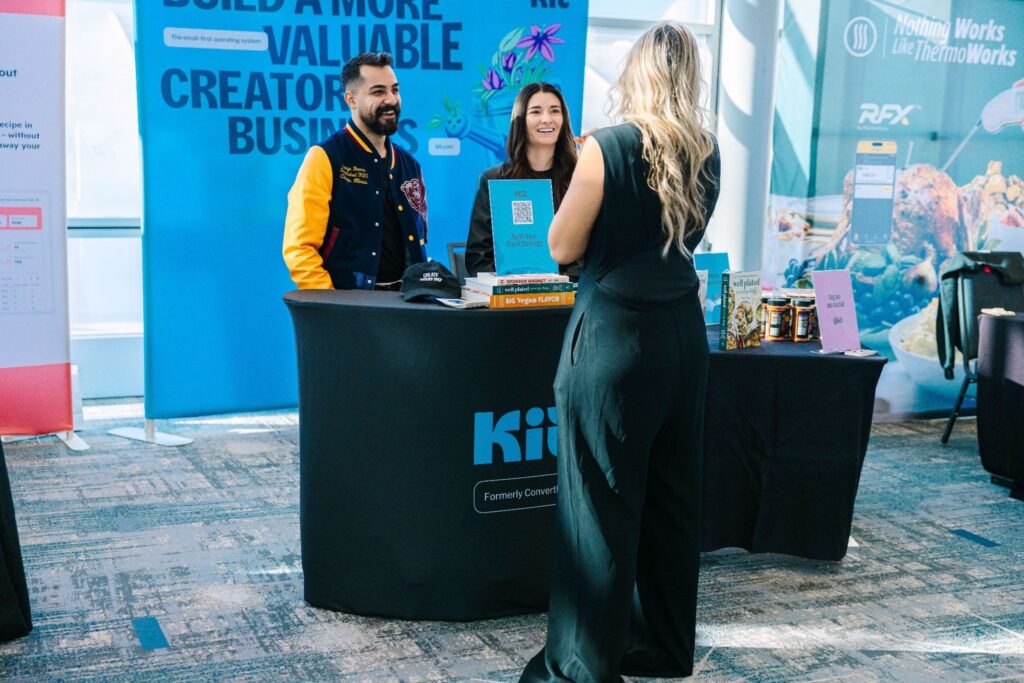
Kit currently operates studios in Boise and Chicago. A New York flagship is opening soon, described by Nathan as the most elaborate of the three. Each location offers recording environments with professional lighting, cameras, and teleprompters, all available at no cost to all Kit Creator and Creator Pro customers.
The investment logic runs against standard growth-stage playbooks. “Most companies raise a bunch of money and then go give all of that money to Meta, Google, and the other platforms in order to pay for advertising,” Nathan says. “That gets your product in front of more customers. It does not provide any value to those customers.”
Kit Studios provides direct value, in Nathan’s framing, and generates referrals that paid impressions cannot. Creators fly in to record content and bring podcast guests. Those guests experience the studio, encounter Kit, and carry that back to their own networks. “You’re naturally going to bring in people that you really respect and want to share,” Nathan says. “It’s just a viral effect on a very small scale.”
The studios also solve a real production problem. At the upper end of Kit’s user base, creators run operations that would look implausible at traditional media companies. Nathan cites James Clear’s newsletter, which reaches 4.5 million subscribers; it is run by Clear and one assistant. Tim Ferriss reaches close to two million subscribers with a team of three. The infrastructure required to achieve that kind of leverage, Nathan argues, should be available before a creator reaches that scale, not after.
The Creator Middle Class Is Real and Kit Has the Data
Nathan recalls a persistent narrative that took hold in 2020/21: the Creator Economy has no middle class. Income, the argument went, was bifurcated between struggling beginners and a handful of ultra-visible stars, with nothing sustainable in between.
He contested it then. He argues Kit’s data has since settled it. “We’re seeing there’s this incredible middle class of creators, people who are earning $60,000, $70,000 a year to $200,000 a year, $500,000 a year and beyond,” he says. “They just operate differently.”
The operational difference, according to Nathan, is that these creators do not treat content as a hits-driven business. They build email lists, sell their own products, automate follow-up sequences, and distribute across multiple platforms simultaneously, using social for reach and email for retention. “It’s fairly straightforward to grow an audience on Instagram and then bring that to Kit and use those two side by side,” he says.
The creators on Kit who have built these systems are often puzzled by the burnout discourse that dominates broader creator culture. “If you were to come to our event and talk to any of the hundreds of creators there, most of them would be like, ‘Well, why don’t you sell your own products instead of brand deals? Why don’t you have automations?'” Nathan says. “And the general pop culture Creator Economy is like, ‘Wait, you can do that?'”
A Different Outcome
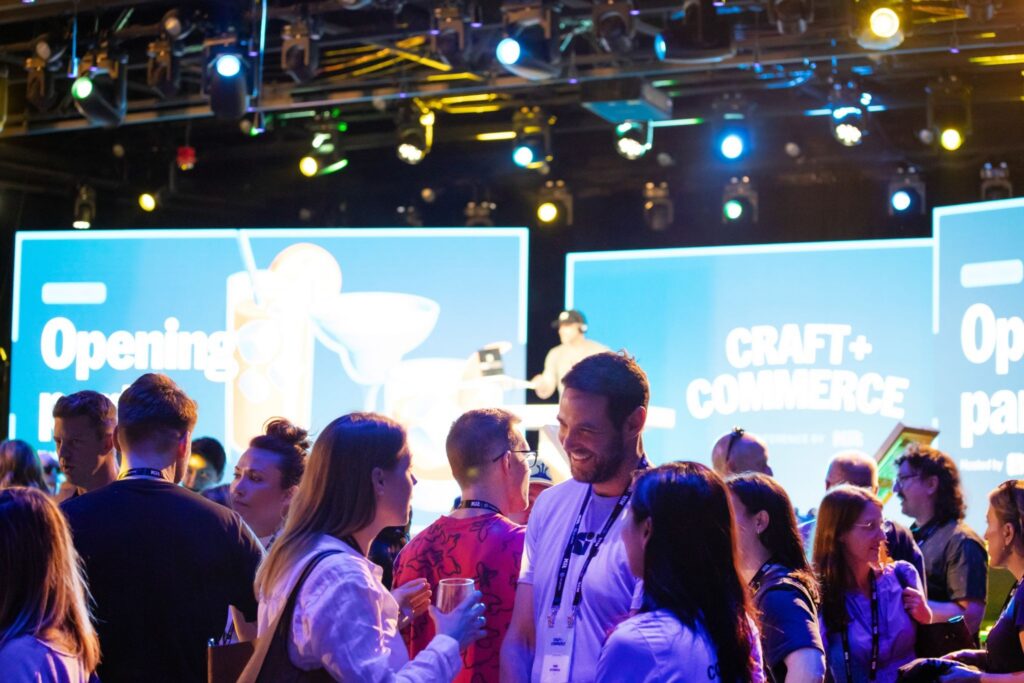
Kit is hosting its Craft + Commerce conference in Boise in the coming weeks, with more than 400 creators attending. The New York studio, the company’s largest physical investment, is preparing to open. Nathan expects to still be running the company in a decade.
His goal for that horizon is not an exit multiple or a valuation outcome. It is the disappearance of a narrative.
“I want to see a thriving middle class in the Creator Economy,” Nathan says. “And I want it to be not just that we see it in the hundreds of thousands of users that we serve, but that everyone understands that’s absolutely true.”
Subscribe to Our Newsletter
Check Out Our Podcast