



Strategy
General Motors Built Five Hollywood Soundstages to Prove Creator Marketing Can Scale


The easiest version of creator marketing is a sponsored post. A brief, a rate card, and a deliverable. Most brands stop there.
General Motors did not. In March, the automaker built five production-grade Hollywood soundstages, each themed to a different vehicle in its portfolio, invited a group of creators to compete on them, and handed out a new car to the winner. The initiative, called GM Creator Lab, generated more than 50 million earned views in its first month, more than double its target, and 200 pieces of content across the portfolio.
“We weren’t trying to buy isolated pieces of content,” says Lucy Tate, GM’s Head of Influencer Marketing. “We were trying to build a creator platform that could produce culturally relevant storytelling at scale.”
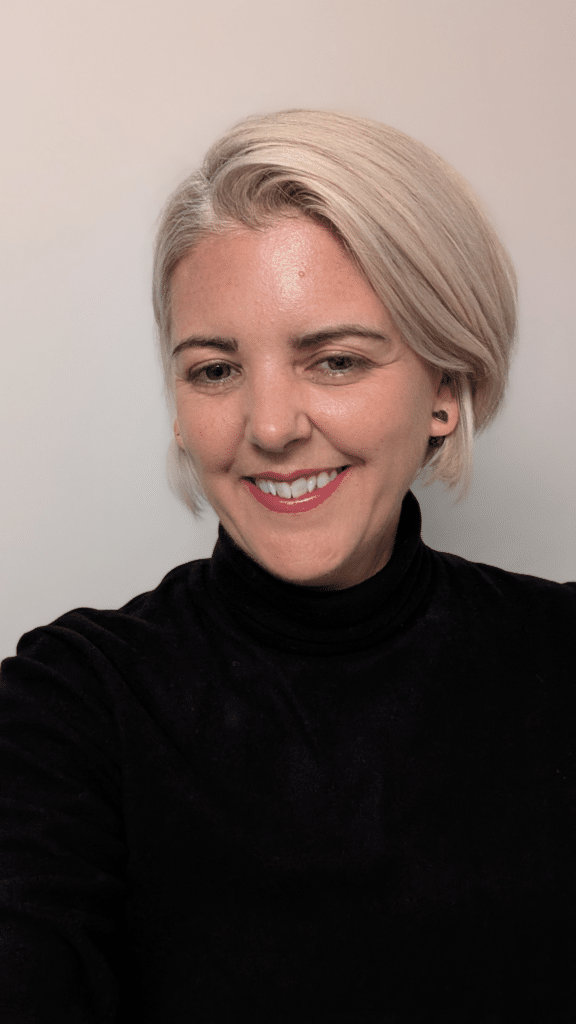
Lucy joined GM in December 2024 after nearly nine years at YouTube, where she served as Global Head of Creator Engagement, followed by stints at Spotter and The Lighthouse. She brings a view of creator partnerships built from the platform side: what actually works, why most brand programs fail, and what it takes to close the gap. Creator Lab, she says, was built around those lessons.
Brands Are Treating Creators Like Media Inventory
Lucy’s diagnosis of the industry is direct. What works, she argues, is when brands stop trying to force creator content into old advertising models. What does not is formulaic work that treats creators as distribution vehicles rather than storytellers.
“Creator Lab was shaped by the belief that if you want standout work, you have to invite creators into something bigger,” she says. “Something with enough ambition, creative freedom, and production support for them to make content their audience will genuinely care about.”
That belief runs counter to how many marketers still think about creator spend. Reach, impressions, and CPMs dominate the conversation. The value of narrative fit rarely makes it into the brief.
“A creator brings trust, interpretation, and cultural context,” Lucy says. “Traditional media can drive reach, but creators can make a brand feel legible inside culture. They translate products into stories, emotions, and moments that audiences actually choose to watch.”
The Internal Case for Taking the Biggest Creative Swing Possible
Getting that kind of ambition approved inside a company like GM required building a case across multiple functions. The pitch involved communications, influencer, legal, marketing, brand leadership, and creative excellence teams.
“The case was really about recognizing how much creator work has evolved, and that our approach needed to evolve with it,” Lucy explains.
An earlier, smaller activation provided a proof of concept. In late 2025, GM partnered with Good Good Golf and Portal A on “The Great American Golf Adventure,” a creator-led series featuring the GMC Sierra EV AT4 in Wyoming. That campaign generated more than 10 million views and over 100,000 engagements across the GMC and Good Good channels, according to the company.
A separate activation in Calabasas, where GM vehicles appeared organically at a creator collaboration event run by agency partner Koala, showed that creators could naturally incorporate vehicles into their storytelling when the environment supported it. “That was promising,” Lucy says, “but it also made clear that if we wanted deeper brand alignment and more intentional storytelling, we needed to show up in a much bigger and more meaningful way.”
Creator Lab was the result. The program was framed internally not as a stunt but as a top-of-funnel brand awareness investment with a scalable content model behind it. “If we wanted breakthrough work, we had to create the conditions for it,” Lucy says.
Five Sets, One Grand Prize
The production ran from March 25 to 27 at a single Los Angeles studio, with five stages built on LED volume walls. Each stage was designed around a specific vehicle and brand narrative: the Silverado in an outdoor canyon campground, the HUMMER EV in a museum heist, the Buick Envista in a downtown street scene, the Corvette in a Miami Art Deco world, and the Cadillac Escalade IQ on a red-carpet premiere set.
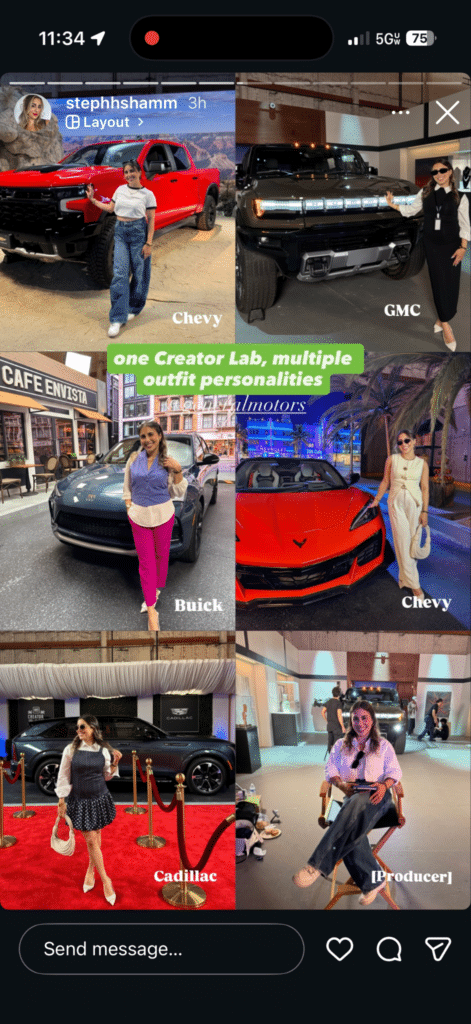
The initiative drew more than 150 submissions. Selected creators were matched to stages based on their storytelling strengths and audience fit. YouTube personalities Adam W and Kinigra Deon hosted the competition, helped drive submissions, and created their own content on set.
“They helped signal the caliber of the program,” Lucy says, “and attract ambitious creators who wanted to be part of something bigger than a typical brand campaign.”
The winner was Brittany Rae, whose submission featuring the Corvette Z06 was evaluated on five criteria: creativity and originality, brand integration, cinematography and technical execution, storytelling, and overall impact. Engagement metrics were not part of the scoring.
“What mattered most was not reach,” Lucy says. “It was the strength of the creative and how effectively the vehicle was integrated into the story.”
Where the Brand Ends and the Creator Begins
Giving a group of creators access to cinematic sets and asking them to make films around brand vehicles carries real risk. Lucy is candid about the tension.
“Audiences can feel it immediately when brands try to borrow creator credibility without truly respecting creator craft,” she says. “The tension is always: how do you protect the brand while still making something people genuinely want to watch?”
Creator Lab managed that tension through structure rather than control. Creators were required to place the vehicle centrally in their content and stay within brand guidelines, but the framing, tone, and execution were their own. Brand influencer leads were present on set throughout, and creators collaborated with agency partner Room 1041 in advance on their concepts.
“The freedom was real, but it lived inside a framework built to make the work both entertaining and brand-right,” Lucy says.
What surprised her was how far creators pushed that freedom once they were in the space. “The ideas they developed on set pushed the work further than expected in a really positive way,” she says.

50 Million Views in the First Month
The over 50 million views and 200+ pieces of content drove 80,000 shares and more than 17,000 comments, which Lucy reads as a signal of genuine audience engagement rather than passive consumption.
Brand lift data is still being collected. Unsolicited amplification included a shoutout from Zach King, a creator with more than 80 million TikTok followers.
If Lucy ran Creator Lab again tomorrow, she says she would give creators more time with the brief and set details in advance, and extend time on set to allow for fuller development. She would also look at getting vehicles into creators’ hands earlier through loaner programs so they could build more informed concepts before arriving on set.
“For some creators, this was an entirely new kind of production environment,” she says. “More preparation time would have let the work go even further.”
Beyond a One-Time Activation
Lucy is direct about what the scale of Creator Lab signals inside GM’s broader marketing strategy. Cross-functional involvement from communications, legal, marketing, and brand leadership does not happen for experiments.
“Creator Lab was our way of leaning into the future now,” she says. “Creators are not an add-on. They are a meaningful part of how GM will continue to show up in culture.”
Her longer-term view is that the most sophisticated brand-creator relationships are still being invented. Shared IP, repeatable creative franchises, and formats that blend brand storytelling with entertainment are all on the table. The brands that get there first, she argues, will be those that treat creators as strategic partners rather than vendors.
“Better briefs, more trust, smarter measurement, and a willingness to build with creators instead of just buying around them,” she says. “That’s where this goes.”
Subscribe to Our Newsletter
Check Out Our Podcast