Strategy
How Jergens Is Using Creator Experiences to Reach Younger Beauty Consumers

For most of its 125-year history, Jergens built brand loyalty the same way: mother to daughter, bathroom cabinet to bathroom cabinet. In 2026, the Cincinnati-based skincare brand is trying something different.
Jergens, owned by Kao Corporation, launched the Joy Club this year, a campaign that began with a creator trip to Miami and is scaling outward through a multi-city consumer tour. The logic is straightforward, but the execution involves a calculated risk: inviting creators to an all-expenses-paid experience, handing them no content mandates, and trusting that the posts will follow.
“Brand trips earn attention, and consumer events earn trust,” says Amy Bella, who leads Influencer Marketing for Jergens at Kao. “They’re not interchangeable, and they shouldn’t be measured the same way. We need both.”
Stephanie Kimutis, Associate Director of Consumer Care at Kao and the marketing lead for the Jergens portfolio, frames the Joy Club as the latest chapter in a longer repositioning effort. The brand has spent the past two years deepening its influencer strategy, but 2026 marks the first time it is scaling that work into experiential formats for consumers.
“For a hundred years, trust in Jergens was passed down from generation to generation,” Stephanie says. “A lot of people will say they first heard of Jergens from their grandmother or their mother. In the world we’re living in today, that trust is coming from creators telling the story in their own voice.”
That shift carries commercial urgency. Jergens is targeting 18-to-24-year-old consumers more than before, and the Joy Club is designed as the vehicle. The brand is also preparing to celebrate its 125th anniversary in July 2026, with new product launches on the horizon that the Miami trip was already quietly previewing.
“We’ve seen good progress in becoming more relevant with younger consumers,” Stephanie says. “But we’re just scratching the surface.”
The Brief: Joy Should Feel Personal, Not Performative
When Jergens handed the experience brief to Trend Social, the agency it brought in to handle end-to-end production, the instruction was deceptively simple. Mary Katherine Evans, VP of Trend Social, describes it as a single overarching theme: joy should feel personal, not performative.
“We weren’t designing a content house,” Mary Katherine says. “We were designing an environment that creators could actually connect with each other and relax in from beginning to end.”
The non-negotiables from the brand were specific: the product had to feel organically integrated, inclusivity was critical, and the experience had to reflect the Joy Club ethos without forced scripts, over-branding, or what Mary Katherine calls “transactional energy.” She notes that the clarity of those constraints made the creative stronger rather than more limited.
The brief was developed over roughly six months. Amy says the internal alignment process centered on reframing what Influencer Marketing was actually supposed to do. “It’s about connecting all parts of your brand ecosystem into a conversation and people that tell stories on your behalf, not just brand stories,” she explains. “Setting that up clearly is what got us across the finish line with our management team.”
Designing for Spontaneity
The Miami trip brought together seven creators spanning a wide range of follower counts, from established names like Mei Mei Deuanxayasane and Cynthia Victor to emerging talent. No creator was required to post anything.
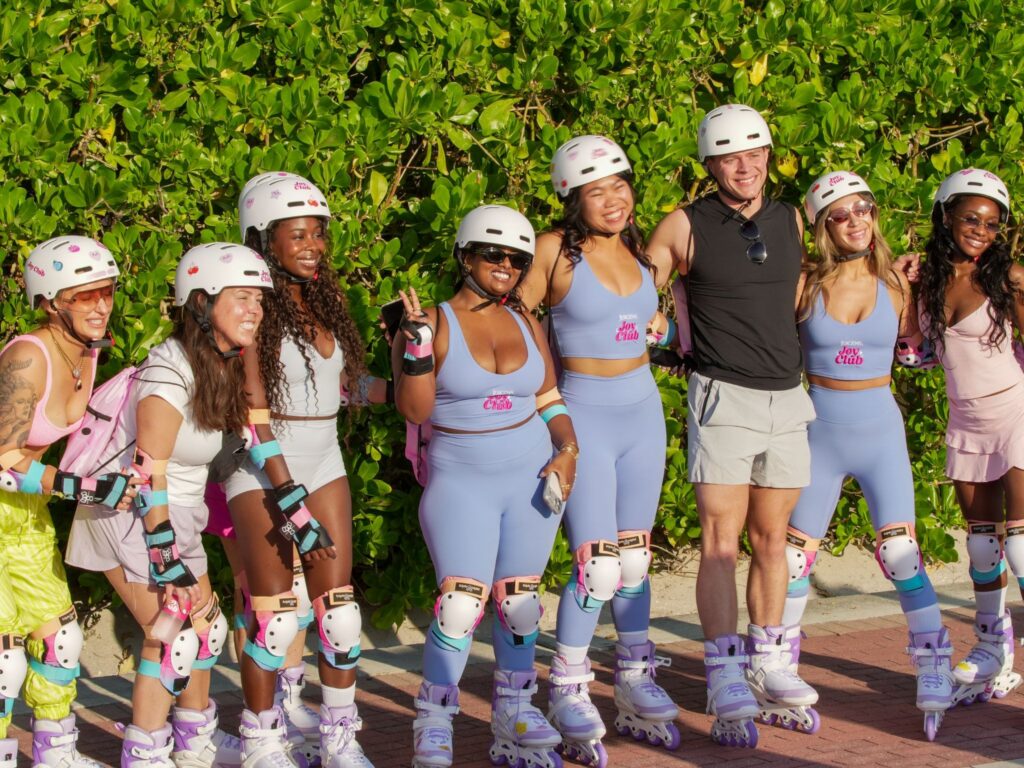
Executing a no-mandate trip without losing control of the output is the central production challenge, and Mary Katherine is direct about how Trend Social approached it. “From a production standpoint, that means obsessing over the details: lighting, flow, aesthetics, and timing,” she says. “We design with a camera-ready mentality, meaning every space should be naturally photogenic, but never feel like a set.”
Pacing was equally deliberate. Trend Social built white space into the schedule so creators were never overscheduled, creating the conditions for unscripted moments. The itinerary included a 7 a.m. trampoline workout, a boat ride to dinner, and rollerblading sessions alongside intentional downtime. “That’s when the most authentic content happens,” Mary Katherine says, “when they’re discovering moments on their own and building genuine friendships.”
The approach surfaced an outcome neither side anticipated. Jergens had embedded informal feedback sessions for 2027 development-stage products into the program. “I expected feedback, but I didn’t expect the level of engagement or depth,” Amy says. “Some of them begged us to send more product before it launches. We’ll definitely continue doing that.”
Mary Katherine pushes back on a common misreading of what made it work. “There’s a misconception that ‘authentic’ means unplanned,” she says. “In reality, it’s incredibly intentional. The best trips are tightly orchestrated but leave room for spontaneity. Striking that balance is where the real work happens.”
What Brands Consistently Get Wrong
The no-mandate structure is not the default. Many brands arrive at agencies with the opposite instinct, and Mary Katherine is specific about what that instinct costs them.
“The one thing brands consistently get wrong is over-controlling the outcome,” she says. “There’s often a desire to script the content or guarantee specific deliverables, which ultimately undermines the very thing they’re trying to achieve: authentic connection. Audiences can feel when something is forced.”
Her framing is direct: the brands that perform best are the ones willing to shift from control to trust. “When you focus on building a meaningful experience instead of extracting content, the content and the impact follow naturally.”
Stephanie echoes that from the brand side, drawing on an earlier activation at the Mall of America. “There does have to be more than just the brand and the product,” she says. “People were going to walk by, and then they saw what we had going on, and it brought them back. It is about the experience you create as a way to connect with the brand versus simply handing out samples.”
Measuring What Matters
According to Jergens, the Joy Club Miami trip generated just over 31 million impressions and views from creator-posted content, with an estimated media value of $3.5 million, figures that exclude reach from the company’s own organic social and PR activity. Amy notes that those metrics were tracked against KPIs anchored to content volume, video views, product mentions, and engagement, benchmarked against the prior year’s results.
But Stephanie points to a measurement priority that sits above campaign-level metrics: social mentions of the Jergens brand itself. “For a long time, Jergens would be what we call ‘MIA’ (missing in action) in the beauty and social conversation,” she says. “Social mentions are how we know we’re becoming part of a conversation we’ve been missing.”
The ultimate measure, both say, is sales. “We need to see this thread through to driving the business,” Stephanie says. “My job, Amy’s job, our job, is to grow the brand. Most specifically, grow it with the 18-to-24-year-old consumer.”
Scaling Joy to Consumers
The Miami creator experience was always conceived as a starting point, not an endpoint. The Joy Club is expanding this year into a multi-city consumer tour, with stops designed to translate the experiential energy from Miami to a broader audience.
The brand’s first stop was the Cheerleading World Championships in Orlando, where Jergens appeared as the event’s first-ever on-site brand partner, accompanied by creator and “Dance Moms” alumna Kendall Vertes. Future tour stops are expected to intersect with music, culture, and events where the brand’s core demographic already congregates.
“We want to meet consumers where they already are,” Amy says. “Be part of the event, the culture, the community they’re already engaged with, and let them tell stories in an experience-led environment when they’re already mentally connected there for some other reason.”
To bridge the gap between creator-facing and consumer-facing activations, Jergens is also running a sweepstakes offering a Miami trip for two to its retail customers. Amy frames the giveaway as structural equity-building. “Sometimes brands get negative feedback from big creator trips when there’s no consumer portion,” she says. “Our giveaway is about engaging the community and the customer who buys Jergens, giving them a similar experience.”
A less-discussed element of the consumer events involves product sampling. Amy argues that the conversion data behind samples-in-hand is chronically undervalued in post-campaign analysis.
“People skip over it because they say, ‘Oh, yeah, we’re going to sample product and consumers will stand in line for it,'” she says. “But the data on how sampling converts into sales and long-term brand loyalty is something that doesn’t get talked about enough.”
What Comes Next?
As the Joy Club tour extends through the rest of 2026, Jergens plans to bring additional creator partners into future consumer stops, continuing the informal product-feedback sessions that generated a strong response in Miami.
The broader arc is one Stephanie describes as just beginning. The brand’s upcoming anniversary, new product pipeline, and deepening creator relationships are converging in a single year, after two years of rebuilding influencer capabilities from the ground up.
“We have so much exciting stuff coming,” she says. “We’ve done a really good job already. But there’s just so much more to come.”
For Amy, the clearest signal that the strategy is working may come from the simplest data point: how many times the Jergens name appears in a social conversation it was not invited into.
“The whole reason we’re leaning into this type of momentum,” she says, “is that trust is still at the core of who Jergens is. It’s just coming from a creator telling the story in their own voice now.”
Subscribe to Our Newsletter
Check Out Our Podcast