





Tech
Fohr’s Bet That Influencer Marketing Can Be as Predictable as Any Other Media Buy

Every time Fohr ran an influencer campaign, it felt like a trip to the casino. Bets were placed, sometimes the results were strong, sometimes they weren’t, and the only honest answer to a client asking what would happen next was a well-educated guess.
James Nord, who founded the New York-based creator marketing company in 2012, decided to find out whether it had to work that way. The question, he says, felt almost intangible. That’s partly why nobody was trying to answer it.
“What would we have to change to no longer be guessing and to know exactly what was going to happen before it happened?” James says. “When we started working on this, we had no idea how to answer that question. But it felt like a question so big and so difficult to answer that none of our competitors were trying to answer it because it felt unanswerable.”
Years of development produced Predictive, a forecasting system built on 13 years of campaign data, more than 6,000 campaigns, $250 million distributed to creators, and 300,000 creator relationships. The system uses probability distributions and risk-weighted modeling, tools borrowed from financial services, to forecast campaign performance before a dollar is committed. Fohr, which counts The RealReal, Aerie, and Dick’s Sporting Goods among its clients, now backs those forecasts with a guarantee.
“Brands are wasting millions on creator campaigns because they’re guessing which campaigns will work and which creators will work,” says James. “At the crux of who we are now is that we’re not guessing, we’re predicting.”
The Metric That’s Been Pointing Brands the Wrong Direction
The problem with standard influencer metrics isn’t that they’re irrelevant. It’s that they measure the past and present it as a forecast.
James illustrates the gap with a single example. A creator with 1.1 million Instagram followers and a viewership rate of 40% averages roughly 540,000 views per post. A brand working from that number would expect 540,000 views from a sponsored post. What Fohr’s modeling shows instead: a 90% probability of getting 88,000 views, a 50% probability of 155,000, and a 10% chance of hitting 1 million.
“What this is telling us is that average viewership would probably only have a 10 to 15 or 20% chance of being real,” James explains. A handful of viral posts inflate the average while the median experience goes unexamined.
His analogy is the stock market. Share prices are priced on future earnings expectations, not on what a company made six months ago. Influencer metrics work in reverse, anchoring projections to history that includes outliers. “Even as you think about the foundational metrics of this industry, they are backwards facing,” he says. “They look behind us.”
Math Plus Cultural Intelligence
Predictive is not purely a statistical exercise. James describes the system as having two components: mathematical modeling that identifies the probability of performance, and what He calls “cultural cartography,” a deep understanding of how culture moves across the internet and where it’s headed.
“We deeply understand how culture moves and the need for creativity to be part of it,” he explains. “We use the mathematical modeling piece, but also the cultural intelligence to figure out exactly what brands need to succeed.”
In practice, this means the system doesn’t only surface creators likely to generate views. It models performance within the context of what’s resonating culturally, helping brands find creators whose audiences are actively engaged with relevant conversations rather than passively scrolling past sponsored content.
The two-part structure also reflects an internal conviction: that the best campaigns require both analytical rigor and creative judgment. The math identifies who is most likely to perform. The cultural layer filters for the right kind of performance. Neither works without the other.
The Same 500 Creators, Two Different Selection Methods
The clearest test of Fohr’s approach came through a split campaign with The RealReal, the luxury resale platform. Fohr ran the same campaign twice, drawing from an identical pool of 500 creators who had expressed interest in the brand.
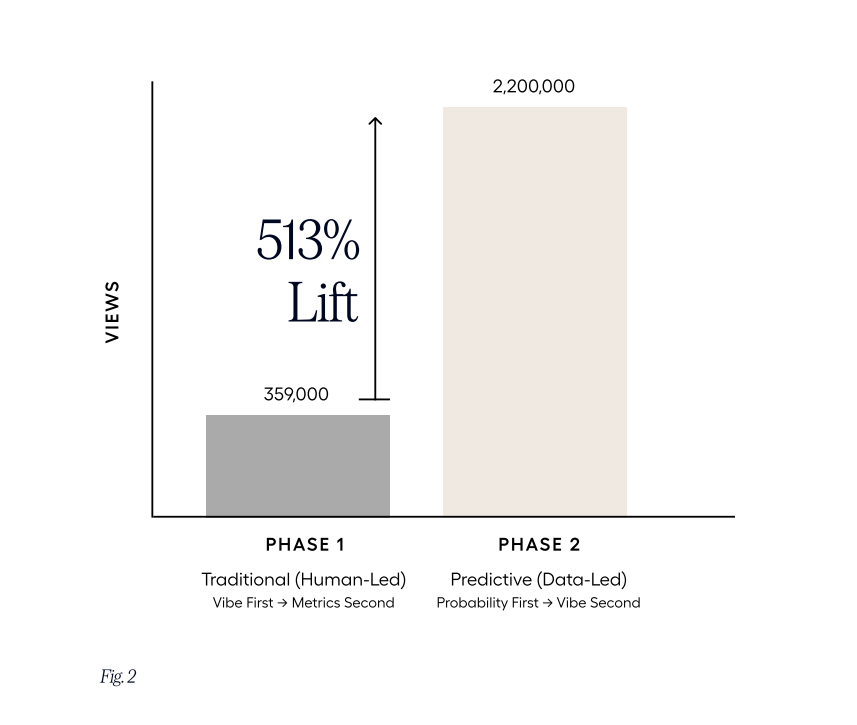
In the first phase, The RealReal selected creators using historical averages, engagement rates, and brand aesthetic, the standard approach. According to Fohr, the campaign delivered 359,000 views and roughly 13,000 interactions. It worked. It wasn’t the benchmark.
In the second phase, Fohr ran the same 500 creators through its predictive system. Those with the highest probability of performing were surfaced first. Brand fit and content quality were applied afterward, as filters on an already data-ranked shortlist. The sequence flipped: probability first, vibe second.
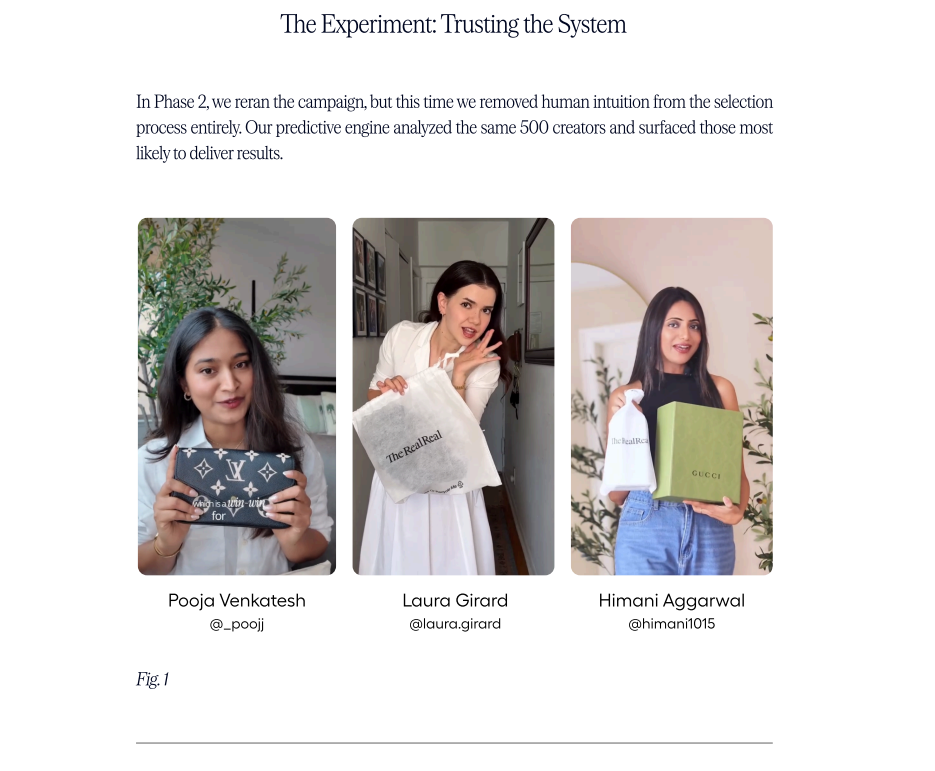
The results: 2.2 million views, nearly 99,000 interactions, and a 14-fold improvement in spend efficiency as measured by views per dollar, a metric Fohr introduced to make cross-channel comparisons against paid media possible. In the traditional phase, the brand received 4 views per dollar. In the predictive phase: 56.
“I had a high amount of confidence that this was going to work because the math was just correct,” James says. “But for everyone, myself included, that was a pretty radicalizing result.”
The Creators the Brand Would Not Have Chosen
Many of the predictive-selected creators weren’t ones The RealReal would have identified on its own. They weren’t off-brand. They were simply outside the brand team’s frame of reference.
James attributes this to algorithmic bias. “Every single person has created their own personalized internet based on their algorithm, interests, and the people they follow,” he says. “Because of this, we naturally have bias about what we see.”
Fohr sees this as a type of halo effect: a preference for creators who feel aesthetically aligned with a brand, regardless of whether that alignment predicts performance. The creators who resonate with a marketing team aren’t necessarily the ones an audience trusts with a purchasing decision.
“The true test is whether brands are comfortable trying something new and trusting Predictive,” James notes. “The RealReal has been an excellent partner because they did just that, and the results were beyond what we had even predicted, which made it easier for them, and all our clients frankly, to be open to new ideas, new creators, and new corners of the internet.”
The Incentive to Keep Wasting Budget
James is direct about why Influencer Marketing’s inefficiency has survived for a decade. The answer isn’t technical.
“Show me the incentive, and I’ll show you the outcome,” he says, paraphrasing the investor Charlie Munger. “Are influencer agents going to say they’re charging too much and the performance isn’t there? Are influencers going to say they shouldn’t make as much money? Even the marketers who are fighting for budgets, it’s not going to help them to go to their CMOs and say this isn’t working very well.”
Nobody in the transaction has a structural reason to surface the inefficiency. Agency fees tied to a percentage of brand spend create the opposite incentive. Fohr’s position is that it can walk into a brand and demonstrate that it could cut the influencer budget in half and deliver the same volume of views. That message has no natural champion in the current system, according to James.
He cites results from other clients to frame the scale of the gap. One moved from 300,000 views in a prior campaign to 4.5 million on the same budget. Another saw effective CPMs fall by nearly 60%. Aerie grew 23% year over year. The guarantee on the 4.5 million-view campaign was set at one million, already three times the prior result. The campaign exceeded it fourfold.
A Perpetual Optimization Machine
James describes Predictive not as a feature but as an evolution of the entire way Fohr operates. The initial system handled creator selection. It has since been extended through every stage of the campaign process into what he calls a “perpetual optimization machine,” with dozens of opportunities to adjust variables across the life of a campaign.
“All of these systems are self-training, so every post that publishes and every campaign that runs tunes the model and makes it smarter,” James explains. “Over time, that creates a gap that’s effectively insurmountable for competitors or lookalikes, because the data only compounds in one direction.”
The stakes, in James’s telling, extend beyond any single brand’s budget. “If we don’t build a way of working that works for both sides of this marketplace, creators risk becoming just a source of content for paid ads rather than participants in something healthier,” he says. “Predictive gives proof of spend and makes the work as measurable and accountable as any other line item.”
The intelligence layer James envisions would allow brands to audit creator selection regardless of which agency runs the campaign, applying Fohr’s probability modeling as an independent check on spend decisions. The question for marketing leadership is whether influencer budget continues to sit in a separate, harder-to-justify category or gets evaluated against paid social, connected TV, and programmatic on the same terms.
“The force for change in this industry is generally brand leaders understanding this exists and telling their teams we need to make this happen,” James says. “The results luckily speak for themselves.”
Subscribe to Our Newsletter
Check Out Our Podcast