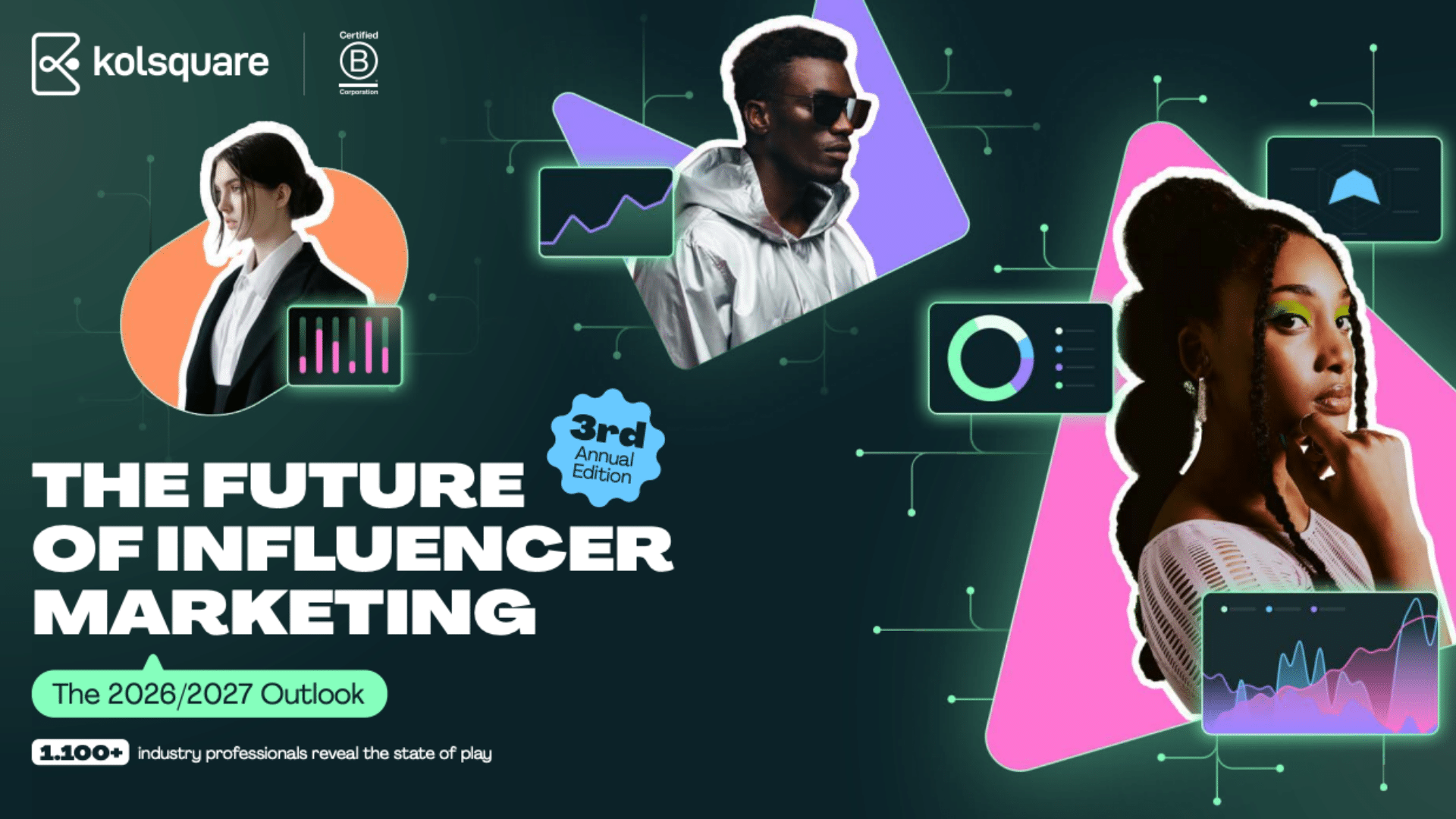
Eighty-nine percent of brands and agencies expect to raise Influencer Marketing spend over the next 12 months, and 84% now use AI or automation in their programs, but only about one in ten describe their strategy as “fully integrated” into their overall marketing mix, according to Kolsquare‘s third annual “Future of Influencer Marketing” report. The gap between how fast the channel is scaling and how fast organizations are learning to run it is the throughline of this year’s findings.
The survey, conducted with B2B International, polled 1,123 marketing decision-makers across seven European markets in May and June 2026, the largest sample in the study’s three-year history.
Confidence in Measurement Lags Behind Measurement Itself
The clearest evidence of the maturity gap sits in how marketers measure success. Engagement rate is the most relied-upon KPI at 37%, a position it has held in all three waves of the study, followed by views at 34%. Yet only 41% of marketers say they are extremely confident in measuring even that top metric. Confidence is highest for the easiest on-platform signals, views (56%) and impressions (50.6%), and lowest for sentiment (22.5%) and Earned Media Value (21%), the metrics that require the most interpretation.
Fanie Genovese, Head of Social Media at digital marketing agency Better&Stronger, framed the disconnect directly: “Investment is advancing faster than vision, because it remains hard to connect individual influencer activations to broad, cross-cutting objectives: affiliation and conversion, awareness, consideration. Until influence is built into a full-funnel logic, with objectives and measurement aligned with the rest of the marketing mix, strategic maturity will keep running behind budgets.”
Strategy Classification Confirms the Pattern
A total of 79% of brands treat Influencer Marketing as a core growth driver or important supporting channel, and only 3% still call it experimental. But when asked how the channel is organized within their broader marketing operations, roughly three in ten brands still run it as a stand-alone activity, and the share connected to broader integrated brand campaigns actually fell to 32% in 2026 from 45% in 2025.
Scott Guthrie, Director General of the UK’s Influencer Marketing Trade Body, said the shift in conversation reflects where the gap now lives: “Today, CMOs debate strategic issues covering impact, integration, scale, and governance, replacing the historic battles to simply ‘sell in’ the channel’s value and fight for larger budgets.”
Spend and Rosters Are Scaling Regardless
None of this has slowed investment. Eighty-nine percent of brands and agencies expect to increase spend in the next 12 months, up from 75% in 2025 and 54% in 2024. Sixty percent of organizations now spend more than €100,000 annually, and 36% spend more than €200,000. Median spend reaches €312,000 at companies with 500 or more employees and €367,000 at those with 1,000 or more.
Rosters are growing at a similar pace. Eighty-five percent of brands and agencies expanded their influencer roster over the past year, and the share working with 100 or more influencers has doubled since 2024, from 18% to 37%.
Technology Adoption Outruns Organizational Change
The same pattern shows up in tooling. Eighty-four percent of organizations now use AI or automation, most often for audience analysis and fraud detection (62%) and content analysis (59%), while predictive use cases trail at just 14%. Dedicated Influencer Marketing platform use has jumped to 65% from 39% in 2025.
Jamie Love, CEO and Founder of Monumental Marketing, tied the two trends together: “The most successful brands don’t separate influencer, affiliate, paid social and e-commerce. They build one creator ecosystem where every piece of content has multiple jobs. Investment has increased faster than organisational change, which is why maturity hasn’t kept pace.”
Standards Are Tightening in Parallel
Even as measurement confidence lags, brands are asking more of creators. Requirements that creators stand up against bullying rose nine points to 34%, and calls for environmental awareness climbed to 30% from 17%. Nearly three in ten marketers (29%) now require a “Responsible Influence” certificate or formal training where such schemes exist, a bar Kolsquare notes barely existed a few years ago.
Jeanette Okwu, Founder and CEO of beyondINFLUENCE and Chairwoman of BVIM, summarized the risk of scaling without aligned infrastructure: “Most brands treat maturity as something that happens automatically once the budget gets big enough, and it doesn’t work that way. You can hire ten specialists and double the spend and still end up with brand, performance, and legal all working off different spreadsheets.”
Image source: Kolsquare The full report is available here
Dragomir is a Serbian freelance blog writer and translator. He is passionate about covering insightful stories and exploring topics such as influencer marketing, the creator economy, technology, business, and cyber fraud.















Eighty-nine percent of brands and agencies expect to raise Influencer Marketing spend over the next 12 months, and 84% now use AI or automation in their programs, but only about one in ten describe their strategy as “fully integrated” into their overall marketing mix, according to Kolsquare‘s third annual “Future of Influencer Marketing” report. The gap between how fast the channel is scaling and how fast organizations are learning to run it is the throughline of this year’s findings.
The survey, conducted with B2B International, polled 1,123 marketing decision-makers across seven European markets in May and June 2026, the largest sample in the study’s three-year history.
Confidence in Measurement Lags Behind Measurement Itself
The clearest evidence of the maturity gap sits in how marketers measure success. Engagement rate is the most relied-upon KPI at 37%, a position it has held in all three waves of the study, followed by views at 34%. Yet only 41% of marketers say they are extremely confident in measuring even that top metric. Confidence is highest for the easiest on-platform signals, views (56%) and impressions (50.6%), and lowest for sentiment (22.5%) and Earned Media Value (21%), the metrics that require the most interpretation.
Fanie Genovese, Head of Social Media at digital marketing agency Better&Stronger, framed the disconnect directly: “Investment is advancing faster than vision, because it remains hard to connect individual influencer activations to broad, cross-cutting objectives: affiliation and conversion, awareness, consideration. Until influence is built into a full-funnel logic, with objectives and measurement aligned with the rest of the marketing mix, strategic maturity will keep running behind budgets.”
Strategy Classification Confirms the Pattern
A total of 79% of brands treat Influencer Marketing as a core growth driver or important supporting channel, and only 3% still call it experimental. But when asked how the channel is organized within their broader marketing operations, roughly three in ten brands still run it as a stand-alone activity, and the share connected to broader integrated brand campaigns actually fell to 32% in 2026 from 45% in 2025.
Scott Guthrie, Director General of the UK’s Influencer Marketing Trade Body, said the shift in conversation reflects where the gap now lives: “Today, CMOs debate strategic issues covering impact, integration, scale, and governance, replacing the historic battles to simply ‘sell in’ the channel’s value and fight for larger budgets.”
Spend and Rosters Are Scaling Regardless
None of this has slowed investment. Eighty-nine percent of brands and agencies expect to increase spend in the next 12 months, up from 75% in 2025 and 54% in 2024. Sixty percent of organizations now spend more than €100,000 annually, and 36% spend more than €200,000. Median spend reaches €312,000 at companies with 500 or more employees and €367,000 at those with 1,000 or more.
Rosters are growing at a similar pace. Eighty-five percent of brands and agencies expanded their influencer roster over the past year, and the share working with 100 or more influencers has doubled since 2024, from 18% to 37%.
Technology Adoption Outruns Organizational Change
The same pattern shows up in tooling. Eighty-four percent of organizations now use AI or automation, most often for audience analysis and fraud detection (62%) and content analysis (59%), while predictive use cases trail at just 14%. Dedicated Influencer Marketing platform use has jumped to 65% from 39% in 2025.
Jamie Love, CEO and Founder of Monumental Marketing, tied the two trends together: “The most successful brands don’t separate influencer, affiliate, paid social and e-commerce. They build one creator ecosystem where every piece of content has multiple jobs. Investment has increased faster than organisational change, which is why maturity hasn’t kept pace.”
Standards Are Tightening in Parallel
Even as measurement confidence lags, brands are asking more of creators. Requirements that creators stand up against bullying rose nine points to 34%, and calls for environmental awareness climbed to 30% from 17%. Nearly three in ten marketers (29%) now require a “Responsible Influence” certificate or formal training where such schemes exist, a bar Kolsquare notes barely existed a few years ago.
Jeanette Okwu, Founder and CEO of beyondINFLUENCE and Chairwoman of BVIM, summarized the risk of scaling without aligned infrastructure: “Most brands treat maturity as something that happens automatically once the budget gets big enough, and it doesn’t work that way. You can hire ten specialists and double the spend and still end up with brand, performance, and legal all working off different spreadsheets.”
Image source: Kolsquare
The full report is available here
Subscribe to Our Newsletter
Check Out Our Podcast