




Influencer
YouTube Creator Jordan Matter Outlines Retention-First Framework At Kidscreen Summit

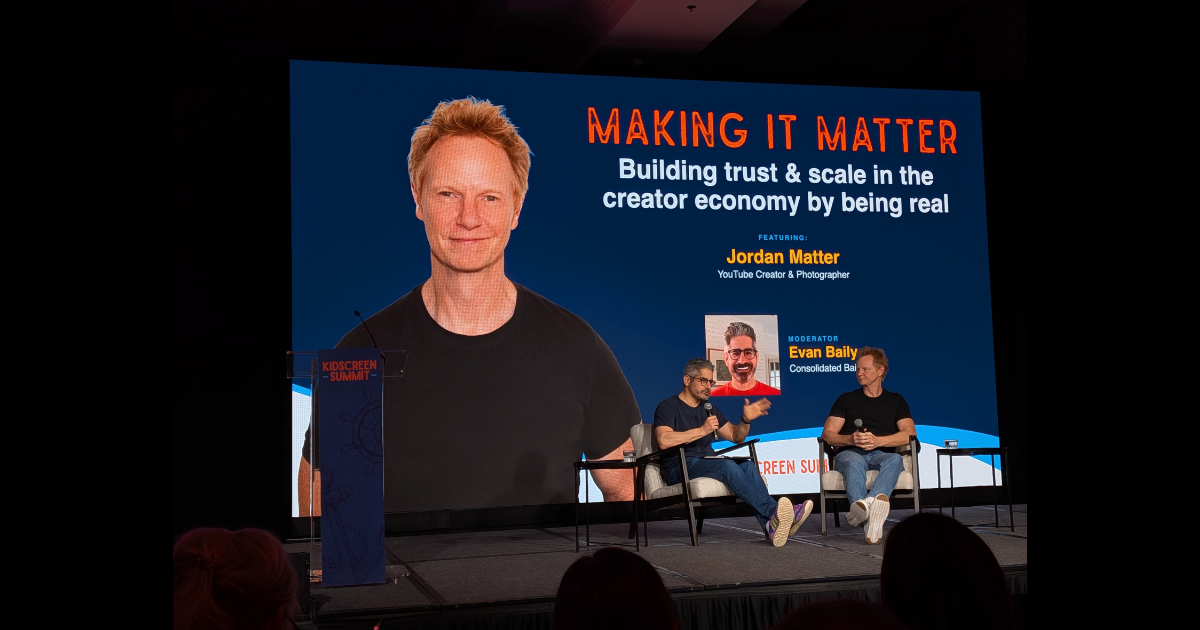
Jordan Matter, whose family YouTube channel has accumulated 33 billion minutes watched and grown to 34 million subscribers, detailed his content strategy at Kidscreen Summit San Diego 2026 (Feb. 22-25), offering guidance on what drives sustainable channel growth on the platform.
Matter, who co-creates content with his daughter Salish and who recently signed a multi-year, multi-project 360 deal with Netflix, framed YouTube viewership in competitive terms.
“YouTube is giving them alternatives all the time,” he said. “It’s like you’re on a date, and then there are all these other attractive people sitting right next to you. And if the date for one second gets boring, you’re like, actually, you know what? I’ll go back again.”
Packaging vs. Execution
Matter described what he calls his framework for YouTube success, built around a layered 80/20 principle that operates differently at the video and channel levels.
At the individual video level, he argues that packaging (thumbnail, title, and presentation) accounts for 80% of a video’s performance. Execution accounts for the remaining 20%, and within that, retention dominates. “Can you give them in the first 30 seconds a reason to watch to the end?” he said.
At the channel level, he inverts the equation. “80% of the success of the channel is about how good the execution is,” he said. “Are you making a video enjoyable enough for people to want to watch more videos of yours? Because you can get them to watch one. It’s not hard to get people to watch a video. It’s hard to get them to keep watching many videos.”
The 10-Second Window
Matter set a specific benchmark for the opening of any video.
“Within the first 10 seconds, you have to have told the people why they should watch the whole thing,” he said. His stated target for a 30-minute video is 50% retention.
He acknowledged that YouTube’s retention demands require techniques that feel unnatural by conventional storytelling standards, including previewing climactic moments early in a video to prevent drop-off. “You can’t do that on YouTube,” he said. “And it’s horrible. It’s like the worst form of stories. I hate it. But you can’t trust that you can just casually allow yourself to let the story unfold without those hooks.”
He attributed this dynamic in part to audience composition. “Most of YouTube, a lot of the viewers are kids and families,” he said. “When a kid gets their smartphone, they start transitioning to TikTok, their attention just plummets.”
Matter also addressed the relationship between short-form and long-form content. “The way to get a lot of views is short-form content. The way to build a relationship is long-form content,” he said. “But long-form content requires that you understand why they love short-form content so much. And that you give them that same ‘oof’ every time, within every 30 seconds.”
Subscriber Count as a Lagging Indicator
Matter pushed back on subscriber count as a primary performance metric, calling it “completely irrelevant” relative to views and minutes watched.
“You can harvest subscribers, but you can’t do that with minutes watched,” he said.
He cited a specific example in which a viral trend brought 3 million new subscribers to his channel in a single day, with no corresponding increase in long-form views. He attributed this to platform architecture: YouTube’s short-form and long-form ecosystems run on separate algorithms, meaning a subscription generated through Shorts does not translate into long-form viewership.
He noted that brands frequently prioritize subscriber counts because they are the only publicly visible metric, but argued that this makes them an unreliable proxy for actual reach. “The views that advertisers and brands and everybody wants is actually U.S. long-form views,” he said.
According to Matter, YouTube’s algorithm places the greatest weight on two factors: audience satisfaction signals such as comments, likes, and shares, and the number of videos per viewer a channel generates. On his channel, he added, 27% of viewers watch a video every single day despite the channel publishing only once per week.
Character Consistency as a Growth Lever
Matter described a deliberate approach to on-camera identity. When he and Salish began collaborating, they identified five core characteristics to consistently surface across videos: she was shy, a vegetarian, an animal lover, a gymnast, and someone who liked to beat her dad. These traits, he said, were genuine rather than constructed, but their consistent incorporation into content was a strategic decision.
“When you’re thinking about what video you’re going to film today, [ask] which of those characteristics can we incorporate into this idea,” he said. “And what happens is, over time, the audience starts to feel like they really know you intimately.”
Consistency Over Quality
Matter publishes every Saturday at 7 a.m. on a fixed weekly schedule. Each 25-to-30-minute video is shot and edited within a single week, with one shoot day on Sundays. He said he prioritizes schedule reliability over production polish.
“I would much rather make sure that people know on Saturday morning at 7 a.m. they can sit down and watch a show, than they don’t know when it’s coming but when it comes, it’s 20% better than it would have been,” he said. “We have to put out an imperfect product. Because consistency is much more important than perfection.”
A Caution on MrBeast Imitation
Matter addressed the dominant influence of MrBeast, Jimmy Donaldson, across YouTube, cautioning against imitation. He described a recent conversation in which Donaldson told him, “‘Everybody’s copying me,’” and said the result is a platform saturated with game show formats that lack the resources or originality to differentiate.
“Don’t look at this shiny object of what Jimmy’s doing,” Matter said. “Instead, find relationships to build and allow them time to breathe and to build.”
He framed this as an opening for creators with traditional media backgrounds. “YouTube needs a refresher,” he said. “It needs you guys to come in with all of your expertise and understanding of traditional storytelling.”