



Influencer
How Crunch Labs Built A Multi-Platform Media Strategy Around Mark Rober

Mark Rober, a former NASA and Apple engineer whose YouTube channel has grown to more than 72 million subscribers, stayed at his day job until he had nearly 10 million. That restraint, according to Scott Lewers, Chief Content Officer of Crunch Labs – the media and education company Rober founded – set the foundation for what the business has since built into a multi-platform operation spanning Netflix, Samsung, subscription products, and school curricula.
Lewers joined Crunch Labs in 2025, bringing executive experience from Warner Bros. Discovery, Lionsgate Alternative, Discovery, TLC, and NBCU, along with credits including the highest-rated telecast in Science Channel history and three Emmy wins.
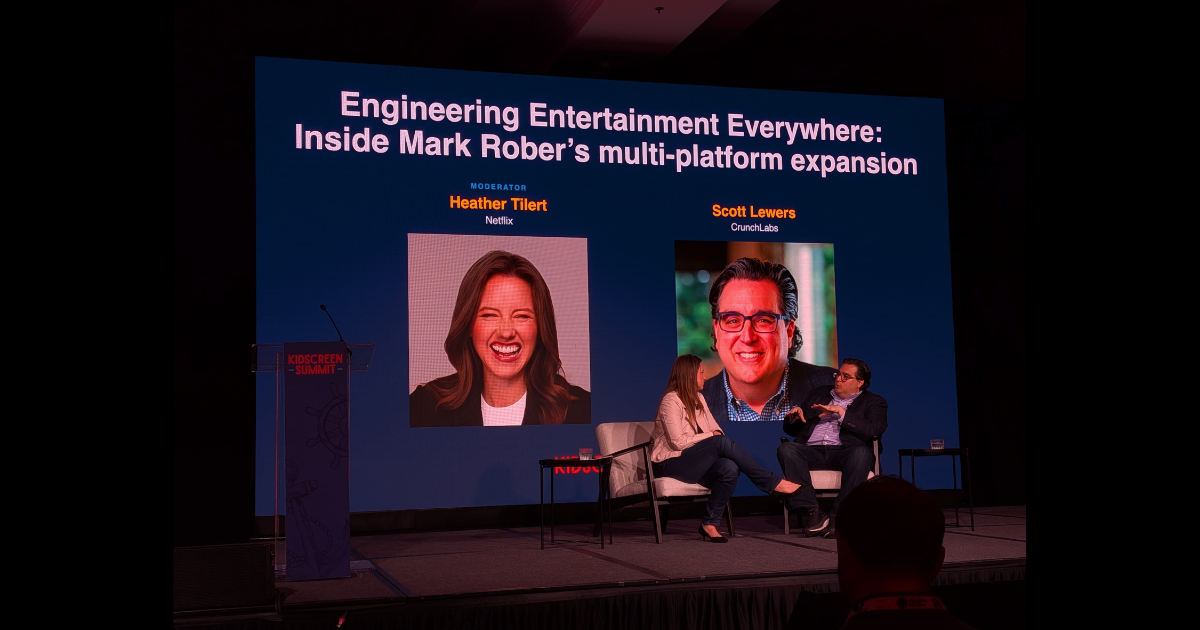
At the Kidscreen Summit San Diego (Feb. 22-25), Lewers outlined the strategy behind Rober’s business and described how it has structured itself to grow beyond any single platform or any single person.
Separating the Brand from the Creator
A foundational decision at Crunch Labs was establishing the company as a standalone brand rather than tying the business directly to Rober’s personal identity.
“He’s an engineer, he’s a realist, so he knows he has a finite number of years on this planet,” Lewers said. “He wants to make those as strong as possible to have a legacy that lives beyond him.”
Lewers described the structural logic plainly. “I love that he created the Crunch Labs brand because that has nothing to do with him. I mean, there’s association, obviously, but one day that will take on its own life.”
The company organizes its operations around what Lewers calls the three E’s: entertainment, experience, and education. “Entertainment content fuels the entire ecosystem, but our experiential and our education pieces are the new ventures,” he said.
Entertainment encompasses YouTube videos, Netflix library drops, and Samsung FAST channel programming. The experience pillar includes three subscription box lines targeting different age groups: Build Box for ages 8 to 12, Hack Pack for ages 14 and up, and Creative Kid for ages 6 to 9, along with an incoming retail line with Moose.
Lewers described Rober’s philosophy for the products: “He is hiding the vegetables, as he likes to say, where he is giving these kids these tools of having a fun build, having fun playing with it, but then taking away what’s the science and the business behind it.”
The education component, ClassCrunch Labs, is a free curriculum with companion video content for late elementary and middle school classrooms, funded personally by Rober. Two units are currently in pilot, with full rollout planned for fall 2026 and a four-year content commitment. “He’s financing [this through his foundation ClassCrunchLabs.org]” Lewers said. “This is a huge commitment to achieve this goal of getting all this content and these different disciplines out there.”
A Low-Frequency Publishing Model
Rober publishes 10 to 11 YouTube videos per year, well below the weekly cadence most creator channels maintain, according to Lewers. He positioned this as a deliberate strategic choice rather than a limitation. “What most YouTubers or creator channels are is a weekly beast. [Mark’s] videos are big.”
Recent productions have included sending a satellite to space, building a goalie robot to compete against Cristiano Ronaldo, and filming an episode at Alcatraz centered on escape methods. “These things are not something you do in six days and shoot on a Sunday,” Lewers said.
Crunch Labs supplements the tentpole releases with a library of more than 100 Shorts. “The short strategy has been a huge lift to the channel,” Lewers said, describing the Shorts as serving algorithmic continuity between major releases while the longer videos drive the broader business.
“If you tell YouTube you shouldn’t start a channel and just do 10 to 11 videos,” Lewers said. “But because of the bar Mark set, because of his audience expecting that bar, we have embraced that [non-traditional] YouTube model of embracing that to be our secret sauce.”
Syndicating Across Platforms
Lewers used the term “syndicating” to describe Crunch Labs’ multi-platform approach. “In the world of creators, syndicating their content and creating these different halos is driving their businesses and their fundamentals,” he said.
Each platform in the Crunch Labs distribution mix serves a distinct function. YouTube operates as the primary publishing home, driven by algorithmic timing and thumbnail performance. Netflix receives libraries of eight to ten episodes drawn from existing YouTube content, with viewers discovering episode one and watching sequentially. “The completion rate is phenomenal,” Lewers said.
When Crunch Labs dropped its first Netflix library, it reached the global top ten on the platform’s adult main page within four to five days. Lewers said the result surprised him. “I knew it would do well, and I knew it would do well with kids, but we did not expect that,” he said. “A library of episodes, of eight episodes from years ago, dropped on Netflix. Four or five-ish days were in the global top ten on the adult main page. I was dumbfounded.”
The audience overlap between YouTube and Netflix proved smaller than anticipated. After the library drop, other creators reached out to Crunch Labs to ask how the team had produced a new show so quickly. “People didn’t realize, because they had not seen some of this content on YouTube, that it was all new to them,” Lewers said.
Samsung’s FAST channel adds a third distribution layer, running Rober’s library as a 24-hour channel. “Samsung is the number one global FAST channel in the world, so we were very excited about having Mark on the TV,” Lewers said. “It’s his library, a 24/7 channel that plays versus a season that drops.”
Lewers described the three platforms as serving meaningfully different consumption behaviors, which he said has kept cannibalization risk low. “I feel like we can have a longevity strategy with Netflix that we know works at this very solid model, whereas YouTube is so at the moment that we can play in both and capitalize on both,” he said.
Speed to Market
Two recent partnerships illustrated how Crunch Labs moves on time-sensitive opportunities.
Lewers pitched a Christmas special to Netflix with “Sesame Workshop” in July. Written in September, shot in October, and published in November, the production brought the full “Sesame” crew to Crunch Labs’ facilities. “That’s where I think the magic of the future lives,” Lewers said. “The best traditional, the best for what’s happening now, we’re mashing it together.”
A second opportunity came when Netflix asked Rober to serve as a live correspondent for Alex Honnold’s free climb of Taipei 101. The request arrived on December 23 for an event in late January. Lewers, drawing on his background in producing live events including Felix Baumgartner’s Stratos jump for Discovery, advocated for accepting. “I think that this is gonna be a moment,” he told Rober. “This is our dream, we’re gonna be a different audience, and your footprint. I think the aftermath is going to be so big that you don’t say no.”
The Case for Legacy Media Professionals
Lewers addressed media executives directly on how to engage with the Creator Economy, offering a specific entry point.
“The number one rule I say to everyone when this question gets asked is you have to become that audience,” he said. He cited his own decision to take up Fortnite as an example of immersing himself in a platform from a consumer perspective.
He also identified a structural opportunity for traditional media professionals. Noting that many creator-led businesses hit an operational breaking point around the ten-year mark, he said the pattern creates demand for experienced partners. “You can see creative-led businesses without a partner hit that breaking point. The history of YouTube, you look at a 10-year marker, they either transcend to the next form, graduate to being another part of the business, or evaporate and disappear because the pressure becomes so much.”
“I think that is going to be a phenomenon that happens now, that people are going to need to extend,” Lewers said, “which is where the option is for traditional legacy media people to find those partners that are looking for that kind of work and that opportunity.”
Subscribe to Our Newsletter
Check Out Our Podcast