






Influencer
How Cass Holland Turned a Beverage Cart Job Into a Multi-Platform Creator Business


The idea arrived between holes. Cassandra “Cass” Holland had started wearing body glitter at the music festivals where she also worked as a beverage cart driver. When she brought the habit back to her regular shift at Chimera Golf Club in Henderson, Nevada, something unexpected happened. The regulars who usually angled for a side hug were keeping their distance. Nobody, it turned out, wanted to go home covered in sparkle.
“I noticed that when I would wear it on the golf course, the golfers who would usually want to get a hug or come a little closer, they were keeping their distance,” she says. “It solved a real problem.”
That observation became Hug Repellant, a body glitter brand built on the premise that the best product ideas sometimes arrive on a beverage cart.
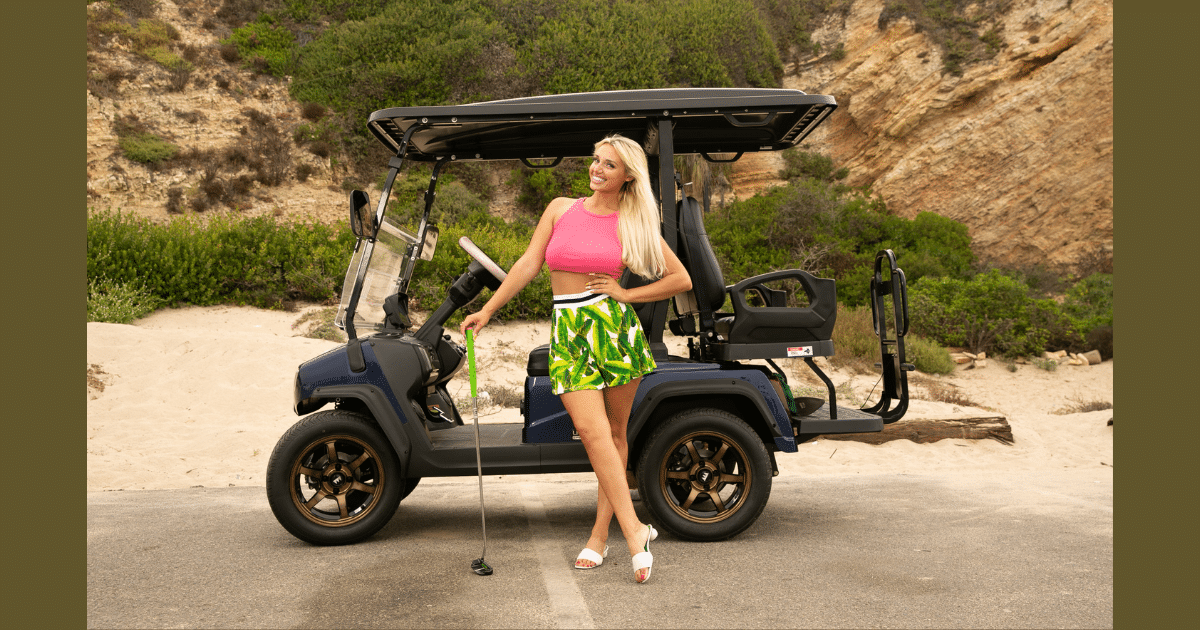
Cass is best known online as the “CartGirl,” and she is, in fact, still a cart girl. Six years into her role at Chimera Golf Club, she parks her personal beverage cart, painted pink and green, in the garage of her house near the course, and drives directly onto the course each morning. She has 2.7 million followers across TikTok, Instagram, and YouTube. She runs “CartGirl Carpool,” a talk show series filmed on the cart itself. She recently launched a product company.
The through line is the cart. Where many creators eventually seek distance from the jobs that first made them interesting, Cass has moved in the opposite direction. The golf beverage cart is her workplace, her production studio, and the recurring setting that makes her content recognizable across platforms.
“People were super interested in the cart girl life and what the golfers were up to behind the gates,” she says. “I started making content about a year into my job there, and it really took off.”

Following the Money South, Then West
Before the content, there was a deliberate migration. Cass grew up in Connecticut and left at 19, spending three years in South Carolina working at a nightclub. It was there she first encountered what would become a career thesis.
“Everyone would talk about golfers; they have the money,” she says. “That’s where the money’s at. They tip really well.”
South Carolina was a place where people settled, and she was not ready to settle. She moved west, following the income opportunity. Vegas delivered service industry work, but not immediately what she wanted. She spent time doing promotional and booth modeling at conventions until COVID eliminated that circuit.
Then the cart girl position at Chimera became available. She took it without fully understanding what it involved. “I didn’t know what I was getting myself into,” she says. “And it worked out.”
The Argument That Launched It
Cass began posting roughly a year into the job, and her first viral video succeeded for a reason she had not planned.
“It was just me kind of talking crap about a guy that wanted to take me golfing and expected more than just golf,” she says. “The comments were somewhere on his side, somewhere on my side. I think that’s what got it to go viral.”
The engagement forced a decision. A single viral video offered short-term traction; committing to the format meant something else. She kept going, expanding into day-in-the-life content, storytimes, and footage of golf culture her audience could not find elsewhere. The format was specific enough to attract a devoted audience and flexible enough to accommodate multiple content types. Eventually, a day-in-the-life video reached 20 million views. “Who would have thought?” she muses.
The Cart as Studio
Managing content across three platforms without a full production team requires clarity about what each platform is actually for. Cass has developed a working approach.
TikTok functions as her most personal channel, “more like the FaceTiming your bestie kind of vibe,” she says. YouTube holds longer, higher-production material, filmed with a videographer friend she met when he was a regular golfer at Chimera. Instagram, she says plainly, “can be hard to navigate. It’s always changing, so you’ve got to be on top of that.”
“CartGirl Carpool,” her YouTube series, emerged from a persistent request in her comment section. Followers kept saying they wished they could ride along for a shift. Her response was direct. “I have my own cart,” she says. “What’s holding us back? Let’s go.” The format brings guests onto the beverage cart for on-camera conversations, currently with other creators and figures from golf culture, although Cass hopes to expand the format to include celebrities.
An upcoming episode will feature her sister, with the conversation shaped around their shared childhood.
When the Cart Is the Filter
Cass has completed roughly 10 brand deals this year across beverages, tech, sports betting, and activewear. The portfolio includes Ocean Spray, Ray-Ban Meta, and DraftKings, and each reflects a specific logic.
DraftKings fits because sports betting is routine in Las Vegas. “We’re already betting on sports every day here,” she says. Ray-Ban Meta glasses allow her to make calls hands-free while managing the cart. “I’m constantly working with my hands, and sometimes I need to get a hold of a golfer,” she says. Ocean Spray, a drinks brand, integrates directly into a cart built around beverages. “It couldn’t have flowed more easily into my content,” she says. “It was so perfect.”
She has also turned a deal down and watched one fall apart, and both confirmed the same principle. This year, she declined a partnership with an energy drink brand despite liking the product category because the creator behind it had made choices she disagreed with. “I would have felt like I was letting down my audience if I agreed to do that,” she says. An earlier activewear deal ended when her audience flagged that the brand, which skewed more tomboy than her pink-forward aesthetic, did not fit. The brand stopped working with her. “That’s why it has to align with you,” she says. “It has to be true to you.”
When brands have tried to steer her content toward something more polished or advertisement-ready, she pushes back. “I usually can talk my way out of it,” she says. “I’m like, no, listen, this is what works. That’s great that you’ve tried that in the past, but maybe it’s time to try something different and listen to somebody else who knows what they’re doing.”
Glitter as Workplace Policy
Building Hug Repellant took about a year. Cass describes herself as not naturally decisive, which created friction during design decisions around the bottle and formulation. She credits the owner of Chimera, a mentor she describes as “basically like my second dad out here,” for guiding her through both the development process and the business decisions behind it.

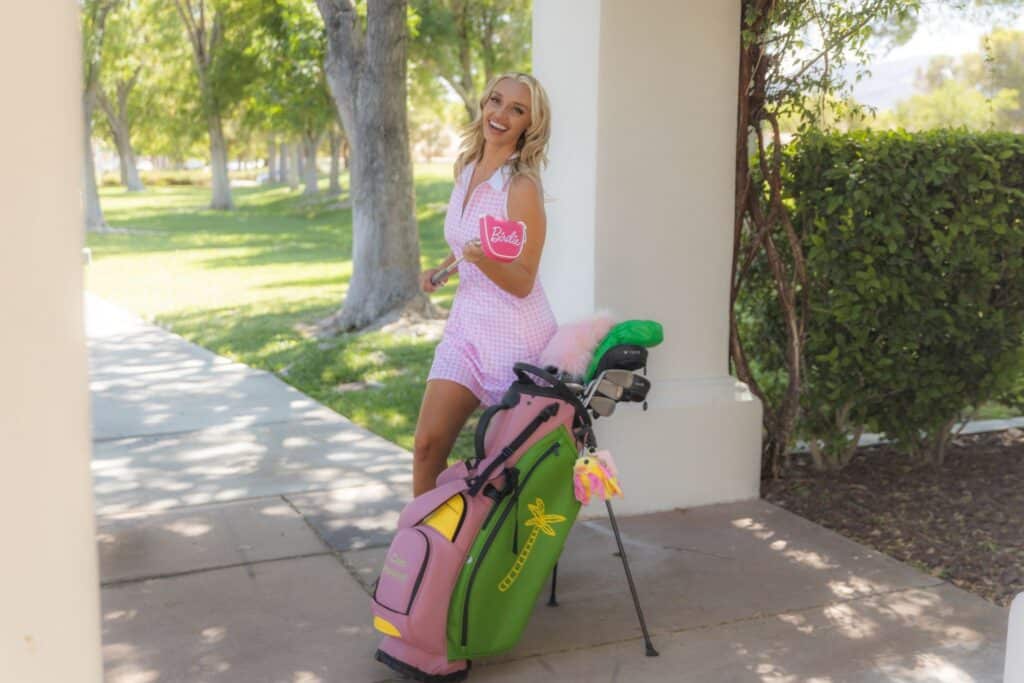
The launch included a seeding campaign: custom golf bags in pink, green, and yellow, packed with a putter, golf balls, and Hug Repellant, sent to 25 influencers in her network. Several produced content around the packages. For Cass, the exercise offered a new vantage point on a business she had been navigating as talent for years. “I had a lot of knowledge from receiving,” she says. “I was like, okay, what would I want to receive? What would I not want to just put in the give-to-a-friend pile?”
She has since seen those posts convert to sales, which she says confirmed something she had believed but not yet tested at this scale. “People trust my opinion,” she says. “I am influential.”
Still Driving, Still Building
In the medium term, Cass expects the CartGirl brand to extend in two directions. A reality show set at the golf course is in development. A golf course of her own is a longer-term ambition, and the vision for it is specific: open to the public rather than private, and designed to make women feel genuinely welcome. “I want females to feel really comfortable there,” she says. “We’re not going to tolerate any nonsense.”
Her path from Connecticut to South Carolina bar work to Vegas convention modeling to a cart girl role she barely understood has been less a planned strategy than a series of decisions made in motion, each one building on whatever situation she was already in. The content worked because she refused to treat the cart as a temporary stop. The product worked because she paid attention to what happened on the cart every day.
For creators at the start of a similar process, she offers a starting point that mirrors her own. “Just set up your phone and hit record,” she says. “That’s all it takes.”
Photo credit: Peter Hyun
Subscribe to Our Newsletter
Check Out Our Podcast