






Technology
Deji Oduwole Built Oya Around the Operational Work That Starts After Brands Choose Creators

Creator marketing software has gotten good at helping brands find creators. The harder problem begins after a brand decides to work with one.
That was the gap Deji Oduwole kept seeing while running influencer programs as chief marketing officer at Windmill. In many cases, Ramp handled payments, and an Excel spreadsheet helped fill in the gaps. For individual partnerships, the system worked. At scale, handoffs became the problem.
In August 2026, Deji launched Oya in Houston to put the operational work of a creator relationship into one system, from the initial offer through content review, payment, and rebooking. The platform is aimed at the growing mid-market program that has outgrown spreadsheets but does not need the complexity of enterprise software.
Deji came to that problem with an operator’s perspective. During 11 years at Procter & Gamble, he moved through engineering, production operations, and brand management before earning an MBA from Duke’s Fuqua School of Business. “When you remove it and put up the primitives,” he says of the comparison between supply chains and marketing systems, “you realize that marketing business is very similar,” adding that “it’s just the core objective changes and the variables change.”
For Deji, the issue is not finding creators. It is managing everything that happens once a brand chooses one. “The harder thing, because of the pace at which creator marketing is growing, is what happens after the creator actually says yes,” he says. “You have to do that a hundred times over for just one campaign.”
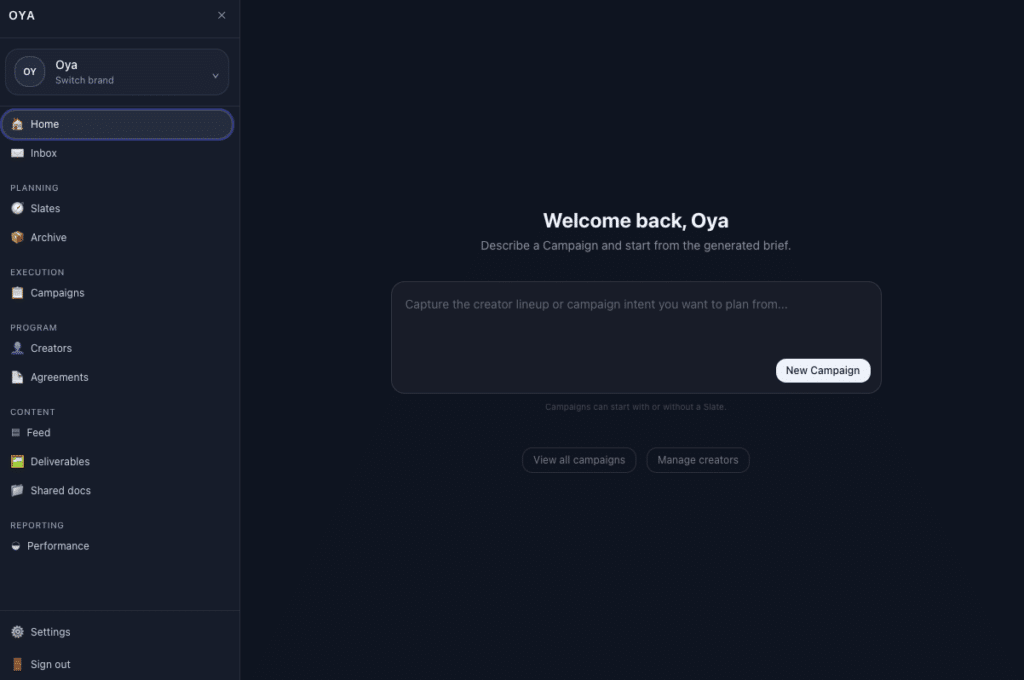
Oya Is Built to Handle Every Handoff Between Offer and Payment
Once a brand decides to work with a creator, the sequence of handoffs begins: an offer goes out, a brief follows, content gets submitted for review, revisions may be needed, the finished post needs to be confirmed, and payment needs to be processed. Do that across a hundred creators at once and the breakdown points multiply. “Balls get dropped, people forget to get access from somebody, people don’t get paid on time,” Deji says. “And there is animosity on both the brand end and the creator end.”
Oya is structured around that sequence. Operators prompt the platform to generate a campaign brief, upload a creator list, and send offers directly from the interface. Content submission and review happen inside Oya, with frame-by-frame feedback that Deji compares to Frame.io, functionality he says is absent from “a lot of platforms today.” Once a creator posts, Oya monitors brand mentions across social feeds and auto-assigns the content to the originating campaign, removing the need to manually confirm deliverables. Payment is processed in one click, without a separate tool.
For operators currently routing payments and campaign data across separate platforms, Deji says the reaction to a demo follows a consistent pattern. “When operators see that, they go, ‘Huh, wow, this makes sense.'”
The Case Against the Five-Tool Stack
If he could force every brand to abandon one tool, Deji’s choice is Excel. The problem is not the software itself but what happens when it becomes the operational record of a creator program. “Your program just becomes as good as your most up-to-date spreadsheet,” he says, and only as reliable as the operator who last updated it.
The typical current stack he describes includes a discovery platform, Airtable automations through Zapier, a social listening service, a payment tool, and Excel underneath. Each adds a maintenance obligation and an integration point. “You have to patch all of these things together to have a program,” Deji says, “versus just starting out of the box without having to create open tabs in your brain for different tools.”
Oya’s design is built against that model. Brief generation is prompt-based: operators describe the campaign, and the platform generates the brief, with creator uploads and offer sending following immediately. The platform is designed to be usable within five minutes, without implementation overhead. Deji’s stated benchmark was simple enough that “a high schooler and my grandma could use it.”
Aggregating Performance Across a Creator Program
The attribution problem of connecting a creator post to a downstream purchase has followed creator marketing for years. Deji focuses on what he describes as the prior problem: most brands running large programs cannot easily answer the simpler question of how many total impressions their content is generating.
“I work with a hundred creators, and then they post things all over the place,” he says. “I can sum together what total impressions are? We change that right now.”
Oya measures estimated media value for each piece of content and aggregates impressions at the campaign level, with content auto-assigned to the campaign that generated it. From there, Deji argues, brands can run the lift analysis he used at Windmill. “When you do a lot of influencer marketing as a D2C brand, you start to see a lot of sales on D2C, on Amazon, and other channels as well,” he says. Comparing those sales trends against impression volume gives a working media mix model. The starting point, he says, is simply knowing what you have.
Oya Organizes Around the Creator Relationship, Not the Campaign
Deji argues that many influencer platforms are built around the campaign as the primary unit. A brand creates one, populates it with creators, runs it, and closes it. The next campaign restarts the process. Creator history from previous work doesn’t carry forward in a form the operator can act on.
Oya’s organizing principle is the relationship. A creator’s performance data, prior deliverables, and communication history stay attached to the brand’s account across campaigns. When a brand wants to rebook a top performer, the context is already there. “You’re not starting from scratch,” Deji says. “You have all the historical context on that relationship, and you can start from where you left off.”
He highlights rebooking as one of the platform’s key differentiators. Oya surfaces creator performance rankings and makes rebooking a direct action rather than something an operator reconstructs from a separate file. “Creators are more than placements,” Deji says. “They are partners.”
Oya Has the Relationship Right. The Rest Is Still Being Built.
Oya is still very new. Discovery is described as coming in the near term. Live event management and affiliate integration are on the roadmap. What the platform covers now is the operational core: brief generation, content review, post-monitoring, payment, and rebooking in one interface.
Deji’s longer-term vision is that the creator relationship, with its history preserved across campaigns rather than reset when each one ends, becomes the organizing unit of every brand’s influencer program. He is direct that this requires brands to arrive with product fundamentals in place: creator marketing, in his view, cannot substitute for fit between a product and its market.
“The brand knows who their top creators are, and the creators know who their top brands are,” he says. “I hope Oya works and we’re able to help brands and creators deepen their partnerships and grow them.”
Subscribe to Our Newsletter
Check Out Our Podcast