







Technology
Creator Content Is Becoming Input for AI Shopping. Artan AI Is Building the Measurement

If AI shopping assistants are citing a brand’s creator content to answer purchase queries, how many brands are actually measuring it?
Most brands are not, according to Andri Sadlak, who founded Artan AI in July 2026 after building e-commerce brands and advising Fortune 500 CPGs. The agentic commerce company tracks and improves how consumer packaged goods (CPG) brands appear in recommendations from AI shopping assistants, including Alexa for Shopping, Walmart Sparky, ChatGPT, Perplexity, and Gemini. Its software and services are designed for Amazon-first CPG brands generating eight figures or more annually, covering AI visibility across both marketplace assistants and large language models.
The observation behind the company came from Andri’s work at a consumer brands group, where he led growth strategy and launched Amazon Creator Connections programs across its brand portfolio. Those campaigns generated, by his account, more than $5 million in annual incremental revenue for Grace & Stella, a beauty and personal care brand, through clean attribution data. They were also producing a return he hadn’t accounted for.
“About a year ago when we spoke, I thought about creator content mainly as the way to generate attention and trust and attribute Amazon sales,” Andri says. “What changed is that I discovered creator content now has a second audience, so it’s the AI systems helping shoppers decide what to buy.”
The Citation Data That Prompted the Company
The shift in Andri’s thinking came from proprietary data Artan AI collects on what AI systems actually draw from when making product recommendations. Across marketplace shopping assistants and large language models, his company tracks citation sources, the third-party content that AI engines use to construct answers to purchase intent questions.
For one client, Artan’s combined data from the six major AI platforms placed YouTube third among domains by citation count. “Once we discovered that, we built those insights into how we select creators and brief content to improve AI visibility,” Andri says. “We realized that AI systems were citing YouTube content when making shopping recommendations.”
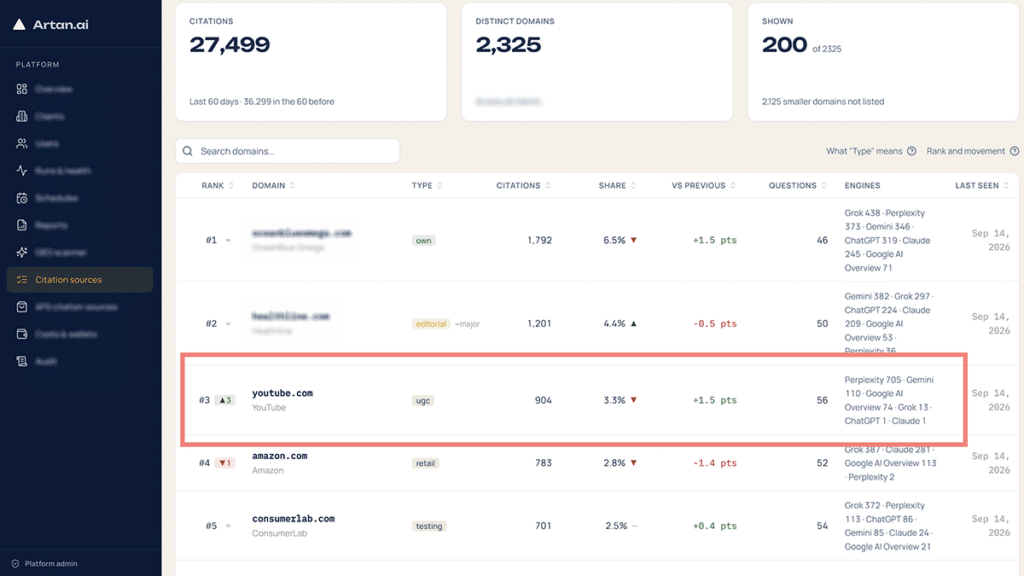
Artan AI Citation Sources: YouTube ranked third among cited domains for a tracked supplement brand, with 904 citations across six AI platforms and 56 question groups over 60 days. Results varied by platform.
That finding reframed how he understood what creator programs produce. The same YouTube comparison that drove affiliate revenue was, when structured well, also functioning as source material for AI recommendation engines, sometimes well after publication. The brand was paying for the click but also funding the citation, without tracking either purpose separately.
The Measurement That Wasn’t There Before
Artan AI’s core product benchmarks what Andri calls “AI Share of Voice,” the metric behind what the industry calls generative engine optimization (GEO): essentially, how frequently a brand appears in AI responses to purchase-intent queries compared to its competitors. His company combines Amazon sales data, search trends, social listening, and related searches generated by AI to identify priority buying topics. It tests different question phrasings and tracks the brand’s share of AI recommendations for each topic over time to assess changes after content updates.
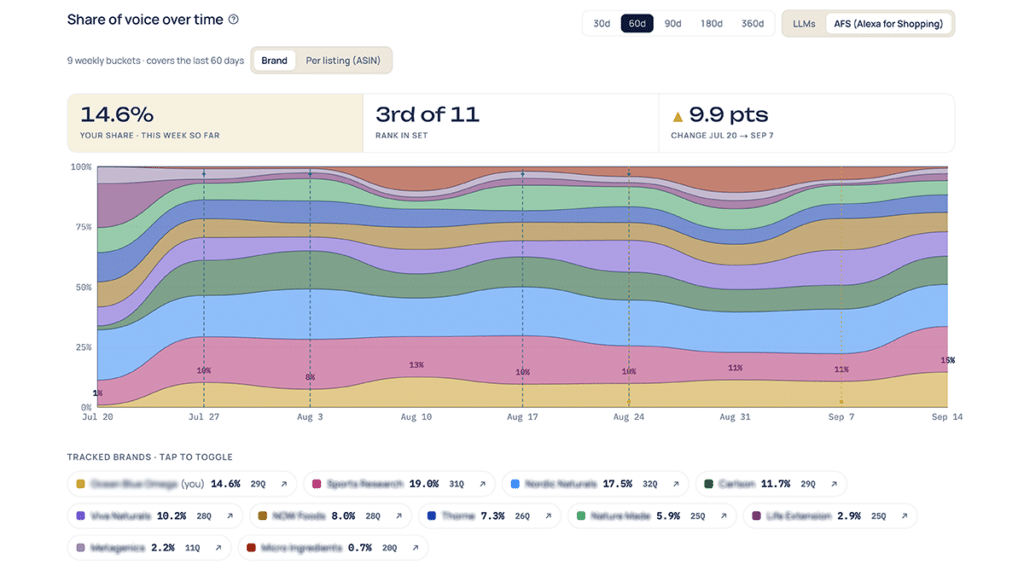
Artan AI Share of Voice Over Time: A supplement brand’s overall share of product recommendations in sampled Alexa for Shopping answers rose from 0.9% to 14.6% over 60 days, compared with 10 competitors. The tracked brand appears in yellow. The AI platforms are tracked separately.
“We ask multiple different questions in myriad different ways to address the same topic,” he explains. “Regardless of the way we ask, do we show up? Do we show up more often than before or less often than before?” The system tracks shifts in that share alongside content changes, creator campaigns, listing updates, and media placements.
Andri is careful about attributing causation. “It’s realistically always an experiment because things change, algorithms change,” he says. “Content freshness also matters a lot, especially for questions that depend on up-to-date information,” he adds.
Followers Measure Distribution, Not Duration
The two-audience model produces a different creator selection framework. Andri no longer treats follower count as the primary signal when evaluating which creators to include in CPG brand campaigns.
“Follower count still matters to AI, but it measures potential distribution. It does not necessarily measure durable influence over time,” he says. He explains that a creator with a large following who posts an Instagram Story reaches an audience for 24 hours. A smaller category specialist who publishes a structured YouTube comparison may surface in search, and AI answers for months.
Andri now prioritizes whether a creator’s content already ranks in Google or YouTube search, whether they can publish on both Amazon and YouTube, and whether they have category expertise sufficient to answer specific buying questions in detail. Comparison content covering dosages, certifications, or product format tradeoffs can give AI systems concrete information to draw on when answering shopping questions. “The main question is how much credible, discoverable influence can this creator create over time,” he says, “not just once.”
Andri also points to a recent development: YouTube has introduced direct Amazon product tagging for eligible U.S. creators across long-form videos, Shorts, and live streams. In his view, this integration gives Amazon-first brands a more direct path from searchable creator content to purchases on Amazon.
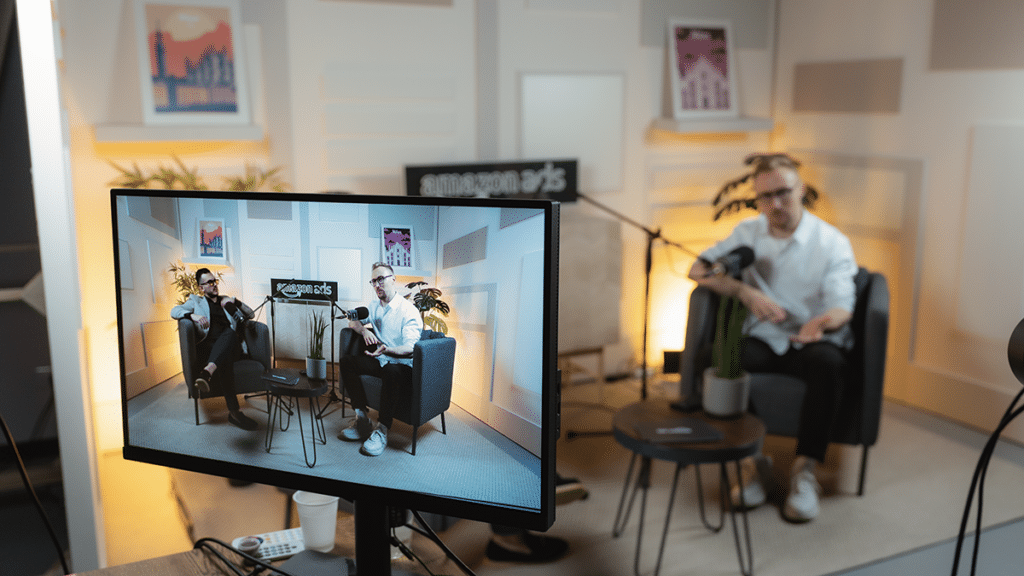
Photo: Andri Sadlak discusses brand ambassador strategies on the Amazon Ads podcast at the Amazon Educator Summit in Milan, 2025
AI Recommendations Pull From More Than Creator Content
Artan AI’s approach treats AI recommendation share as a content infrastructure problem, not just an influencer sourcing problem. For supplements, for example, Andri points to inputs such as product certifications and third-party testing documentation, comparison content from independent review sites, high-authority media coverage that addresses category problems, and community discussions on platforms like Reddit and Quora.
Listing consistency across channels plays a role most brands underestimate. “A lot of brands have inconsistencies across different marketplaces and retailers, and that confuses AI,” Andri says. When Amazon, a brand’s direct-to-consumer (DTC) website, and its retailers disagree about the same product, AI can repeat the wrong information when a shopper is deciding what to buy.
Andri describes Artan’s service as one that maps where a brand appears and does not appear in AI responses to relevant purchase questions, identifies which content categories are missing or underrepresented, and builds a program of creator, media, and listing changes to address those gaps across Amazon, Walmart, and the major LLMs. “All of a sudden, all the sources that matter to AI start talking about you in the right light,” he says.
Optimizing for Machines Does Not Require Abandoning the Human Element
The most common objection Andri hears to structuring creator content for AI discoverability is that optimization erodes the credibility that made creator content work in the first place. “The content still has to be authentic and real and honest and persuasive. It has to be human. And that’s why AI engines trust creator content as one of the signals,” he says.
What Artan’s approach adds is structural briefing rather than scripted conclusions. The company mines the suggested questions Alexa for Shopping displays across hundreds of competitor listings, backed by Amazon’s own search reports, to rank the buying questions shoppers ask most in a category, and shares that list with creators as research input. A video titled “Which Dog Food Toppers Have the Fewest Fillers? I Checked 6 Labels” addresses a specific purchase-intent query that AI systems are structured to answer. A video titled “My Thoughts on This Dog Food Topper” addresses no specific query.
Andri draws a clear line between brand input and creator output. The brand supplies research and question context. The creator reaches the conclusion. That separation, he argues, is what preserves credibility for both the human audience and the AI systems that eventually cite the content. “It’s a win for all three sides,” Andri says. “The creator gets found by answering what shoppers actually ask, the brand gets sales and a source AI can cite, and the AI gets a more reliable reference to recommend from.”
The Playbook Is Changing, in Real Time
Andri expects the relationship between creator programs and AI recommendation to become more systematized as both sides of the market build infrastructure for it. He describes a future in which AI agents on both sides do the matching: the creator’s agent knows which purchase questions that creator can credibly answer, the brand’s agent knows which questions it is losing in AI answers, and the platform pairs them by question rather than by follower count.
“It’s going to be much more productized,” he says. In his projection, creator-brand matching eventually operates with the specificity of programmatic advertising, driven not by audience size but by which questions a creator’s content can credibly address. He adds that the end result should be better purchase outcomes for consumers, with return rates declining as shoppers get more substantive answers to their questions before buying.
The present moment, he argues, favors brands that begin measuring AI recommendation share before competitors recognize the metric exists.
“People are no longer typing two words to find a product,” Andri says. “They’re asking their assistant very comprehensive prompts explaining their situation and figuring out what the best solution is in their specific case. And increasingly, that assistant doesn’t just answer; it can compare, build the cart, and, with permission, buy. And with that big shift, the whole playbook is changing.”
Subscribe to Our Newsletter
Check Out Our Podcast