


Agency
Why Creators Agency’s Apple Crider Thinks Creators Need Operators, Not Just Brand Deals

Apple Crider launched Creators Agency after watching his friends, talented YouTubers and educators, struggle to turn their growing influence into fair, sustainable income. They were signing confusing contracts, leaving money on the table, and missing out on the long-term value their audiences had helped them build. Apple didn’t see a gap in the market so much as a gap in protection, and decided to build an agency to close it.
“I saw too many creators being taken advantage of,” he says. “They were signing predatory contracts, getting underpaid, and missing out on the long-term value they had worked hard to build.”
Four years later, Creators Agency has facilitated more than 3,500 brand deals, paying out over $50 million to creators in the finance and business niche, according to Apple. The company’s mission is to help creators earn a collective $1 billion through performance-driven partnerships that deliver measurable ROI (Return on Investment) for brands and long-term stability for creators.
“I’m a finance nerd,” Apple admits. “I’ve been obsessed with money since I was fourteen. While my friends were out partying, I was figuring out what a Roth IRA was and how to invest.” That early fascination shaped not only his own YouTube channel, but also the creator-first ethos behind the agency he now leads.
Before he launched Creators Agency, Apple was a content creator himself. He has posted more than 1,000 YouTube videos, hosted a Top 100 business podcast, and even licensed his content to a blockbuster film. But, as his own career developed, he noticed a troubling pattern among peers in the finance creator community.
“I started out just helping some of my friends who were better at making YouTube videos than me,” he recalls. “I saw a huge opportunity and said, ‘You guys should be doing sponsors.’” Seven years ago, few financial brands were investing in influencer marketing, especially on YouTube. Apple became the bridge between two industries that barely spoke the same language.
One of his earliest pitches paid off almost instantly. “It took only a few weeks, and I had my first offer on the table for one of my friends. It was for something like $80,000,” he says. “I was shocked. I went back and said, ‘I’ve got this money,’ and they said, ‘That’s more than I thought you were going to come back with.’”
That first deal turned into a domino effect. “Those friends started telling their friends,” Apple says. “It went from three creators to 13 to 30. And at a certain point, I said, ‘This is more than a one-person job.’” Within two years, he partnered with co-founders and officially launched Creators Agency in 2021, with its headquarters in Austin, Texas.
An Agency for Financial Educators
Rather than chasing purely entertainment or lifestyle verticals, Creators Agency specializes in finance and business creators, a category with unique responsibilities and risks. “There are people on the Internet creating videos that empower others to use money as a tool to live a rich life,” Apple explains. “We help those creators reach more people. That’s what we do in a nutshell.”
The agency’s performance-driven model focuses on connecting financial educators with brands that align with their values and content. “Early on, I realized it’s not worth a quick payday if it sacrifices your reputation,” he says. “Brand safety is the number one most important thing.”
That philosophy has guided the agency’s growth, as well as its restraint. “Over the past year, we’ve probably only brought on three new creators,” Apple notes. “We have a really solid roster of very big creators who are only getting bigger.”
He notes how this selective approach allows his team to dig deeper into pricing, brand fit, and long-term growth. “A lot of creators are undercharging,” he says. “The highest-leverage thing you can do as a creator is price yourself appropriately. We’ve done about 4,000 sponsorships, so we have a ton of data points on what different creators charge and what ROI those brands actually got.”
For Apple, data is only one side of the equation. The other is human understanding. “Being an agency isn’t just about selling brands,” he explains. “It’s about selling creators, too. Sometimes in your head, you think, ‘This brand and creator make perfect sense,’ but the creator says no. You have to slow down and explain your thought process. Once they see the full picture, it clicks.”
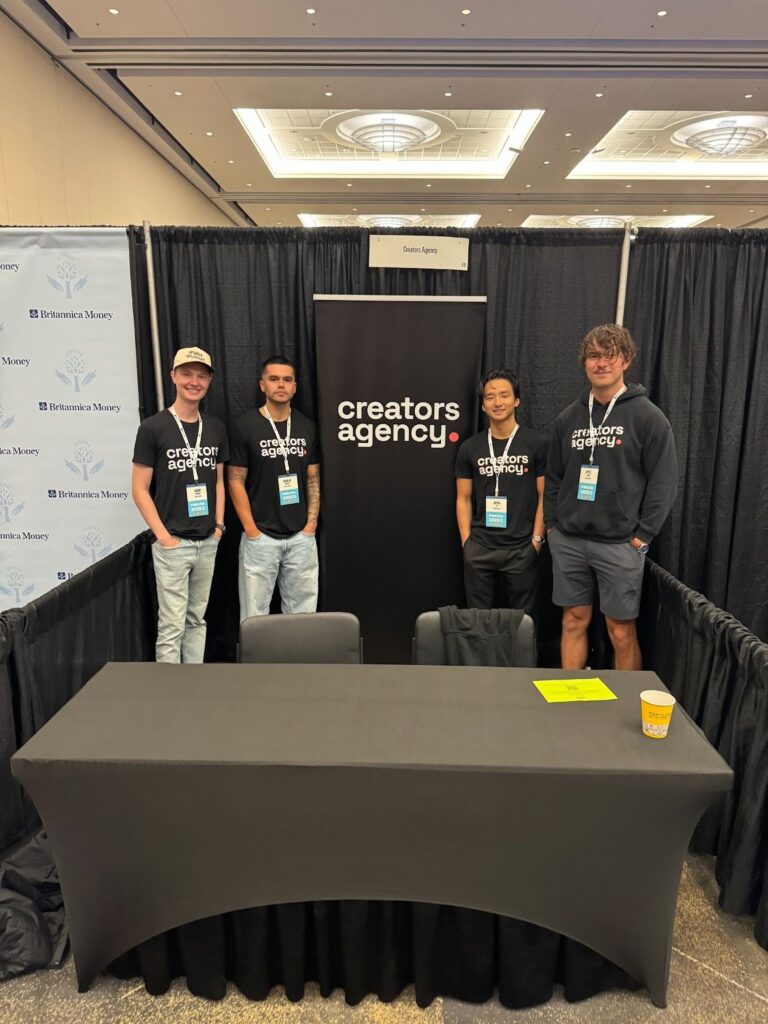
Creators Agency at FinCon
Helping Creators Become Operators
As Creators Agency grew, Apple began noticing a recurring pattern among even his most successful clients: they were creating exceptional content, but struggling to operate efficiently behind the scenes.
“A lot of creators think they can do it all,” he says. “At the beginning, doing everything yourself is an advantage. But when you try to grow and keep that same mentality, that’s where things break down.”
His solution? Building tools and systems to help creators manage their businesses with the same precision as startups. “For some of our creators, we are that operator,” he says. “We’ve been building technology from scratch to make their lives easier; systems that clean up the operational chaos so they can focus on making content.”
Instead of relying solely on spreadsheets and email chains, Apple’s team is developing proprietary software designed to simplify campaign tracking, payments, and performance metrics. “We brought on developers and started building tech to make it easy for creators to make more money,” he explains. “They’re being pulled in so many directions. If we can remove friction, they can focus on what they do best.”
Apple also applies his own disciplined mindset to productivity. “I track every hour of my day religiously,” he says. “It’s very honest. It shows where your time really goes, and then you can build solutions to stop doing the same thing manually every week.”
Creator or Creator Entrepreneur?
As the creator economy matures, Apple believes sense of purpose is essential. “The first thing creators need is clarity on what they want,” he says. “You can be a creator, or you can be a creator entrepreneur. They’re two very different paths.”
He defines the distinction succinctly: “A creator makes videos, and most of their income comes from those videos plus one or two small revenue streams. A creator entrepreneur makes videos, but those videos are a marketing engine for other businesses: apps, courses, memberships, or services.”
He points to finance YouTuber Caleb Hammer as a prime example of the latter. “Caleb’s content drives people to his membership program, his budgeting app, his courses; he’s built a team of thirty around it. That’s very different from someone like Graham Stephan, who makes most of his money from the videos themselves.”
The danger, Apple warns, is trying to do both. “When creators try to go down the creator path and hire a bunch of people, it doesn’t work. And when they try to go down the entrepreneur path without hiring, the content gets neglected. You have to decide which one you want to be.”
Rethinking How Brands Work With Creators
On the brand side, Apple sees a mix of promise and misunderstanding. “A lot of brands new to influencer marketing don’t understand that testing is required,” he says. “Your first campaign isn’t going to be your best one. You have to figure out what works, just like with Facebook ads. You test, then scale.”
He often reframes the first campaign as an experiment rather than a transaction. “You’re not just putting money in and getting money out,” he says. “You’re putting money in and getting learning out. Once you figure out what messaging and platforms work, then you can start putting one dollar in and getting two dollars out.”
What the smartest brands do, he adds, is think long-term. “A one-off video doesn’t help anyone. The creator gets some money, but they withdraw from their audience’s trust. The brand probably doesn’t see results. And the agency wastes time that could have gone into building a real relationship.”
Therefore, Apple ensures that at Creators Agency, every deal is designed with longevity in mind. “Before we sign any contract, we ask, ‘What implications does this have for the long term? How do we set everyone up for success a year from now, not just today?’”
Predictions for Creator Agencies
Apple believes the next phase of the industry will be defined by technology and trust, not automation alone.
“Agencies will always be relevant for large creators,” he says. “But for smaller creators, there’s going to be new tech that makes it easier to get value. The thing that’s never going away is the human touch. This industry is built on relationships.”
He adds, “Anyone could send one of our creators the same offer. But if it comes from a trusted person, it gets across the line. That human-to-human connection is what drives everything.”
As for Apple’s path, the focus is scale. “Our big priority is figuring out how to go from the 80 creators we work with now to 800,” he says. “How do we scale without becoming commoditized? How do we make sure people know why we’re different?”
The question that fuels him, though, isn’t about headcount … it’s about impact. “It’s only getting bigger,” he says of the creator economy. “Trust is becoming more important, and it’s only becoming more obvious who’s in it for the right reasons and who’s just trying to make a quick buck.”
Checkout Our Latest Podcast