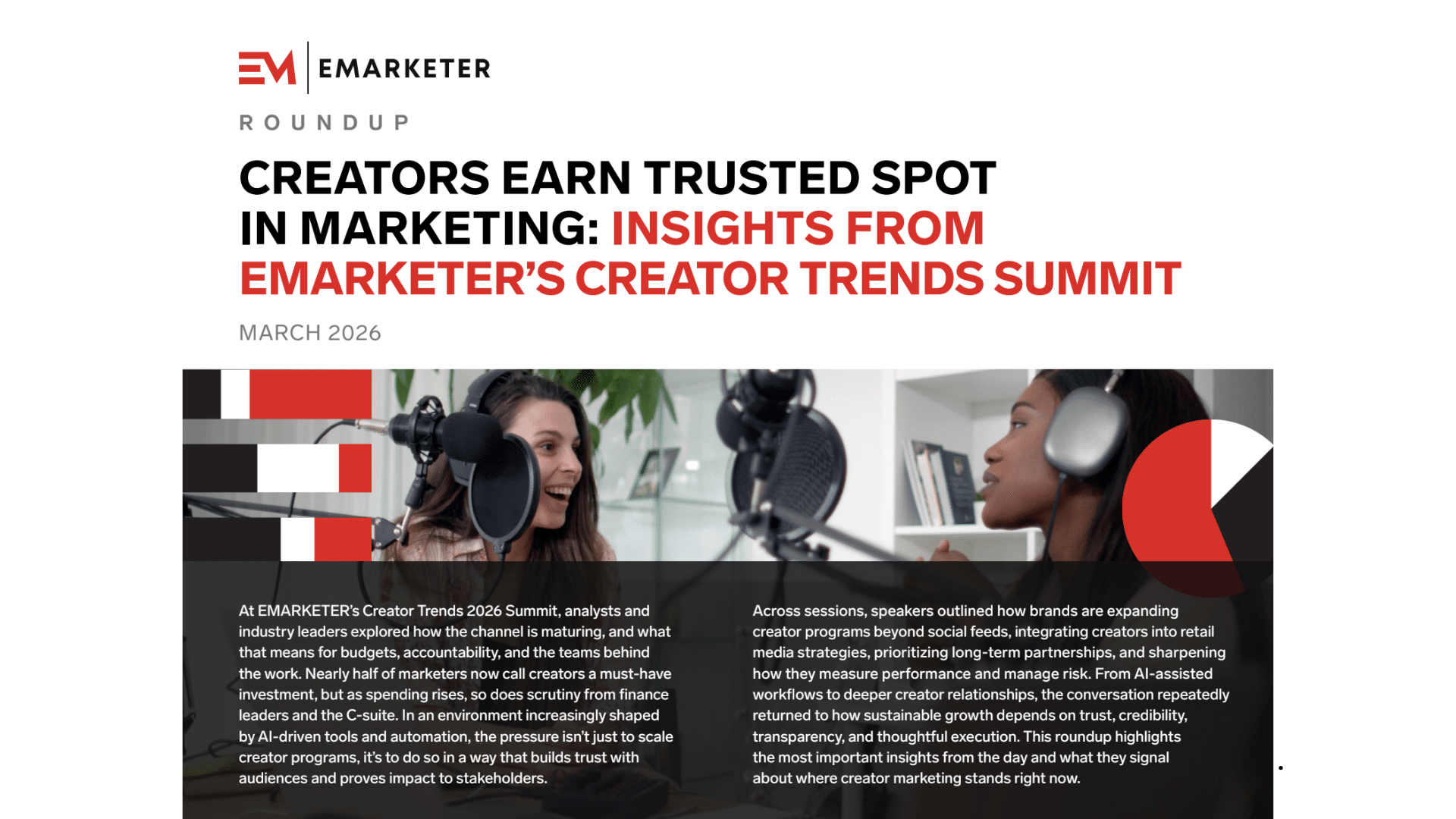
U.S. social media creator revenue will reach $21.10 billion in 2026, more than doubling since 2022, according to EMARKETER’s February 2026 forecast. The figures emerged from the research firm’s Creator Trends 2026 Summit, where analysts and brand executives outlined how creator marketing has expanded from social-first campaigns into retail media networks, connected TV, and in-store environments.
“Creators have really graduated from being a bright, shiny object in the eyes of many CMOs several years ago to really becoming a critical plank in most marketing strategies today,” said Max Willens, Principal Analyst at EMARKETER.
The channel’s growth has coincided with a structural shift in how brands allocate their spending. Nano and micro-influencers now account for nearly half of U.S. creator spend, at 49.9%, up from less than a fifth a few years ago, according to EMARKETER data presented at the summit. Willens attributed the shift to brands prioritizing audience alignment over raw reach.
“The industry has moved away from the legacy digital thinking of hunting for cheap reach,” Willens said, adding that marketers now focus on selecting creators who match a specific aesthetic, carry an authentic affinity with a brand, or reach a defined target audience.
Q4 2025 data from the IAB found 48% of marketers consider creators a must-have investment.
Content Repurposing Extends Creator Value Across Channels
Brands are applying creator content beyond its original platform context. According to CreatorIQ data cited at the summit, 58% of enterprise brands reuse creator content on their websites, while 55% repurpose it for paid social or digital advertising, and 53% use it for organic social. Brands are also deploying creator content across email, events, TV, and print.
Gap Inc. Head of Influence Cory Weaver described a model that moves creator content through the full purchase funnel. “The utility of creator content means we are absolutely weaving it into our PDPs,” Weaver said, referring to product display pages. “We’re seeing wonderful success there.”
Gap launched a cross-brand creator affiliate and advocacy program in October 2025 that spans its portfolio of stores, including Gap, Old Navy, Athleta, and Banana Republic.
Retail Media Networks Integrate Creator Inventory
Retail media networks are adding creator content to their offerings as growth from on-site advertising and trade budgets plateaus. EMARKETER VP and Principal Analyst Sarah Marzano said retailers are looking toward brand and national budgets as a new revenue source, with creators serving as a pathway to those dollars.
“They’re effectively positioning themselves as middlemen who want to insert themselves in between the social platform and the advertiser,” Marzano said of retail media networks pursuing this strategy.
Best Buy integrated creator-generated content into connected TV placements for the first time during the 2025 holiday season. Allison O’Keefe, Senior Manager of Influencer and Creator Marketing at Best Buy, said the influencer-led creative performed on par with traditional CTV assets. Marzano noted that more than 80% of retail dollars are still spent in physical stores, raising the strategic value of creator programs that can be measured against in-store transaction data.
U.S. livestreaming retail ecommerce sales are projected to rise 35% to $19.76 billion in 2026, per a separate EMARKETER forecast. TikTok Shop is forecast to reach $23.41 billion in U.S. ecommerce sales in 2026, a 48% year-over-year increase.
AI Adoption Grows, With Calls for Caution
Nearly three-quarters of marketers (74%) are using AI for Influencer Marketing in some capacity, according to July 2025 data from Linquia. Creative ideation is the leading use case at 78.4%, followed by writing influencer briefs at 68.9%, streamlining workflows at 63.5%, and finding creators at 45.9%. An additional 69% of marketers support automating Influencer Marketing, according to data from CreatorIQ.
Willens cautioned against moving too quickly. “It’s going to be really essential that marketers tread really lightly as they figure out the relationship between AI and creators,” he said.
Measurement Becomes Central to Program Justification
As creator budgets grow, finance teams and C-suite executives are applying greater scrutiny to the channel.
Nicholas Spiro, Chief Commercial Officer at Viral Nation, said brands need to establish measurement frameworks before scaling programs. “We try to focus on measurement first, meaning you want to start with what your goals are and you want to make sure you understand not just your actual KPIs, but how you think about measuring them,” he said.
Spiro added that brands should treat social media as a source of intelligence rather than purely a distribution channel. “Historically, social media was the amplifier of a brand voice,” he said. “The shift is from output to input.”
Platform Performance Data Shows Facebook and YouTube Gains
Analysis from Metricool, based on more than one million accounts across 10 social platforms and over 39 million posts, found Facebook’s average reach grew 51% year over year in 2025, with impressions up 57% and interactions up 56%. On LinkedIn, carousels and polls drove impressions up more than 158% year over year and generated 247% more interactions than the average post. YouTube views rose 76% year over year as the platform expanded its role across both short- and long-form content formats.
Image source: EMARKETER The full report is available here
Jonathan is a South African content creator, photographer and videographer with 25 years of experience in journalism and print media design. He is interested in new developments in AI content creation and covers a broad spectrum of topics within the creator economy.














U.S. social media creator revenue will reach $21.10 billion in 2026, more than doubling since 2022, according to EMARKETER’s February 2026 forecast. The figures emerged from the research firm’s Creator Trends 2026 Summit, where analysts and brand executives outlined how creator marketing has expanded from social-first campaigns into retail media networks, connected TV, and in-store environments.
“Creators have really graduated from being a bright, shiny object in the eyes of many CMOs several years ago to really becoming a critical plank in most marketing strategies today,” said Max Willens, Principal Analyst at EMARKETER.
Budget Concentration Shifts Toward Smaller Creators
The channel’s growth has coincided with a structural shift in how brands allocate their spending. Nano and micro-influencers now account for nearly half of U.S. creator spend, at 49.9%, up from less than a fifth a few years ago, according to EMARKETER data presented at the summit. Willens attributed the shift to brands prioritizing audience alignment over raw reach.
“The industry has moved away from the legacy digital thinking of hunting for cheap reach,” Willens said, adding that marketers now focus on selecting creators who match a specific aesthetic, carry an authentic affinity with a brand, or reach a defined target audience.
Q4 2025 data from the IAB found 48% of marketers consider creators a must-have investment.
Content Repurposing Extends Creator Value Across Channels
Brands are applying creator content beyond its original platform context. According to CreatorIQ data cited at the summit, 58% of enterprise brands reuse creator content on their websites, while 55% repurpose it for paid social or digital advertising, and 53% use it for organic social. Brands are also deploying creator content across email, events, TV, and print.
Gap Inc. Head of Influence Cory Weaver described a model that moves creator content through the full purchase funnel. “The utility of creator content means we are absolutely weaving it into our PDPs,” Weaver said, referring to product display pages. “We’re seeing wonderful success there.”
Gap launched a cross-brand creator affiliate and advocacy program in October 2025 that spans its portfolio of stores, including Gap, Old Navy, Athleta, and Banana Republic.
Retail Media Networks Integrate Creator Inventory
Retail media networks are adding creator content to their offerings as growth from on-site advertising and trade budgets plateaus. EMARKETER VP and Principal Analyst Sarah Marzano said retailers are looking toward brand and national budgets as a new revenue source, with creators serving as a pathway to those dollars.
“They’re effectively positioning themselves as middlemen who want to insert themselves in between the social platform and the advertiser,” Marzano said of retail media networks pursuing this strategy.
Best Buy integrated creator-generated content into connected TV placements for the first time during the 2025 holiday season. Allison O’Keefe, Senior Manager of Influencer and Creator Marketing at Best Buy, said the influencer-led creative performed on par with traditional CTV assets. Marzano noted that more than 80% of retail dollars are still spent in physical stores, raising the strategic value of creator programs that can be measured against in-store transaction data.
U.S. livestreaming retail ecommerce sales are projected to rise 35% to $19.76 billion in 2026, per a separate EMARKETER forecast. TikTok Shop is forecast to reach $23.41 billion in U.S. ecommerce sales in 2026, a 48% year-over-year increase.
AI Adoption Grows, With Calls for Caution
Nearly three-quarters of marketers (74%) are using AI for Influencer Marketing in some capacity, according to July 2025 data from Linquia. Creative ideation is the leading use case at 78.4%, followed by writing influencer briefs at 68.9%, streamlining workflows at 63.5%, and finding creators at 45.9%. An additional 69% of marketers support automating Influencer Marketing, according to data from CreatorIQ.
Willens cautioned against moving too quickly. “It’s going to be really essential that marketers tread really lightly as they figure out the relationship between AI and creators,” he said.
Measurement Becomes Central to Program Justification
As creator budgets grow, finance teams and C-suite executives are applying greater scrutiny to the channel.
Nicholas Spiro, Chief Commercial Officer at Viral Nation, said brands need to establish measurement frameworks before scaling programs. “We try to focus on measurement first, meaning you want to start with what your goals are and you want to make sure you understand not just your actual KPIs, but how you think about measuring them,” he said.
Spiro added that brands should treat social media as a source of intelligence rather than purely a distribution channel. “Historically, social media was the amplifier of a brand voice,” he said. “The shift is from output to input.”
Platform Performance Data Shows Facebook and YouTube Gains
Analysis from Metricool, based on more than one million accounts across 10 social platforms and over 39 million posts, found Facebook’s average reach grew 51% year over year in 2025, with impressions up 57% and interactions up 56%. On LinkedIn, carousels and polls drove impressions up more than 158% year over year and generated 247% more interactions than the average post. YouTube views rose 76% year over year as the platform expanded its role across both short- and long-form content formats.
Image source: EMARKETER
The full report is available here
Subscribe to Our Newsletter
Check Out Our Podcast