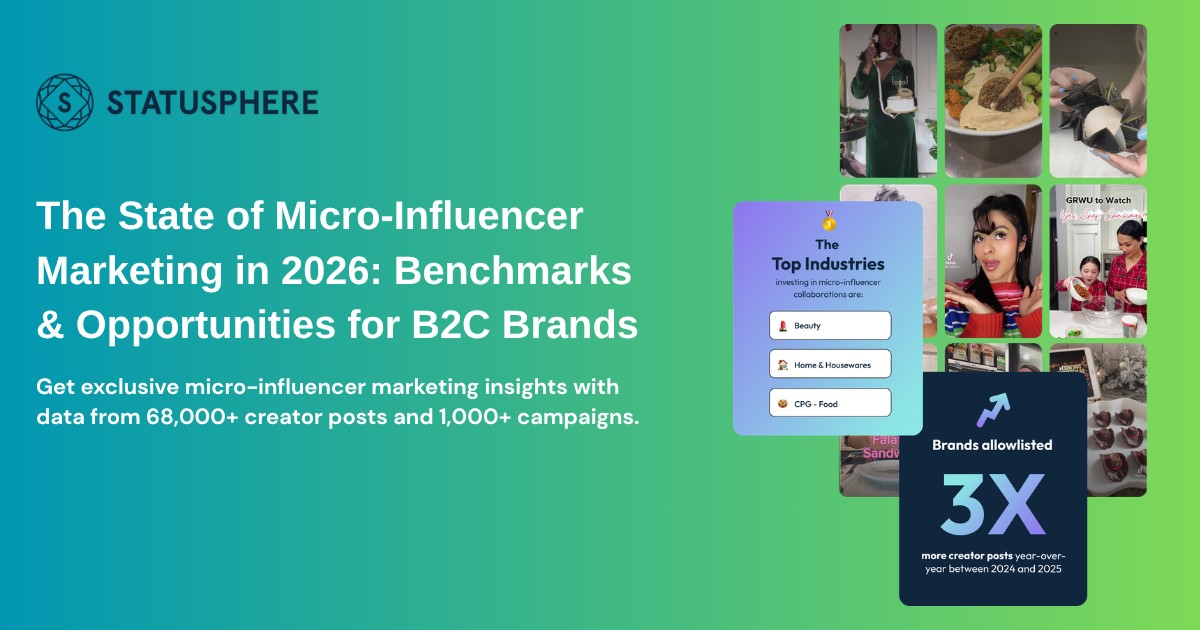
Brands working with micro-influencers in 2025 ranked awareness growth as their primary campaign objective, while social search optimization emerged as the fastest-growing campaign objective for creator partnerships, according to a new benchmark report from Influencer Marketing platform Statusphere.
The findings draw on more than 68,000 creator posts across more than 1,000 campaigns on TikTok and Instagram conducted between January 2024 and December 2025. Statusphere, which uses AI to manage creator sourcing, matching, and campaign fulfillment for enterprise brands, paired creators with brands through a proprietary algorithm applying more than 300 targeting parameters.
The company tracks performance metrics in real time through API integrations with both TikTok and Meta. Statusphere noted that outcomes in the dataset may trend higher than those from campaigns conducted outside its platform.
Campaign Goals and Content Formats
Increasing brand awareness ranked as the top stated goal among brands working with micro-influencers during the reporting period. TikTok videos were the most requested content format among those brand partners.
Social SEO recorded the sharpest year-over-year growth among campaign objectives. Enterprise brands ran 2.5 times more social SEO campaigns in 2025 than in 2024.
Brands also expanded their use of creator content in paid advertising. Allowlisted creator posts, which enable brands to run paid promotions using creator-generated content, grew three times year-over-year between 2024 and 2025.
Top Industries & In-Store Retail Content
Beauty, Home and Housewares, and CPG-Food ranked as the three leading sectors investing in micro-influencer collaborations during the period studied.
Creator posts featuring in-store retail moments boosted engagements by 118 per 100,000 views.
Shifting Toward Always-On Programs
The report describes a structural shift in how brands deploy creator content, framing it as having moved beyond one-off reviews and campaigns. “Creator content is becoming the engine of the buyer’s journey,” it states, with teams increasingly treating it as the foundation for how consumers discover, evaluate, and purchase products.
Marketing teams are also directing more investment toward social SEO and AI-driven discovery, and scaling creator content into paid channels where, the report notes, it drives stronger performance and higher return on ad spend. The report positions the ability to produce and distribute creator content on an ongoing basis as a key competitive requirement in 2026, stating that well-executed tentpole campaigns are no longer sufficient on their own.
Four Areas to Watch in 2026
Statusphere outlined four forward-looking areas based on the data and early 2026 trends.
On search visibility, the report cited figures showing YouTube citations appearing in 78% of Google AI Overviews for product comparison searches. As product discovery fragments across LLMs, AI overviews, social search, and chat-based experiences, the report projected that brands will increase micro-influencer content distribution on YouTube Shorts as a key tactic for improving discoverability.
On paid performance, the report found brands sourcing creator content through its platform achieved three to five times higher return on ad spend compared to non-creator advertisements. It projected broader deployment of user-generated content across acquisition campaigns and product detail pages in 2026.
On Pinterest, the report cited Circana data showing social has surpassed word-of-mouth as the leading product discovery channel, at 42% versus 31%. The report also noted that 85% of weekly Pinterest users have made purchases based on branded content, with 55% viewing Pinterest as a shopping destination, and projected that micro-influencer content tailored to discovery-first platforms will grow in value.
On Amazon, the report cited Amazon data indicating product detail pages with shoppable video see an average 23.8% increase in sales. It projected that brands will activate more Amazon influencers to drive higher conversion rates on marketplace pages in 2026.
Image source: Statusphere Get the full report here
Jonathan is a South African content creator, photographer and videographer with 25 years of experience in journalism and print media design. He is interested in new developments in AI content creation and covers a broad spectrum of topics within the creator economy.













Brands working with micro-influencers in 2025 ranked awareness growth as their primary campaign objective, while social search optimization emerged as the fastest-growing campaign objective for creator partnerships, according to a new benchmark report from Influencer Marketing platform Statusphere.
The findings draw on more than 68,000 creator posts across more than 1,000 campaigns on TikTok and Instagram conducted between January 2024 and December 2025. Statusphere, which uses AI to manage creator sourcing, matching, and campaign fulfillment for enterprise brands, paired creators with brands through a proprietary algorithm applying more than 300 targeting parameters.
The company tracks performance metrics in real time through API integrations with both TikTok and Meta. Statusphere noted that outcomes in the dataset may trend higher than those from campaigns conducted outside its platform.
Campaign Goals and Content Formats
Increasing brand awareness ranked as the top stated goal among brands working with micro-influencers during the reporting period. TikTok videos were the most requested content format among those brand partners.
Social SEO recorded the sharpest year-over-year growth among campaign objectives. Enterprise brands ran 2.5 times more social SEO campaigns in 2025 than in 2024.
Brands also expanded their use of creator content in paid advertising. Allowlisted creator posts, which enable brands to run paid promotions using creator-generated content, grew three times year-over-year between 2024 and 2025.
Top Industries & In-Store Retail Content
Beauty, Home and Housewares, and CPG-Food ranked as the three leading sectors investing in micro-influencer collaborations during the period studied.
Creator posts featuring in-store retail moments boosted engagements by 118 per 100,000 views.
Shifting Toward Always-On Programs
The report describes a structural shift in how brands deploy creator content, framing it as having moved beyond one-off reviews and campaigns. “Creator content is becoming the engine of the buyer’s journey,” it states, with teams increasingly treating it as the foundation for how consumers discover, evaluate, and purchase products.
Marketing teams are also directing more investment toward social SEO and AI-driven discovery, and scaling creator content into paid channels where, the report notes, it drives stronger performance and higher return on ad spend. The report positions the ability to produce and distribute creator content on an ongoing basis as a key competitive requirement in 2026, stating that well-executed tentpole campaigns are no longer sufficient on their own.
Four Areas to Watch in 2026
Statusphere outlined four forward-looking areas based on the data and early 2026 trends.
On search visibility, the report cited figures showing YouTube citations appearing in 78% of Google AI Overviews for product comparison searches. As product discovery fragments across LLMs, AI overviews, social search, and chat-based experiences, the report projected that brands will increase micro-influencer content distribution on YouTube Shorts as a key tactic for improving discoverability.
On paid performance, the report found brands sourcing creator content through its platform achieved three to five times higher return on ad spend compared to non-creator advertisements. It projected broader deployment of user-generated content across acquisition campaigns and product detail pages in 2026.
On Pinterest, the report cited Circana data showing social has surpassed word-of-mouth as the leading product discovery channel, at 42% versus 31%. The report also noted that 85% of weekly Pinterest users have made purchases based on branded content, with 55% viewing Pinterest as a shopping destination, and projected that micro-influencer content tailored to discovery-first platforms will grow in value.
On Amazon, the report cited Amazon data indicating product detail pages with shoppable video see an average 23.8% increase in sales. It projected that brands will activate more Amazon influencers to drive higher conversion rates on marketplace pages in 2026.
Image source: Statusphere
Get the full report here
Subscribe to Our Newsletter
Check Out Our Podcast