Creator agency Billion Dollar Boy finds that leading social video content with product or brand messaging reduces view rates by 44%, according to new research analyzing 5,000 creator-led campaign assets across the United States and the United Kingdom.
The study, titled “Creator Instinct: Unlocking The Social Code,” identifies five broader creator content patterns that outperform brand-directed alternatives on social platforms.
Produced in partnership with creative effectiveness firm DAIVID, the research assessed 39 emotional signals frame by frame across the dataset, tracking four performance metrics: organic engagement (including saves, shares, and re-watches); view-through rate; brand favorability; and purchase and consideration intent. The dataset covered 77 brands across six product categories: beauty, fashion, personal care, entertainment, food and drink, and retail.
Front-Loading Branding Reduces View Rates
The first finding shows that leading a social video with product, benefit, or brand messaging reduced the 25% view rate benchmark by 44% on paid Instagram and TikTok placements. Assets that front-loaded brand messaging also generated 12% lower brand favorability scores and 41% lower consideration scores. The report notes that creators build audience attention through narrative pacing before introducing the product, treating the brand reveal as a payoff rather than an opening hook.
Demonstration Outperforms Verbal Claims
Content showing product performance rather than making verbal claims produced 33% higher brand favorability and 15% higher consideration. When content registered as trustworthy, organic view rates rose 50% on Instagram and TikTok, while content that viewers found confusing produced a 17% decline in organic engagement.
Creator Laura Adlington, quoted in the report, said she focuses on explaining “why something works” rather than declaring it, adding the educational approach “really helps build confidence for customers rather than just selling a product.”
Emotions Perform Differently Across Product Categories
The report introduces what it calls an “Emotion Matrix,” showing that the same emotional signal increases performance in some verticals while suppressing it in others.
Anxiety lifted performance in beauty and food and drink but suppressed it in entertainment, retail, and fashion. Warmth lifted beauty, entertainment, food and drink, and fashion, but reduced retail performance. Gratitude lifted retail and fashion but suppressed beauty, food, and drink. The report states there is no universal effective ad emotion, describing effectiveness as a category-conditional system.
Raw Emotion Outperforms Safe Creative
Content that generated visceral reactions produced a 25% higher organic view rate on Instagram compared to safe creative. A 6% view rate increase appeared when paid content on Instagram and TikTok provoked awkwardness. When content moved from a raw emotion to a positive resolution, it generated 22% higher consideration and 17% higher recommendation scores.
The report references the “Pratfall Effect,” a social psychology concept in which imperfection increases likability. An IKEA and Chupa Chups collaboration cited in the study involved a limited-edition meatball-flavored lollipop designed to provoke a visceral viewer reaction. Vincenzo Riili, CMO at IKEA Retail (Ingka Group), said the campaign sought to occupy “the space between them, where cultural surprise can do real commercial work.”
Endings Drive Notable Engagement Gains
Assets building to a satisfying payoff generated 110% higher organic view rates on Instagram and TikTok combined, with TikTok showing a 318% organic view rate increase and an 83% engagement rate gain. Holding viewer attention in the final three seconds produced a 31% increase in organic engagement on Instagram.
Content ending with a peak of strong positive emotion drove 34% higher brand awareness and 11% higher purchase intent. The report cites behavioral economist Daniel Kahneman’s Peak-End Rule, which holds that people recall experiences primarily through their emotional peak and final moments.
Creator Duncan Smith, whose campaign work for Pinterest Predicts 2026 appears as a case study, said the final reveal “is the reward for the viewer investing their time, that’s the moment that sticks with them.”
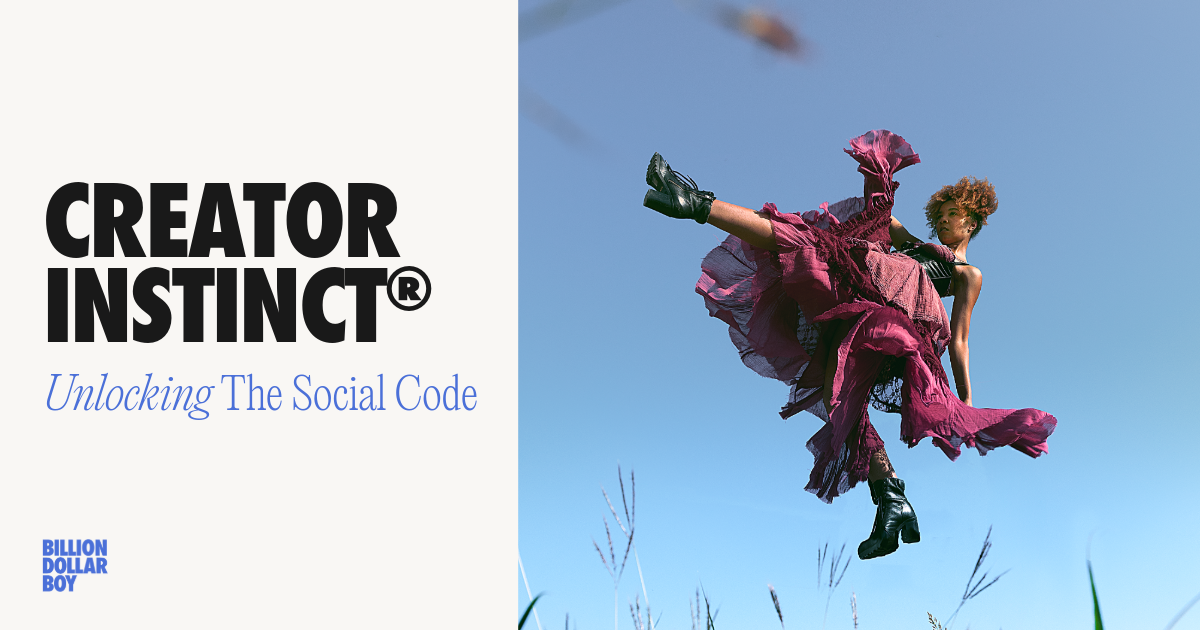
Image source: Billion Dollar Boy The full report is available here
Cecilia Carloni, Interview Manager at Influence Weekly and writer for NetInfluencer. Coming from beautiful Argentina, Ceci has spent years chatting with big names in the influencer world, making friends and learning insider info along the way. When she’s not deep in interviews or writing, she's enjoying life with her two daughters. Ceci’s stories give a peek behind the curtain of influencer life, sharing the real and interesting tales from her many conversations with movers and shakers in the space.
















Creator agency Billion Dollar Boy finds that leading social video content with product or brand messaging reduces view rates by 44%, according to new research analyzing 5,000 creator-led campaign assets across the United States and the United Kingdom.
The study, titled “Creator Instinct: Unlocking The Social Code,” identifies five broader creator content patterns that outperform brand-directed alternatives on social platforms.
Produced in partnership with creative effectiveness firm DAIVID, the research assessed 39 emotional signals frame by frame across the dataset, tracking four performance metrics: organic engagement (including saves, shares, and re-watches); view-through rate; brand favorability; and purchase and consideration intent. The dataset covered 77 brands across six product categories: beauty, fashion, personal care, entertainment, food and drink, and retail.
Front-Loading Branding Reduces View Rates
The first finding shows that leading a social video with product, benefit, or brand messaging reduced the 25% view rate benchmark by 44% on paid Instagram and TikTok placements. Assets that front-loaded brand messaging also generated 12% lower brand favorability scores and 41% lower consideration scores. The report notes that creators build audience attention through narrative pacing before introducing the product, treating the brand reveal as a payoff rather than an opening hook.
Demonstration Outperforms Verbal Claims
Content showing product performance rather than making verbal claims produced 33% higher brand favorability and 15% higher consideration. When content registered as trustworthy, organic view rates rose 50% on Instagram and TikTok, while content that viewers found confusing produced a 17% decline in organic engagement.
Creator Laura Adlington, quoted in the report, said she focuses on explaining “why something works” rather than declaring it, adding the educational approach “really helps build confidence for customers rather than just selling a product.”
Emotions Perform Differently Across Product Categories
The report introduces what it calls an “Emotion Matrix,” showing that the same emotional signal increases performance in some verticals while suppressing it in others.
Anxiety lifted performance in beauty and food and drink but suppressed it in entertainment, retail, and fashion. Warmth lifted beauty, entertainment, food and drink, and fashion, but reduced retail performance. Gratitude lifted retail and fashion but suppressed beauty, food, and drink. The report states there is no universal effective ad emotion, describing effectiveness as a category-conditional system.
Raw Emotion Outperforms Safe Creative
Content that generated visceral reactions produced a 25% higher organic view rate on Instagram compared to safe creative. A 6% view rate increase appeared when paid content on Instagram and TikTok provoked awkwardness. When content moved from a raw emotion to a positive resolution, it generated 22% higher consideration and 17% higher recommendation scores.
The report references the “Pratfall Effect,” a social psychology concept in which imperfection increases likability. An IKEA and Chupa Chups collaboration cited in the study involved a limited-edition meatball-flavored lollipop designed to provoke a visceral viewer reaction. Vincenzo Riili, CMO at IKEA Retail (Ingka Group), said the campaign sought to occupy “the space between them, where cultural surprise can do real commercial work.”
Endings Drive Notable Engagement Gains
Assets building to a satisfying payoff generated 110% higher organic view rates on Instagram and TikTok combined, with TikTok showing a 318% organic view rate increase and an 83% engagement rate gain. Holding viewer attention in the final three seconds produced a 31% increase in organic engagement on Instagram.
Content ending with a peak of strong positive emotion drove 34% higher brand awareness and 11% higher purchase intent. The report cites behavioral economist Daniel Kahneman’s Peak-End Rule, which holds that people recall experiences primarily through their emotional peak and final moments.
Creator Duncan Smith, whose campaign work for Pinterest Predicts 2026 appears as a case study, said the final reveal “is the reward for the viewer investing their time, that’s the moment that sticks with them.”
Image source: Billion Dollar Boy
The full report is available here
Subscribe to Our Newsletter
Check Out Our Podcast