






Influencer
Meet Roxy Couse, the Corporate Insider Making Personal Branding a Strategy for Visibility

Roxy Couse was already doing the work. Three lateral moves and years of filling gaps no one else would fill. When she finally asked directly what it would take to get promoted, the answer was not a roadmap. “There’s nothing else you need to prove,” she recalls being told. “We’re not ready to promote you.”
No one had said that to her before. What followed was less grief than reckoning. “No one is coming to save you,” she says. “It’s literally on you. You need to save yourself.”
Today, Roxy is a creator and founder with more than 600,000 followers across TikTok, Instagram, LinkedIn, and Threads, and over 100 million views. Her brand, built around the professional experiences of millennial managers and corporate employees, has attracted partnerships with LinkedIn, IBM, P&G, Anthropic, Amazon, and CVS, and earned features in Forbes, Business Insider, and Newsweek.
This month, she opened the beta and waitlist for Sloefy™, a personal brand platform designed to help corporate professionals build strategic visibility across platforms. Eight months after leaving her senior director role at a digital experience management company, she says she has made more money as an independent creator than at any point in her corporate career.
The question she keeps returning to, for herself and for the audience she has built, is the one she never stopped asking in conference rooms: What does staying invisible actually cost you?
A 15-Year Climb That Went Sideways
For nearly 15 years, Roxy worked in e-commerce and digital marketing at companies including Dillard’s, Avery Dennison, Whirlpool, and Bloomreach. She was known as reliable and thorough. She was less known as someone who took up space. “I was intimidated to speak up,” she says. “I made myself smaller, so other people could appear bigger.”
The pattern held across organizations. To advance, she had to leave. She built new teams from scratch, delivered results, and absorbed the costs of institutional loyalty that never paid out. When the promotion she had earned failed to materialize, she understood what had actually been happening. Doing good work, she concluded, is not the same as being visible.
“I’ve had to work so much and so hard to get half as much,” she says. The conclusion she reached was not bitterness. It was structural. In most corporate environments, promotions happen in rooms where most employees are not present. Being visible only to a direct manager is not sufficient.
“If nobody knows who you are, no one’s going to advocate for you.”
The Millennial Who Didn’t Want to Be on TikTok
Roxy resisted TikTok for a reason that will read as familiar to most of her audience. She was a senior manager ascending to director. The platform seemed like a category error. “I thought TikTok was just dance videos,” she says. “It wasn’t a place for me.”
She created an account in late 2021, initially posting trends without much strategy, partly because she figured her colleagues were not watching. “I didn’t think anyone who knew me in real life was on TikTok.”
That assumption gave her room to experiment. She started talking about being a homebody, which she describes as “a part of myself you would never know just looking at my LinkedIn profile.” When her audience began asking what she did for work, she started talking about working from home, then corporate culture, then digital marketing.
Her audience grew on TikTok before she replicated the approach on Instagram and LinkedIn. The two identities, creator and corporate professional, reinforced each other rather than creating conflict. A video critiquing Target’s Circle loyalty program was picked up by Business Insider. Her employer’s PR team flagged it approvingly. “She knows digital marketing, and she works for this company that does digital marketing,” she recalls what they said. “They’re not in conflict. They actually complement each other.”
What Invisibility Actually Costs
Roxy’s argument about personal branding is not about self-promotion as performance. It is about professional survival. “Your personal brand is your career insurance,” she says, and she is concrete about why.
Only 1% of people on LinkedIn actually post. Calibration meetings happen by committee. If you are not known beyond your direct manager, you are negotiating against people who are.
Her audience reflects the specific type of person most at risk. She describes them as overachievers, people-pleasers, eldest daughters: people who, as she puts it, “do whatever it takes to get the job done” without documenting or advocating for that work. “You have no idea the work they’ve done. You just know that it got done.” What they receive in return, she says, is not recognition. It is more work and eventually burnout.
She is also explicit about what happens when organizational goodwill runs out. “When layoffs happen, I’m just a name on a spreadsheet.” A performance review early in her career told her she needed to be more visible internally. When she started advocating loudly for a team she was building, she was told to play for the name on the front of the jersey, not the back.
Roxy disagreed. “I actually have to play for the name on the back of the jersey,” she says, “because I could be let go, and what happens then?”
Building Sloefy™
When Roxy began one-on-one consulting in 2025, the results confirmed her thesis and exposed its limits. She could not scale herself. Each client required follow-up and re-engagement. The ceiling was visible from the start.
Sloefy™, founded in December and launching in May, is the infrastructure she built from that constraint. The platform combines a brand strategy framework, a 90-day content plan, coaching, and community, structured specifically for corporate professionals navigating the same terrain she covered herself. Her year of consulting became the curriculum. “Let me build what I’ve learned into a platform,” she says.
The community component is not peripheral. “Building a personal brand while working in corporate is very lonely,” she says. “I would hear the jokes. I would hear people laughing.” What she observed in her own journey was that the presence of others doing the same work made consistency easier to maintain.
She also designed Sloefy™ to address what she calls analysis paralysis. Corporate professionals, she argues, respond to structure. “We love a plan. We love a road map.” The platform provides one without leaving users stalled at the blank box. “You can’t get hung up on this one post because you’re going to post a hundred times.”
She pushes back on the saturation argument that discourages professionals from entering creator spaces. “There’s always room for one more,” she says. “There’s no one else who has your personal brand. That’s why.”
The Corporate Creator as a Business Asset
As brands have expanded creator programs, Roxy has made a specific case for the B2B and career creator category. Her pitch is not based on reach alone. “I know if we work with Roxy, she’s going to read the brief, she’s going to deliver on time,” she says of agency partners. “There are very few times where they’re like, ‘Reshoot this.’”
The skills that make corporate professionals effective inside organizations, she argues, translate directly. Deadlines, briefs, revision cycles, and strategic alignment are not unfamiliar frameworks. “You’re just built differently,” she says.
After Corporate
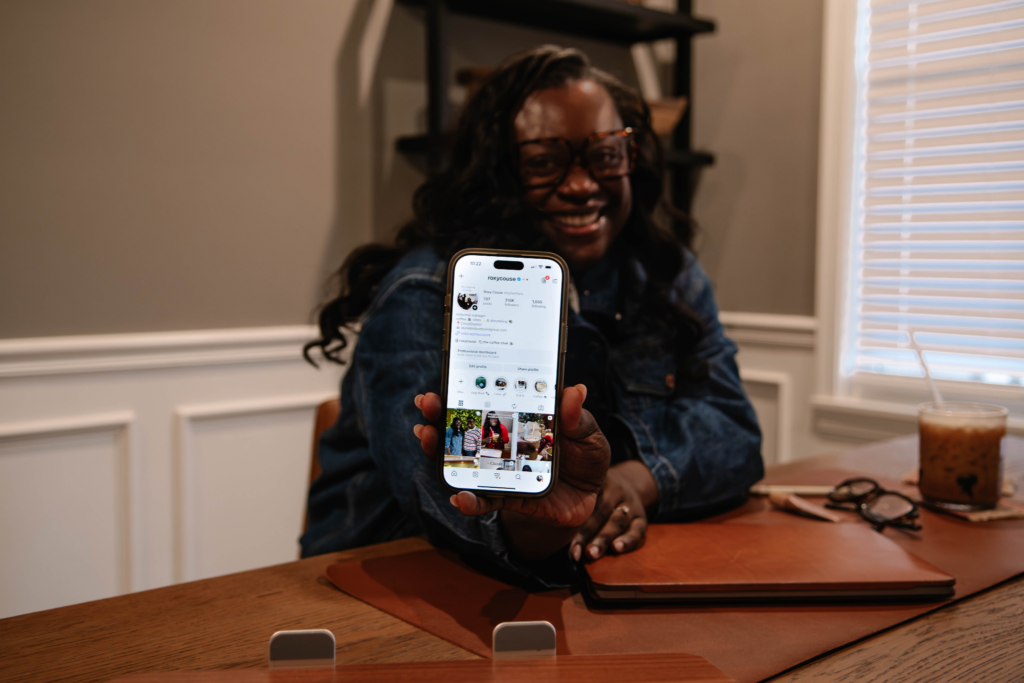
Roxy left her corporate job in August 2025, but not abruptly. She had shifted to part-time first, working 20 hours a week in corporate while expanding her creator work. The transition gave her the evidence she needed. “There were days when I didn’t work at all,” she says. “I was like, ‘I think I will be okay.’”
Since leaving, she has made more money than at any prior point in her career. She is not inclined to overstate the significance. “I’m just going to ride this wave.”
What has changed more than the income is how she introduces herself. For most of her career, she led with her title. Now she leads with herself. “I’m going to tell you that I’m a mom. I’m going to tell you about my husband,” she says. “I try not to lead with my title as much as possible.”
For her, the measure of Sloefy™’s success is not a subscriber count. It is a shift in how people understand their own value. “The first thing that happens when you start to build your personal brand has nothing to do with money,” she says. “It has everything to do with confidence. When you create an opportunity for yourself without a company name attached, it changes your life.”
For the professional still waiting to be noticed, her answer is unambiguous. “If you believe that it could happen for you, it can.”
Subscribe to Our Newsletter
Check Out Our Podcast