






Influencer
From Radio Co-Host to DIY Creator, Erika Ver Wants Her Brand to Outlast Influencer Culture

When Erika Ver lost her radio job in early 2020, she had no clear next step. What she did have was a house to transform, an instinct for audience-building, and a bet that home design content could be more useful than aspirational.
After more than eight years as a co-host on WMMS’s “The Alan Cox Show” at iHeartMedia Cleveland, a four-hour daily afternoon-drive program, Erika’s contract ended amid health challenges that left her on state disability in Ohio. She began documenting home projects online, turning a personal reset into Peony and Honey, a home decor, DIY, and lifestyle brand built around what she describes as “bringing the luxury lifestyle, romanticizing your life to the everyday home.”
Peony and Honey now has more than 1.5 million followers across Instagram, Facebook, TikTok, and YouTube. Erika has worked with brands including Martha Stewart CBD, Samsung, Michaels, and Big Lots, and recently launched her first product line, a renter-friendly wallpaper collection.
“I started this on state disability in Ohio because I was dealing with health problems,” she says. “I thought, ‘What am I going to do with my life now? I’ve left radio. I don’t have a backup plan.’”
What Radio Gave Her, and What It Didn’t
The job that defined Erika’s early career also constrained it. Radio gave her daily access to a live audience, creative output, and the kind of instant feedback that performers depend on. “It gave me an outlet to be creative and to entertain people on a daily basis,” she says. The trade-off was total absorption.
“I think what it took away from me is my ability to pursue outside interests because radio is like, if you want to be successful at it, you have to be all in,” she says. Events on weekends, live broadcasts during the week: there was no room for the home renovation projects she would eventually build a career on. The family’s previous home was chosen specifically because it was turnkey.
Radio also came with a particular dynamic she doesn’t miss. As the female co-host on an otherwise all-male show, she was, as she puts it, not going to be the favorite character on the cast. The departure, when it came, wasn’t voluntary. Her contract was up, her health wasn’t cooperating, and the decision was effectively made for her.
“I’m so immensely grateful for all of the experiences that I had doing that show, and I do think it’s prepared me in so many ways for the career that I’m in now,” she says.
The Pandemic Drill and the Permission It Gave Her
Erika had never picked up a drill before 2020. Her father and grandfather were both handy, but power tools weren’t passed down to her growing up. “It never occurred to me to ask,” she says.
During the pandemic, while most people were attempting sourdough, she was on YouTube and calling her father on FaceTime, learning how to use tools one project at a time. “It just kind of clicked from there,” she says.
The shift from observer to practitioner unlocked something that had been dormant. She started documenting the projects online, and the audience followed. Reaching 10,000 followers was the first signal. “I was calling up my mom and telling her, ‘I think I can make something out of this,’” she recalls.
The harder projects followed. Her IKEA built-in bookshelf wall, the project she describes as having scared her most, required flying in both her father and a fellow DIY creator, Krystle from “Perkins on Parkway” in Texas, to execute it. “Once I had just a few tips from those guys and just kind of laying out the full plan, it was a lot easier than I thought,” she says.
That project gave her the confidence to tackle everything that came after.
Attainable Over Aspirational
The question Erika gets asked most often is some version of: Why should anyone take design advice from someone without a design degree? Her answer is a framework, not a deflection.
“I consider there to be two types of content out there: aspirational and attainable,” she says. “And I think both deserve a place.” Classically trained interior designers offer principles from a textbook. She offers something different, and she is careful to say so.
“I’m not an interior designer, I’m an interior decorator,” she says. “And there is a difference, because I do have respect for people who did go to school and get their degree in interior design.” The distinction also frees her from pretending expertise she doesn’t have. Her tutorials are structured around how she herself would want to be taught: step by step, from the perspective of someone figuring it out in real time.
“Your failures end up being your biggest lessons, and then that gives you the confidence to move forward,” she says.
That philosophy applies as much to her content as to the projects themselves: she shares the construction dust, the piled-up boxes, the mistakes. It is not a brand strategy so much as a personality trait. “I don’t think I could hide it if I tried,” she says.
How She Structures the Business
Erika’s revenue falls into two active brackets. Brand partnerships are the primary income source, affiliate linking is secondary, and a third bracket, subscriptions or digital products, she deliberately avoids. The reasoning is explicit.
“I want my content to always be free,” she says. “I want people to come and get whatever they want to take away from my page, inspiration, product links, whatever, and have nothing cost them any money.”
The affiliate piece is out of necessity. For years, she underdelivered on it, reluctant to appear sales-focused. Audience behavior changed her mind. “I was under-serving my audience,” she says. “They were asking for links that I was not delivering.” Now she curates product posts, but keeps them proportional to organic content.
Brand deals are built around her current projects: with a lake house recently purchased, current campaigns revolve around furniture and renovation. Her one documented misstep in partnerships taught her the rule she holds to now. She once signed a contract before receiving the product, trusted the reviews, and found it fell short. She went back to the brand and said she would not be sharing the content on her platforms, and negotiated her way out of the contract. The person she delivered that news to respected her integrity and later brought her work through a different brand.
“Your platform is built on your integrity, your recommendations,” she says. “If you start leading people astray, they’re gonna find out pretty quickly.”
Platform Strategy and the Limits of the Niche
Erika maintains a presence on Instagram, Facebook, TikTok, and YouTube, running the same projects across all four but adjusting the content to suit each platform.
TikTok is where she takes more risks. “I feel like TikTok is a little fast and loose over there,” she says.
She started Peony and Honey as a broad lifestyle page covering makeup, fashion, food, and home. DIY pulled ahead because it was where her passion sat at the time. Now, she pushes back on being defined solely by it. “Come to my page, take what you want, and leave the rest,” she says. “If you’re not interested in any of the makeup stuff or anything else I share, totally cool. Just come back for the home stuff.”
The mindset also has a business logic. “You definitely don’t want to niche down too far,” she says. “You want to make yourself sellable for all different types of products.” Series content has been her focus in 2026, particularly on Instagram, where it has performed well.
The constant, she says, is adaptation. “The style of videos I’m putting out this year may not work next year.”
The Brand She’s Building Toward
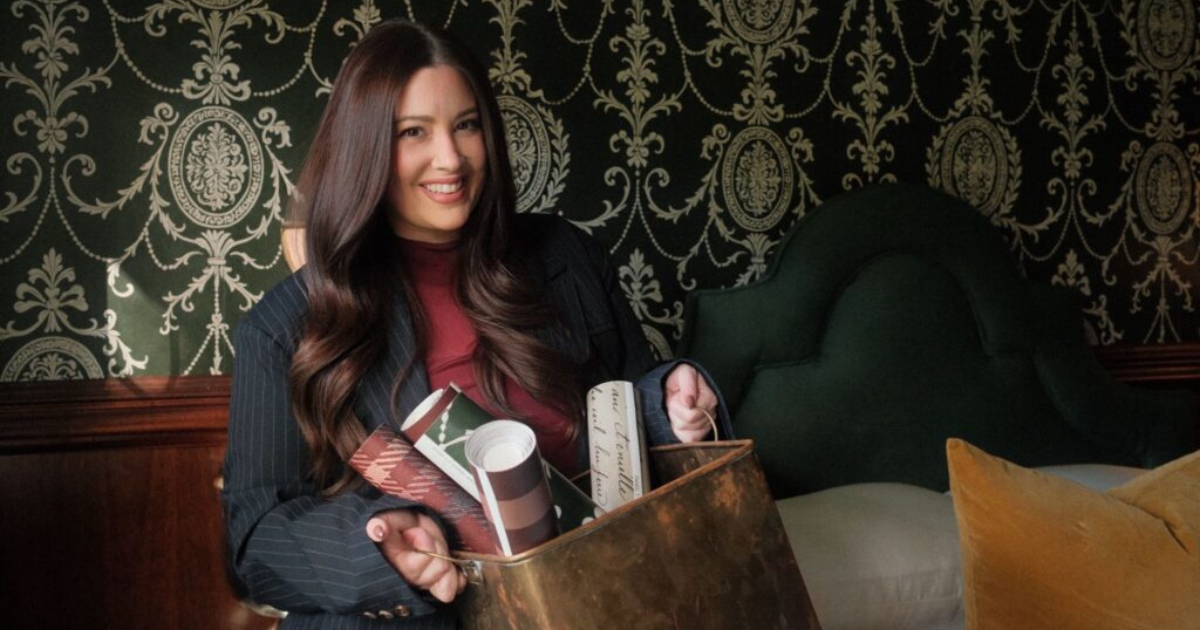
In early May, Erika launched “The Modern Manor,” a 35-design wallpaper collection created in collaboration with Wall Blush, the direct-to-consumer editorial wallpaper brand. Spanning eleven design categories, the collection pulls from antique European interiors, historic estates, and vintage textiles, pairing aged florals and hand-drawn damasks against geometrics and stone textures under a single curated palette. Renter-friendly was a baseline requirement. She and her husband rented for over a decade before buying their current home, and that experience shaped what she wanted to put on the market.

“The inspiration came from a blend of antique European interiors, historic estates, vintage textiles, and the quiet beauty of everyday life,” she says. “I’ve always been drawn to the richness of old-world design. Aged florals, classic stripes, and intricate detailing have all been reinterpreted for modern living. It’s really about romanticizing your home and creating spaces that feel layered, intentional, and full of character.”
The product line is the clearest articulation of how she thinks about legacy. She is not chasing virality. She measures Peony and Honey against the standard set by Ina Garten, Nancy Meyers, and Martha Stewart. “I think about the brands that they’ve built and how they’ve led with those brands,” she says. “I’m not interested in being famous. I want to be known as a trusted brand.”
Influencer culture, she argues, has an expiration date. “The people who try to branch out and create products that people want to have in their homes, those are the people who are going to stand the test of time,” she says.
That conviction started taking shape on state disability in Ohio, with no backup plan and a father on FaceTime walking her through how to use a drill. Years later, it has produced a wallpaper collection. The metric she uses to measure it has nothing to do with revenue.
“I don’t care if it makes me $0,” she says. “Just knowing that someone else has something I designed in their home. That is fulfilling in and of itself.”
Erika is managed by Odyssey Entertainment Group.
Subscribe to Our Newsletter
Check Out Our Podcast