






Tech
TopFan And The Long Bet On Creator Ownership

Jeffrey Kohn believes creators should operate like Fortune 100 companies.
“To achieve long-term predictable success in any business, of course, you have to know your customer and be able to directly engage and sell to them on your own terms,” he says.
As CEO and founder of TopFan, the Denver-based technology company he launched in 2016, Jeffrey has spent the past decade building infrastructure that allows creators, sports teams, and entertainment brands to own and monetize direct relationships with their fans. After years of serving enterprise clients, TopFan is now exiting private beta with a fully white-labeled platform aimed at independent creators.
Jeffrey describes himself as “a technologist who has a background in data science and enterprise architecture.” Before founding TopFan, he held senior roles at Oracle and served as a mission specialist at NASA, experiences that shaped his systems-level thinking. Today, the problem he is solving is structural: creators depend heavily on third-party social platforms for reach, monetization, and data. As organic reach declines and algorithm shifts intensify, Jeffrey argues that long-term financial sustainability requires ownership of data, of commerce, and of the fan relationship itself.
“With the rise of the Creator Economy, independent creators, including bloggers, podcasters, athletes, fitness, food, and health experts, are also recognizing that they can’t only rely on brand endorsements on social media platforms to make ends meet,” he says.
The Structural Problem: Reach Without Ownership
Despite growth in the Creator Economy, Jeffrey argues that one fundamental issue has not changed.
“One of the biggest problems that never really went away is creators’ lack of control,” he says. “Even as the Creator Economy has grown more mainstream, creators are still heavily reliant on third-party platforms for both engagement and monetization – and in many ways, that dependence has only gotten worse.”
The math illustrates the challenge. “Industry research shows that creators now reach only about 3.4% of their followers organically. That means a creator with 1 million followers is likely reaching just 34,000 people with a given post,” says Jeffrey.
In his view, the issue is not simply competition among creators, but competition with platform advertising inventory. “Every post is competing not only with millions of other creators, but also with platforms’ own advertising inventory inside the feed – particularly on platforms like Meta.”
He frequently uses a metaphor to explain platform dependency: “When a creator ‘builds their mansion on rented land,’ they’re always subject to the landlord’s rules.”
That includes algorithm changes, policy shifts, demonetization, account locks, and outbound link restrictions. Creators often lack access to detailed customer relationship management (CRM) data, including direct contact information.
“I can’t think of any other industry where a vendor doesn’t have a detailed CRM of their clients besides the Creator Economy,” Jeffrey says.

A White-Labeled Alternative
TopFan’s solution is not another social platform. Jeffrey emphasizes that distinction clearly.
“I tell them that this isn’t another 3rd party platform to join, it’s YOUR platform.”
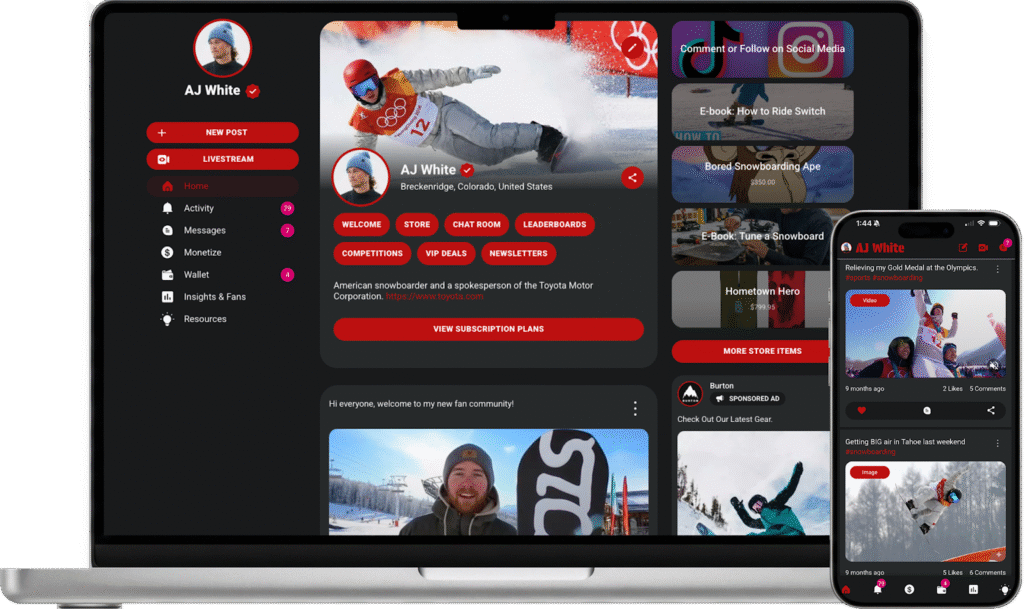
The company provides creators with websites and apps that centralize content, commerce, and community features in one place. That includes premium subscriptions, merchandise sales, personalized video requests, podcasts, video series, music albums, event tickets, newsletters, crowdfunding, live streams, and more.
Previously, Jeffrey notes, creators might have used multiple vendors to manage these services. “With TopFan’s technology offering, there simply is no reason to be sending fans to multiple service providers’ sites, when everything can be done at creatorname.com under a 100% white-labeled and unified experience for the fan.”
The economic argument is central to Jeffrey’s thesis. He offers a simplified example: “If a creator can get a small percentage of their fans, for example, 10% of their 100K fan followers (10,000 fans), to come over to their direct-to-fan platform and spend $100 with them each year, that’s a $1M/year recurring business that the creator owns.”

Data as Infrastructure, Not Afterthought
Ownership, in Jeffrey’s framework, extends beyond revenue to data.
“When we say ‘owning your audience’ we mean every aspect of the fan relationship and every data point about a creator’s fan should be owned by the creator, bar none.”
TopFan’s system captures demographic and behavioral data tied to purchases, content engagement, event attendance, and more. Creators can segment audiences using detailed filters (location, age, purchase history, and engagement behavior) and deploy targeted campaigns via branded email, SMS, push notifications, or direct messaging.
Jeffrey describes a hypothetical use case: identifying fans “within a 10-mile radius of a specific location who listened to a specific song, purchased a specific merch item, attended a certain event, and have spent more than $100 with the creator in the past 60 days.”
The goal is not just data capture, but activation. “Owning data is the first step, but leveraging is where the real value is created.”
He emphasizes that privacy controls remain intact and that fans retain control over what personal information they share.
Why Now?
After ten years serving enterprise clients, why shift focus to independent creators now?
“The maturation of the Creator Economy from hobbyist creators to those who view being a creator as a full-time career, and their entrepreneurial spirit and desire to build sustainable empires.”
He also points to globalization. “The creator movement is now a global phenomenon, which allows us to invest in building very high-end technologies that are internationalized for a worldwide audience.”
In his view, this year may mark a turning point. “We are optimistic that 2026 is the year that creators make a paradigm shift towards owned and operated micro-communities for their superfans.”

Rethinking the Creator Business Model
For Jeffrey, the long-term ambition is to change how creators perceive themselves.
“We think of creators as business owners. They should have very high expectations and demand the same level of tools, data, and control as a major corporation.”
By consolidating content, commerce, and community, he believes creators can build durable brand equity, rather than simply generating engagement inside someone else’s ecosystem.
“By bringing all the content, community, and commerce into one unified self-branded space where true data ownership exists, the creator puts themselves in a position to achieve long-term financial sustainability and finally build personal brand equity for themselves.”
He frames the opportunity as both defensive and generative: protection against declining organic reach and algorithmic volatility, and the ability to create recurring-revenue assets that compound over time.
As the company enters its next chapter, Jeffrey’s vision remains consistent with the thesis he formed a decade ago.
“We think this paradigm shift provides not only a counter-balance to the declining organic reach problem on social media, but also provides long-term upside for the creator who is creating asset equity in something they own, versus their creativity and fandom being used to increase the value of someone else’s large social media company.”
Images: TopFan user pages
Source: TopFan
Subscribe to Our Newsletter
Check Out Our Podcast