



Agency
The Operator Behind the Creator: How Pylo is Turning Attention Into Owned Businesses

Most creators earning six figures are still one brand contract away from zero. According to Pylo founder Pierre-Louis Jacob-Morin, that is not an income problem. It is a structural one.
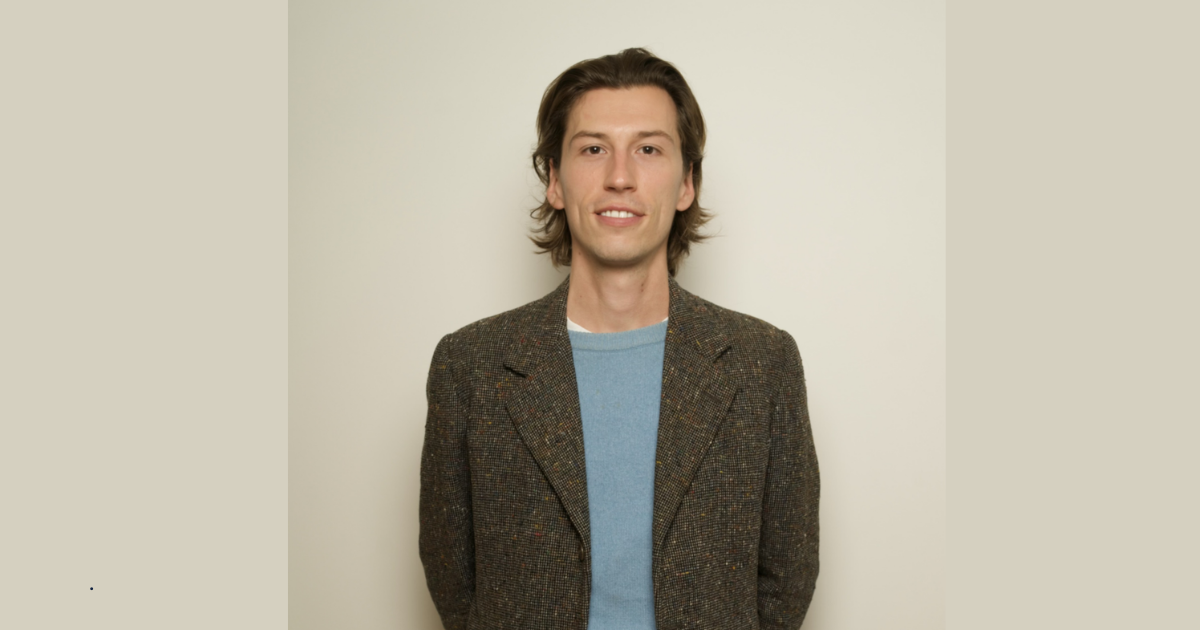
Pierre-Louis spent his early career in M&A and as chief of staff at two Paris-based startups before concluding that the Creator Economy had an operator problem. In January 2025, he launched pylo studio, a Paris-based studio that co-founds and operates digital brands alongside wellness creators, taking a revenue share and co-owning the IP in exchange for handling everything from product development and CRM infrastructure to press and paid acquisition.
Pylo works exclusively with what Pierre-Louis calls the top one percent – creators with deep audience trust, genuine expertise, and the ambition to build a business rather than accumulate sponsorships.
“Our job is to take them from content creator to company founder,” he says. “We handle the entire journey.”
The company’s first partnership was with Alice Pilate, one of France’s top Pilates creators. Nine months after launch, Le Studio, the brand Pylo built with Alice, has thousands of paying subscribers and has been featured in Vogue.
The Brand Deal Problem Is Structural, Not Incidental
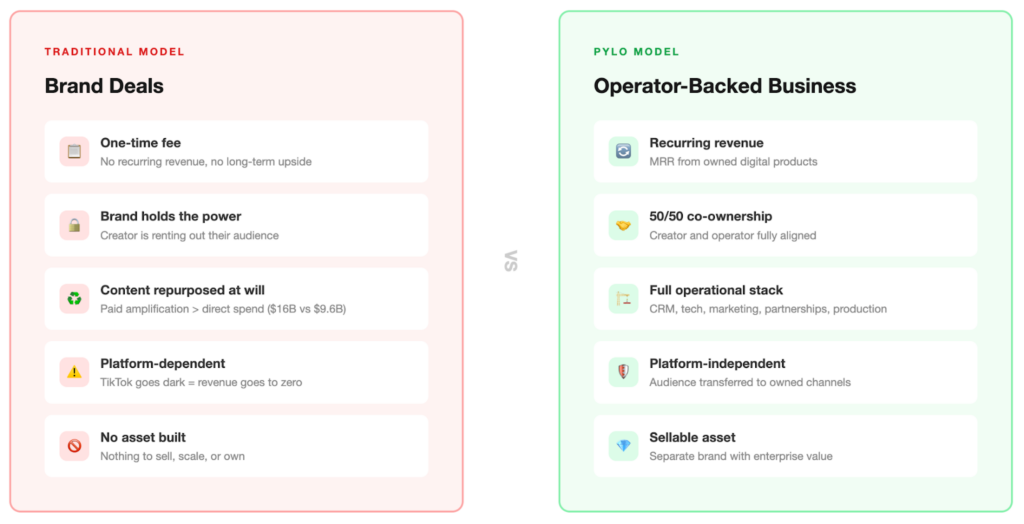
Brand deals are not going away. According to IAB data, paid amplification of creator content in the United States now exceeds direct creator spend: $11.2 billion versus $9.6 billion. That gap, he argues, reveals the real dynamic at play.
“With brand deals, a creator is essentially renting out their community to a brand,” he says. “The brands hold the power, not the creators.”
Pierre-Louis notes that the math favors the brand in every scenario. A creator receives a one-time fee; the brand extracts ongoing value from repurposed content. When brand strategy shifts or a creator’s style evolves, the relationship ends. “Creators think they’re being courted, but it’s only their audience the brand wants,” he says.
The TikTok outage last year illustrated the stakes. Creators with millions of followers and no owned platforms had no fallback. Pierre-Louis frames the lesson directly: “If a creator has transferred their audience from social media to a platform they own, their business continues to exist. Brand deals don’t.”
Why Creators Fail When They Go Alone
The typical path for a creator attempting to launch a business independently involves hiring freelancers, working with friends and family, and, in Pierre-Louis’ view, underestimating the gap between building an audience and running a company.
“They underestimate the complexity: pricing strategy, supply chain, customer support, retention, team management,” he says. “What works in a YouTube video doesn’t translate to product design.”
The pattern holds even when launches go well. A creator’s distribution channel drives an initial spike, but without CRM infrastructure, a retention loop, or a conversion architecture, growth stalls within months. “Most creators think that posting a story will convert directly into sales,” he says. “At Pylo, the majority of our revenue consistently comes from nurturing email flows, not stories and posts. Those are just the top of the funnel.”
The broader issue is operational appetite. Most creators chose their profession for freedom, not to manage teams or navigate supply chains. “Not all creators want to be a CEO or entrepreneur,” Pierre-Louis says. “Creating content is one thing. Selling is another.”
The Operator Model
Pylo occupies an unusual position in creator services. It is not a management agency, a marketing contractor, or a traditional venture studio. Pierre-Louis describes it as all three simultaneously.
“We ideate, we co-found, we operate, and we advance all the costs,” he says. “No one in this space does all four simultaneously.”
The revenue share structure is deliberate. Upfront fees would position Pylo as a contractor, which Pierre-Louis sees as corrosive to the long-term alignment these partnerships require. “If they fail, we fail. If they win, we win,” he says. According to the NeoReach data he cites, creators with professional management earn three times as much as those without, and creators who own their brand earn twice as much. “We sit at the intersection of both,” he says.
Before committing, Pylo runs a full audit: engagement quality, retention signals, purchase intent, and a creator’s ability to adapt to algorithm changes. Filling out a form, Pierre-Louis notes, is a meaningfully stronger signal of audience intent than a tap. “We can’t launch ten brands at a time, so we need to select carefully,” he says. “This is a multi-year commitment on both sides.”
Digital First, Then Physical
Pylo’s product sequencing is a direct response to the economics of creator-brand launches. As Pierre-Louis explains, physical product lines require working capital, supply chain infrastructure, and longer iteration cycles. Digital products can be launched faster, iterated quickly, and scaled without inventory risk.
“You can launch way faster than anything. You have higher margins. It’s scalable,” he says. “We couldn’t launch five physical brands, but we can launch five digital products.”
More importantly, he adds, the digital-first approach generates the data needed to justify the risk of physical expansion. With Le Studio, thousands of paying subscribers now represent a built-in demand signal for future product lines, including a forthcoming capsule collaboration with a major European activewear brand. “We have thousands of clients on the platform already waiting for [Alice] to launch a physical product,” he says. “They’ll buy it way easier than if it’s just a new brand with no existing customer base.”
A second brand in the Pylo portfolio is a manifestation and self-improvement platform built with Stephanie, an Australian wellness creator based in Miami. A third is in development with Leia, one of France’s top voices in sexual wellness for women, where Pylo identified a white space in the French market modeled on the success of comparable U.S. platforms.
Building to Sell
One distinction Pierre-Louis enforces from the outset of every partnership is the separation between creator and brand. The two are designed to operate as distinct entities, with separate social accounts, separate visual universes, and separate communities.
“To build something sellable, it needs to live on its own,” he says. “The creator accelerates distribution. They’re the rocket fuel. But the brand needs its own engine.”
Pierre-Louis shares that Le Studio’s brand account has accumulated over 30,000 followers independently of Alice’s personal feed. He points to Hailey Bieber’s rhode acquisition as the proof of concept. “Exit events are becoming more common, but they only happen if the brand was designed to be separable from the start,” he says. “That’s exactly how we build.”
A fund acquiring a creator-backed brand, he notes, is buying more than recognition. “A fund doesn’t just buy the brand. It buys the team behind it,” he says. “You need a structured operation behind it, one that can survive without the creator on camera every day.”
From Creator Economy to Creator Industry
Pierre-Louis is not predicting the end of brand deals. With the majority of CMOs planning to increase creator budgets in 2026, and legacy television budgets continuing to migrate toward social, he expects the sponsorship market to keep growing. What he expects to change is the hierarchy.
“Brand deals will become the side income, not the main income, for top creators,” he says. “Operator-backed businesses will be the primary and recurring revenue source. The smartest creators are already making this transition.”
The examples he cites are instructive in their scale. Sissy MUA generates millions of euros annually with a single fitness app built for the French market. Rhode was acquired for over $1 billion. MrBeast is building a $5 billion holding company. “These aren’t influencers,” Pierre-Louis says. “They’re industrial players. We’re no longer witnessing the Creator Economy. This is becoming the creator industry.”
“The winners of this decade won’t be the creators with the most followers,” he concludes. “They’ll be the ones with the best operators behind them.”
Subscribe to Our Newsletter
Check Out Our Podcast