






Technology
How NILENT’s Gamified Platform Is Providing NIL Education For Gen Z Athletes

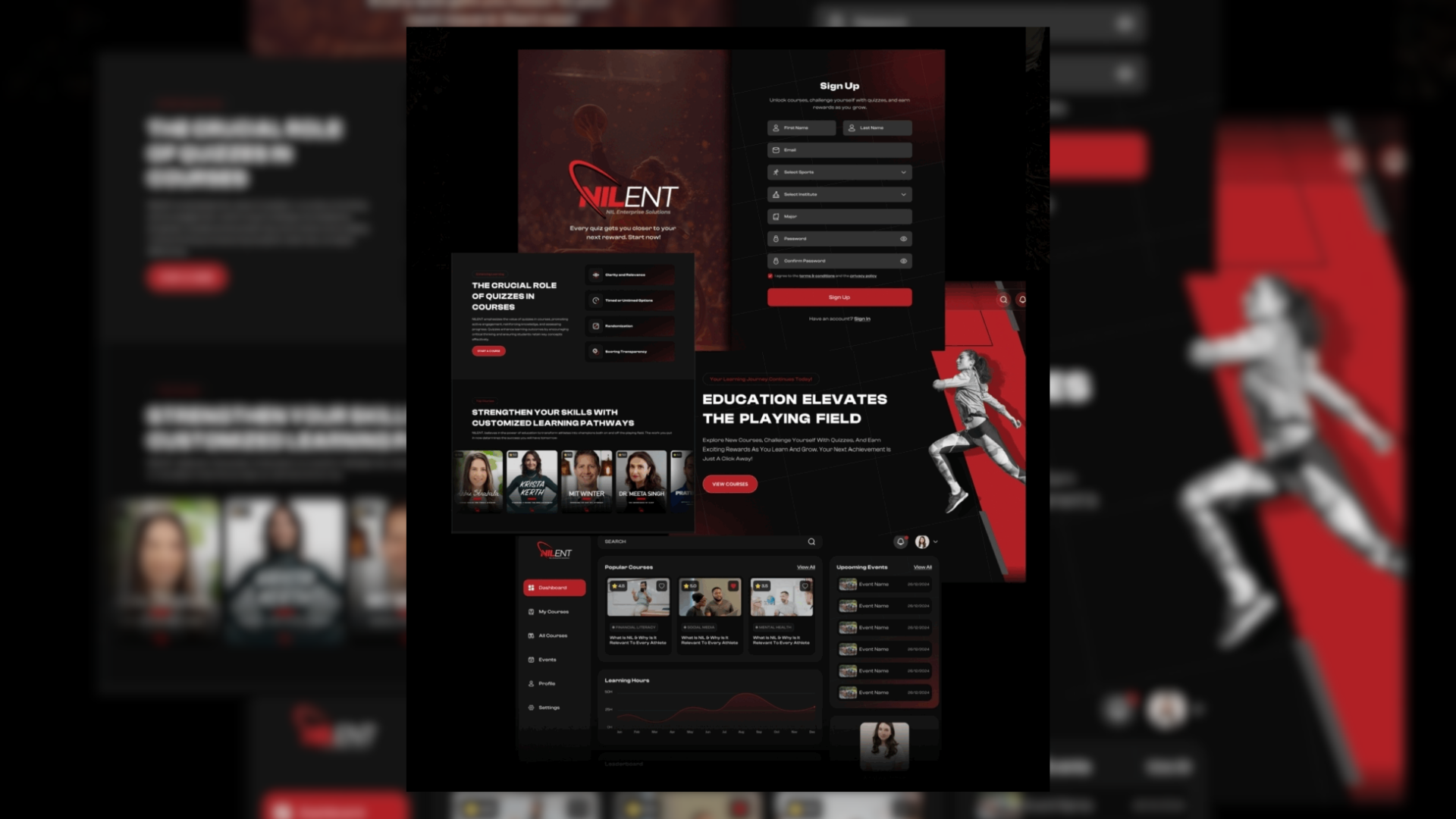
NILENT (NIL Enterprise Solutions), founded in late 2021, offers a digital gamified education platform specifically designed for collegiate athletes managing Name, Image, and Likeness (NIL) opportunities. The platform delivers 3-5 minute video modules on financial literacy, mental health, brand building, and career transition, all taught by professional athletes and industry experts who share real-world experiences.
“NIL isn’t about four years, it’s about 40,” explains Steven Simmons, co-founder and Chief Operating Officer of NILENT. “How you carry yourself on social media, how you interact with brands, how you build your own brand – you’re laying the groundwork for the next 40 years, after you’re done playing.”
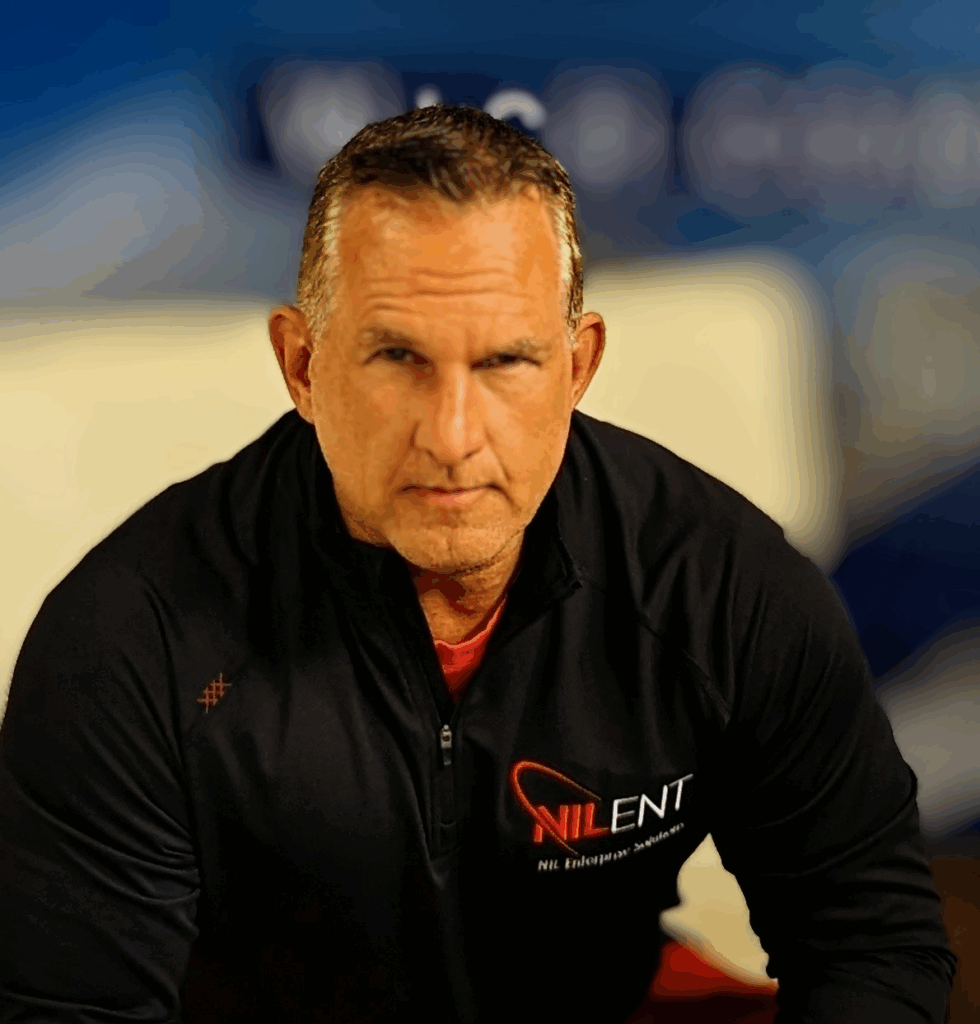
Steven Simmons
Simmons and co-founder Peter Hassen, who spent nearly 20 years with the Chicago Blackhawks organization, created NILENT after witnessing firsthand the challenges athletes face with financial management and career transitions.
Understanding the Digital Generation
The NILENT team quickly discovered that reaching today’s college athletes required a complete rethinking of educational delivery. Early attempts at traditional instruction proved ineffective with their target audience.
“Our initial modules were 10-15 minutes, and it was an eternity. The athletes lost focus. It didn’t matter who was teaching or what the subject was,” Simmons reveals.
After extensive consultation with student-athletes themselves, NILENT transformed its platform. “Once we cut these down to 3-5 minutes and added graphics to keep it interesting, it made all the difference,” Hassen says. “We could cut right to the point for these college athletes.”
The result is what NILENT describes as a hybrid of “Masterclass meets TikTok” – professional-quality educational content delivered in a format that today’s college athletes actually consume. The platform’s Netflix-style interface presents short modules that maintain engagement through visual stimulation and concise messaging.

Gamification: Turning Education Into Achievement
Observation of how young people engage with technology provided another crucial insight for the NILENT platform. Watching his 17-year-old son interact with video games, Simmons noticed patterns that informed NILENT’s strategy.
“I watch how he and his friends interact with games; everything is about, ‘I’m beating so-and-so,’ ‘I ranked higher,’ or ‘I won this reward,’” Simmons says. “We realized that had to be part of it.”
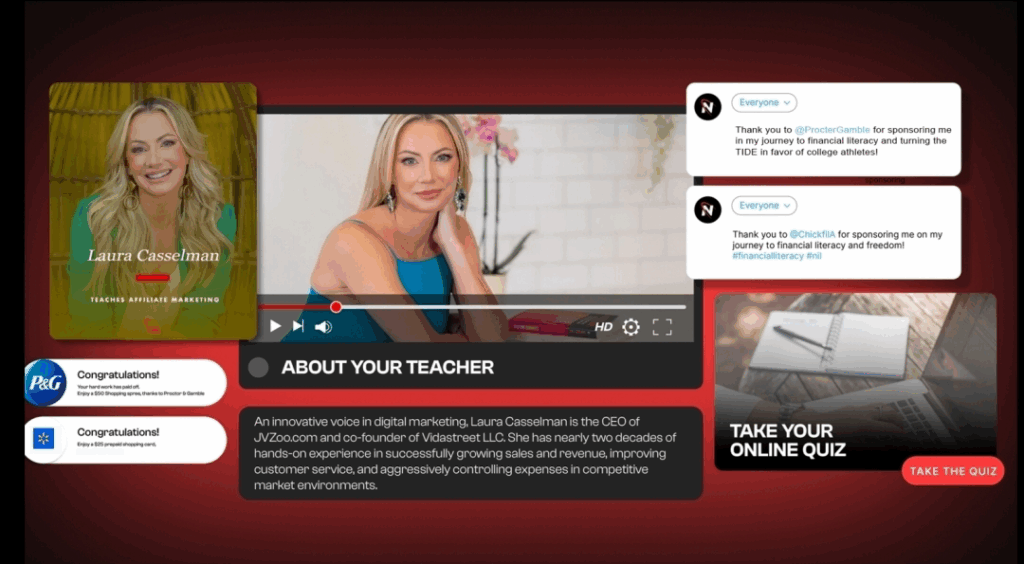
This insight led to NILENT’s distinctive reward system. Athletes who complete educational modules and pass subsequent quizzes earn tokens redeemable with brand partners. These rewards range from gift cards to retail stores to airline miles, with more valuable rewards available as athletes complete additional modules.
“So I finish a module on taxes and get a token, maybe a $10 Dick’s Sporting Goods card, a $20 Amazon card, or airline miles,” Hassen explains. When athletes accept these rewards, they must create social media content showing themselves with the reward and thanking the sponsoring brand.
Simmons believes the system creates a virtuous cycle where athletes share their rewards on social media, providing brands with genuine endorsements while reinforcing the educational value for the students. “For brands, it’s a great way to interact with this demographic in a way nobody else is doing,” he says. “They also get a feel-good campaign backing financial literacy and mental health.”
Reimagining Brand-Athlete Relationships
For brands seeking to connect with Gen Z consumers, NILENT offers an alternative to traditional influencer marketing that aligns with how young athletes actually engage with products and services.
“We always look at it like ‘Fortnite,’” Simmons says. “When students play ‘Fortnite’ and suddenly Taco Bell is integrated – you can buy a taco skin. My son had no affinity for Taco Bell, but then came home the other night with a Taco Bell bag. It’s working.”
This information-based approach allows NILENT to match brands with athletes who show actual interest in their products. “We’re a data play. We see who the athletes are, where they’re based, what their sport is,” Hassen explains. “If we see 50 athletes from Florida Atlantic University all liked a Gatorade reward, we can identify a few who’d make great ambassadors.”
By doing so, the company creates opportunities for athletes in less prominent sports who might otherwise be overlooked in traditional NIL deals. “For marquee athletes like Livvy Dunne or Caitlin Clark, the path is clear,” Simmons notes. “But now rowers, lacrosse players, and golfers also have the chance to build an NIL platform.”
Education for a Digital-First Career Path
NILENT’s approach to career development reflects the aspirations of today’s college athletes, many of whom are already thinking like entrepreneurs.
“Lots of athletes are entrepreneurs,” Hassen points out. “They want to know how to launch a business, how to invest in one.” The platform aims to address these ambitions with practical guidance on modern career paths, including content creation and personal brand development.
The team deliberately made student feedback a central part of their development process. “We didn’t want to decide how the platform should look and work,” Simmons notes. “We went to the athletes and athletic departments: ‘Give us feedback, tell us what works.’” This collaborative approach ensures the platform genuinely resonates with its users.
NILENT emphasizes that the skills learned through the platform have applications well beyond sports. “We tell these athletes, ‘You’re not just trying to get a corporate sponsor’s attention, but also a recruiter’s,’” Hassen says. “If I’m a recruiter, I want to hire you because you’re showing key skill sets.”
Managing Compliance in a Complex Field
Beyond engaging Gen Z learners, NILENT also helps athletes handle the complex compliance challenges of the NIL field, where rules vary by state, school, and sport.
“Any deal you get should be reviewed by an attorney to protect yourself,” Simmons advises. He cites examples where young athletes sign with local brands only to later receive offers from Nike or Under Armour, but find themselves locked into restrictive contracts.
The platform offers schools a way to track educational compliance with financial literacy requirements. “In New York, for example, athletes need five hours of financial literacy before competing,” Hassen says. “Is it strictly enforced? Not always. But schools can monitor and push athletes to keep up.”
A Vision for Sustainable Influence
Looking to the future, NILENT sees the meeting point of NIL and the creator economy as a space where a genuine appeal will be the key differentiator. Hassen observes that “athlete creators usually have better ROI than traditional influencers,” mainly because their engagement feels more authentic.
For college athletes looking to build their presence as creators, Simmons offers the following advice: “Treat it like a business. You’re the CEO of your brand. Nobody will support it more than you.” He encourages athletes to partner with causes and brands that truly matter to them, as this creates the most sustainable partnerships.
As NILENT continues to expand with new content and partnerships, its core mission remains helping young athletes translate their collegiate experience into long-term success. “Find things that align with your interests and beliefs,” Simmons concludes. “That makes it genuine, realistic, and sustainable.”
Checkout Our Latest Podcast