





Tech
As Institutional Money Flows Into Creator Content, Curbily Is Building the Studio Infrastructure Behind It

Jon Barnett has spent 15 years in creator production watching the same scene play out: a creator blows up, gets a budget, hires their friends for jobs they have never done before, loses track of the money, and burns out. Curbily, the Los Angeles startup he co-founded in 2024, is his attempt to interrupt that cycle.
Jon came up as a production assistant at “Jimmy Kimmel Live” and spent most of the following decade as a supervising and lead producer at pocket.watch and Jellysmack, working alongside some of YouTube’s largest creator channels. He watched creators at the top of their game run into a production wall they had no framework to navigate.
“It always breaks my heart when I see someone say, ‘I’m leaving YouTube,'” Jon says. “It’s always the same reason. It’s just too much.”

Curbily operates as a two-sided platform. The Studio side functions as an AI line producer: a creator drops in a concept, beat sheet, or script and receives a script breakdown, shot list, budget, schedule, and call sheet. The Creator Campaign side connects brands to a network that currently includes 2,900 creators managed by 60 talent management firms, according to the company. Brands pay for access; creators, managers, and crew members join for free.
Production Stayed Broken Because Nobody Thought It Was Broken
For most of the Creator Economy’s first decade, production infrastructure was not recognized as a missing piece. Creators who built audiences from home did not immediately register the distance between what they were doing and what professional content would eventually demand.
“Most creators made it holding a phone or a camera in their bedroom,” Jon says. “When they start to go viral, when they start to build an audience, it can be a little intimidating because they don’t know where to go next.”
Before Curbily, the standard approach was improvisation. Jon describes what he consistently saw when creators called him for help: Excel sheets stitched together, friends hired into roles they had never performed, budgets tracked by intuition. “I don’t think most people are keeping up with their budgets,” he says. “They’re like, ‘I know I have $30,000 this month.’ And then you look back at your bank account, and you’re like, ‘Oh no, what happened?'”
The existing software alternatives – Movie Magic, StudioBinder, and Filmustage among them – were built for a different tempo. “Traditional budgeting and scheduling software is made for making three movies a year or one television show,” Jon says. “They aren’t built for creators who literally need to make three videos this week.”
From Concept to Call Sheet in Minutes
Curbily’s production workflow takes roughly 30 seconds to initialize. A creator logs in, clicks new project, and either uploads their source material or uses the platform’s concept generator to draft a script. From there, the system runs through a script breakdown, shot list, sourcing recommendations with purchase links for props and wardrobe, a budget calibrated to the creator’s stated number, a production schedule, and a call sheet.
Jon describes the full run as taking about ten minutes and prices eventual access at $79.99 per month, with early users currently receiving free runs while the company refines the product. A crew network runs alongside the tool, where directors of photography, sound operators, and other crew members register free and receive location-based job suggestions. “They need you, and you need them,” Jon says. “Let’s figure it out.”
Human review still matters throughout. “You’re still going to want a human in the loop,” Jon says. “You don’t need to know how to build a budget. You just need to know how to look at the spreadsheet and say, ‘This should be four days, not three.'”
Rep’d Creators Move Faster, and Brands Pay for Speed
Curbily’s brand-side marketplace restricts listings to creators with management representation. The logic is accountability rather than exclusivity.
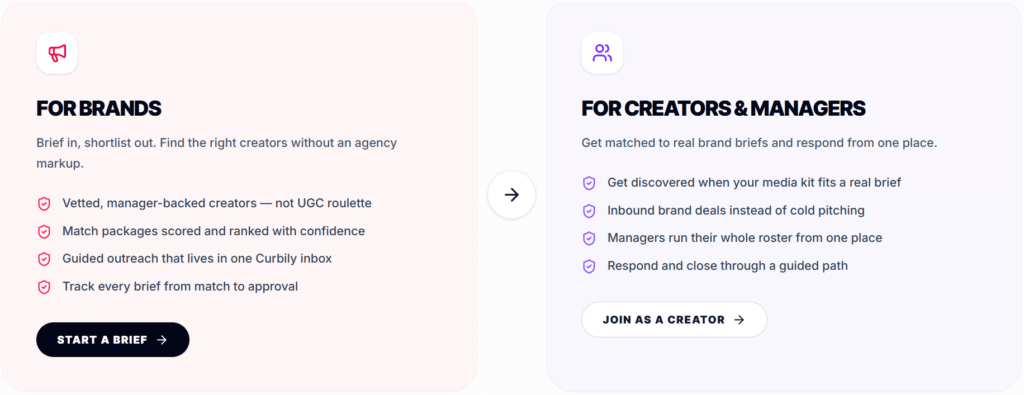
Creator management has proliferated sharply over the past several years. Jon estimates the industry has gone from a few hundred firms to far more, and brands that try to reach creators directly now run into management layers anyway. Curbily aims to make the management relationship a prerequisite rather than an obstacle.
“Anyone who’s repped, we know their manager is going to get in touch with them and make sure they follow up and follow through,” he says. “You’re not waiting days to get responses. You’re waiting minutes, if not hours.”
The brand side is where most of Curbily’s paying customers currently sit. The studio side is still gaining traction, partly because the market shift pushing creators toward professional production has only recently become visible.

Netflix’s Creator Deals Changed the Pitch
About two and a half years before Curbily launched, Jon and co-founder Kevin Herrera began calling management companies and venture capital firms to pitch production support. Nobody wanted it.
The conversation changed when major streaming and entertainment companies began announcing deals to bring YouTube creators into formal content pipelines. Jon cites moves by Netflix, Disney, and Tubi as turning points that prompted management companies to reconsider. “When they started signing these creators, I was like, ‘This is a big signal,’” he says. “Because now we have traditional and institutional money flowing into the Creator Economy.”
Jon also cites the recently launched $250 million creator fund from CAA and separate venture commitments he says total over $150 million from other firms.
His read on what follows is pointed: management companies sitting on large creator rosters, where not every creator converts consistently, will look for production infrastructure to unlock that supply. “My thesis is you’re sitting on all this supply, and not all of them are converting,” he says. “You’re going to want to find a way to leverage that.”
Jon predicts consolidation analogous to the Multi-Channel Network (MCN) era, this time backed by institutional capital. “I think we’re going to see a rise of the MCN again,” he says. “It’s going to make it a lot harder for someone working out of their bedroom.”
AI Is Good at Math. It Is Not Good at Being Creative.
Curbily started as an AI video editing company. It did not stay one. “We quickly found out that AI is not great at creative stuff,” Jon says. “Consistency across generation is hard. And it is so expensive.”
The company pivoted to logistics, where AI’s capabilities match what production operations actually require. “Where AI is really, really good is data entry and math. And that is literally all the logistics of running a studio.”
The platform’s outputs are structured decisions: how many days, how much spend, how many crew, who. Errors and adjustments still require a human reviewing the output, which Jon describes as intentional. “We’re not trying to take away jobs,” he says. “We’re trying to give people the ability to work in these fields.”
Hollywood’s Contraction Is Sending Experienced Crew to the Creator Economy
The entertainment industry’s reduction in traditional production volume has a second-order effect Jon discusses directly. Experienced crew, assistant directors, directors of photography, and sound operators are working fewer jobs than several years ago, and the roles that remain tend to go to people already inside established networks.
“There’s not a lot of jobs for first timers,” Jon says. “The best way to get a foot in now is to work with a creator.”
He describes a recent conversation with an assistant director who now works roughly one major production per year, down from several previously. “I said, ‘There are so many creators out there that are willing to pay you six figures, but you don’t know them, and they don’t know you,'” Jon recalls. “And that’s 219 million creators across the world making money, and a good chunk making six, seven, eight figures a year.”
Jon notes that the crew portal on Curbily is designed to bridge that disconnect, surfacing location-matched opportunities for crew who otherwise have no path into the Creator Economy.
A Producer for Everybody
Jon’s five-year vision for Curbily circles back to infrastructure. “We want to be the first stop when you’re like, ‘I need crew,’ or ‘I have $5,000, and I really want to make something,'” he says.
The Creator Economy has built infrastructure for distribution, audience growth, monetization, and brand deals. The operating layer governing what happens once a creator commits to a real production, the budgeting, staffing, scheduling, and coordination, is still mostly improvisation. That mismatch is becoming more expensive as institutional money pushes creators toward content that requires professional execution.
“A producer for everybody,” Jon says. “That’s where we want to be in the next five years.”
Subscribe to Our Newsletter
Check Out Our Podcast