






Tech
Fypro.ai Is Building an AI Creator Success Manager to Turn Audiences Into Owned Businesses

Steven Zhou spent more than two decades across ecommerce and consumer brands before moving into the Creator Economy in 2023. Early on, he watched a little-known creator turn a single viral video into more than a million dollars in sales and a level of recognition that followed her into daily life, while others posting with the same effort and consistency never got a comparable break. That inconsistency, he says, pointed to a missing layer of support that most creators simply couldn’t access.
“Could there be a solution in which AI actually becomes a digital creator success manager that provides the resources, advice, and a personalized growth plan?” Steven mused. That notion became Fypro.ai.
Fypro.ai, a product of Caelith AI, launched publicly at VidCon 2026 in Anaheim in June. Caelith AI was founded in 2025 and is based in Southern California. The platform reads a creator’s social handle, produces a personalized growth plan, and builds the branded site, storefront, and customer list behind it. In a written follow-up after the interview, Steven said the product’s core focus today is creators with 5,000 to 100,000 followers. “Those creators are too big to wing it and too small for an agency to support them,” he says.
Fypro entered public beta with more than 2,000 active creators, a number Steven says is “growing every day,” and content planned on the platform generated more than 10 million views last quarter, according to the company.

The Growth Plan Starts With a Diagnosis, Not a Hook
A creator who drops their handle into Fypro first gets a baseline report built from public data: audience demographics, content style, engagement rate, and niche. Connecting a TikTok account unlocks a deeper version of the same report, which Steven says feeds a fuller growth plan, including a branded page.
The AI has been trained on more than four million videos, according to the company, and uses that dataset to identify which hooks and content structures tend to perform within a given niche. It then benchmarks a creator against comparable accounts in the same category. “We give you the top three, and then we tell you exactly the gap between you and the top creators,” Steven says.
The first payoff, Steven notes, lands immediately. Creators describe the initial diagnostic as “eye-opening” because, for the first time, they can point to a concrete, data-backed answer for what is driving their growth, rather than a guess.
Product Picks Only Show Up When the Data Says a Creator Is Ready
Fypro’s output isn’t a single template. Depending on where the diagnostic places a creator, the branded page it builds can be a simple link-in-bio, a hybrid site pairing a story with content blocks, or a full storefront. Steven says the platform asks for a creator’s approval before any of it goes live.
Product recommendations follow the same logic. A creator whose content sits in a category without an obvious retail angle, such as true crime or horror storytelling, isn’t pushed toward products at all. Instead, Steven says, the plan focuses on growing followers, affiliate fundamentals, and e-commerce literacy until product pairing makes sense.
“The plan adapts to where each creator is, rather than pushing a one-size-fits-all monetization path,” he says.
The Margin Pitch Rests on Traffic Creators Already Have
Fypro pulls its product pool from dropshipping catalogs, including AliExpress, but Steven says that an item only qualifies once two filters clear: it must already be warehoused and fulfilled inside the U.S., and it must show trend signal, newness, and fit with the platform a creator posts to.
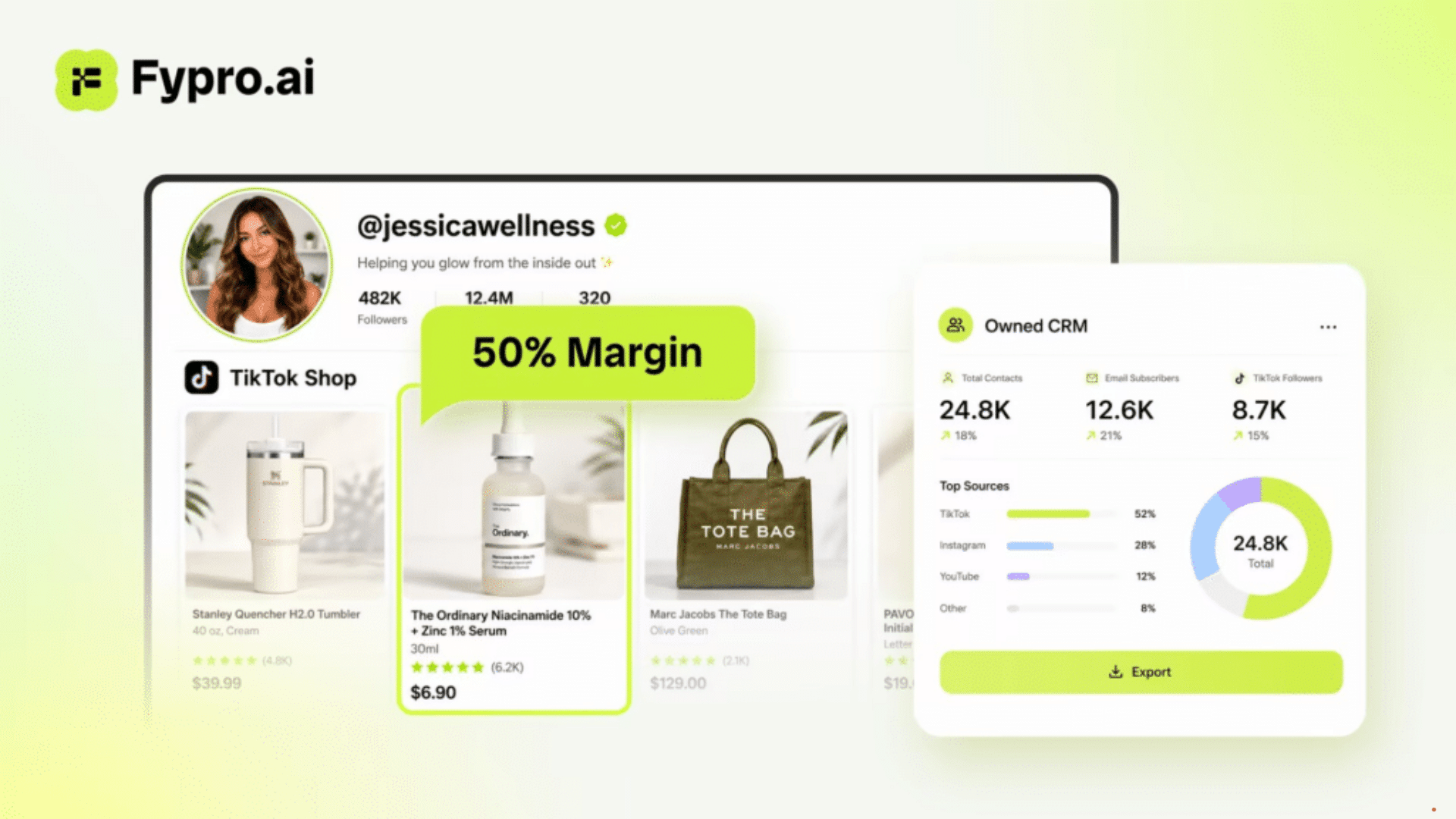
Fypro shows a gross margin of 30% to 70% on dropshipped products, above the roughly 10% typical of affiliate deals, according to the company. Steven attributes the gap to distribution cost. He notes that for a marketplace like Amazon, “traffic costs like 40% of the selling price are not uncommon,” while a creator’s audience is already built in and effectively free to reach.
Earning that margin, Steven says, comes down to the same behavior that makes a creator valuable in the first place: “posting consistently, maintaining strong engagement, and treating their page as a real storefront rather than a side hobby.”
An Owned Customer List, Not Just an Audience, Is the Asset
Every sale through a creator’s Fypro page adds an email address, purchase history, and repeat-buyer signal to a CRM the creator controls and can export. The day-to-day audience still lives on TikTok, but the page becomes the place where that relationship compounds independent of any single platform.
Steven argues that’s the more urgent problem for most creators, ahead of any single algorithm shift. Followers and engagement “live on the platform,” he says, “and then it can go to zero overnight” if an account is banned or a platform disappears.
The U.S. Creator Market Is Still More Fragmented Than Asia’s
Steven describes a persistent mismatch between brands, which he says often chase follower counts, and creators, whose actual value shows up further down the funnel. Much of the resulting monetization, in his account, settles at the affiliate level, which he estimates pays out around 10%.
He contrasts the U.S. market with what he describes as a more structured ecosystem in China and Southeast Asia, where he says information, support, and tools are more readily available to creators. Despite a crowded field of CRMs and marketplace tools in the U.S., he argues, the matching problem between brand, creator, and product remains unresolved, a gap he says extends beyond the creator space into other corners of e-commerce.
Replacing the Human Creator Manager Is Sensitive
Before tools like Fypro, Steven says, personalized growth advice came from human creator success managers, but one person could realistically support around 20 creators at most. On his account, that kind of support was largely reserved for creators above roughly the fourth of TikTok’s informal creator tiers, leaving the bulk of the platform’s creators without it.
On whether tools like Fypro challenge the role of talent managers and marketing agencies, Steven calls the question “kind of sensitive,” but answers “yes and no”: some labor-heavy human work is already being automated, he says, but he expects the shift to create more total work rather than less, concentrated in tools built with deep knowledge of a specific vertical rather than generic AI models.
The Bet Is on Ownership, Not on the Next Viral Hit
Steven frames the shift he’s building toward as a move “from influence to ownership,” where creators who build a direct relationship with their own audience data outlast those who simply chase reach. He expects that shift to accelerate as AI search tools reduce the click and referral traffic that once fed platform-based monetization, pushing more creators toward direct commerce over ad revenue and affiliate links.
On the risk that a platform like TikTok could disappear overnight in the U.S., Steven says he considers the odds low, but treats it as beside the point either way. “At the end of the day, it’s the creator who is the value, the core, not the platform,” he says.
“I think it’s a golden era to be a creator,” he says. “It’s just that you have to put in the work, and you have to be willing to do it.”
Subscribe to Our Newsletter
Check Out Our Podcast