




Agency
The Internal Politics of TikTok Shop: Why Brands Resist a Channel Already Outperforming E-Commerce Teams

Many brands still treat TikTok Shop as a pilot program. Itai Winter thinks that approach is becoming expensive. As VP of Social Commerce and Paid Media at Genni, a performance-driven creator marketing platform, he says he sees affiliate creators, including faceless accounts, outperform traditional e-commerce teams and argues that the window for low-cost distribution is already narrowing.
The tension, he says, is not only whether TikTok Shop can drive sales. It is what those sales imply inside companies built around older e-commerce structures. If one creator account can move more product than a brand’s existing digital operation, the question becomes less about channel testing and more about budget control, team ownership, and who gets credit for growth.
Genni, a Nashville-based platform and agency, helps brands manage creator sourcing, contracting, payments, and TikTok Shop optimization. Its clients range from independent beauty brands to entertainment properties, including Disney, Lollapalooza, and Dolly Parton.
Itai’s view of TikTok Shop comes from both paid media and creator operations. After being let go from a talent agency during the pandemic, he launched PushTok, a TikTok-focused media buying company, within ten days. Genni acquired the company four years later, a move Itai says was driven by the infrastructure required to manage creator commerce at scale.
“I discovered social commerce, and I discovered that I did not have the infrastructure required to activate so many creators at scale,” he explains. “That’s where Genni really came in for me personally.”
Before PushTok, Itai worked in the music industry booking tours and managing talent, including artists such as Jelly Roll and 50 Cent. He says that experience shaped how he thinks about creator relationships, distribution, and why brands often misunderstand what creators contribute.
Discovery Commerce Has Matured Faster Than Brand Teams
Itai draws a clean distinction between how people shop on Amazon and how they shop on TikTok. Amazon trained consumers to arrive with intent, searching for a specific product category. TikTok inverts that. “I’ll be scrolling on the platform, and then I’ll see a kitchen utensil I really like,” he says. “That’s context-driven, discovery-driven shopping.”
That structural difference, he argues, was understood by the music industry long before consumer brands figured it out. Record labels grasped distribution as a way to penetrate TikTok’s algorithm early, seeding creators with songs before anyone called it a strategy. But Itai is careful not to overcredit them. “I think the music industry monetized attention the old way with new packaging, essentially,” he says. “The real innovation is happening in commerce, not culture.”
The evidence he points to is concrete. In research he reviewed recently, 180 faceless affiliate accounts on TikTok Shop, creators who have never shown their faces on the platform, generated a combined $38 million in gross merchandise value (GMV) in a single 30-day period. One account, “Cake Find 6,” alone drove $2.2 million, he says. “That’s more than some shops in major malls generate,” Itai notes. “To me it’s not an experiment.”
Why Brand Teams Resist TikTok Shop (and What It Actually Costs Them)
Itai has a theory about why otherwise data-savvy companies keep hedging on TikTok Shop: internal politics. A single affiliate creator can consistently outperform a brand’s entire traditional e-commerce operation. That result does not fit neatly into existing org charts.
“That might be a political problem within the company,” he says, “but it kind of turned the whole system on its head.” The resistance, he argues, is not about skepticism of the platform’s commercial potential. It’s about what success there implies for the people who currently run e-commerce budgets.
His pitch to CFOs is that creator seeding can deliver distribution at a price that traditional paid media often cannot match. “If I can get you the same amount of views that a Super Bowl commercial does for a dollar CPM,” he says, “wouldn’t you prefer that versus a Super Bowl? Most businesses are not Apple.”
What TikTok Shop Requires After Brands Say Yes
The Scent Beauty case study is Genni’s most-cited proof point. In three months, the platform helped launch the brand on TikTok Shop, driving more than $350,000 in GMV, 8,000 new customers, 20 million product impressions, 650,000 shop visits, and 2,500 creator videos, according to the company.
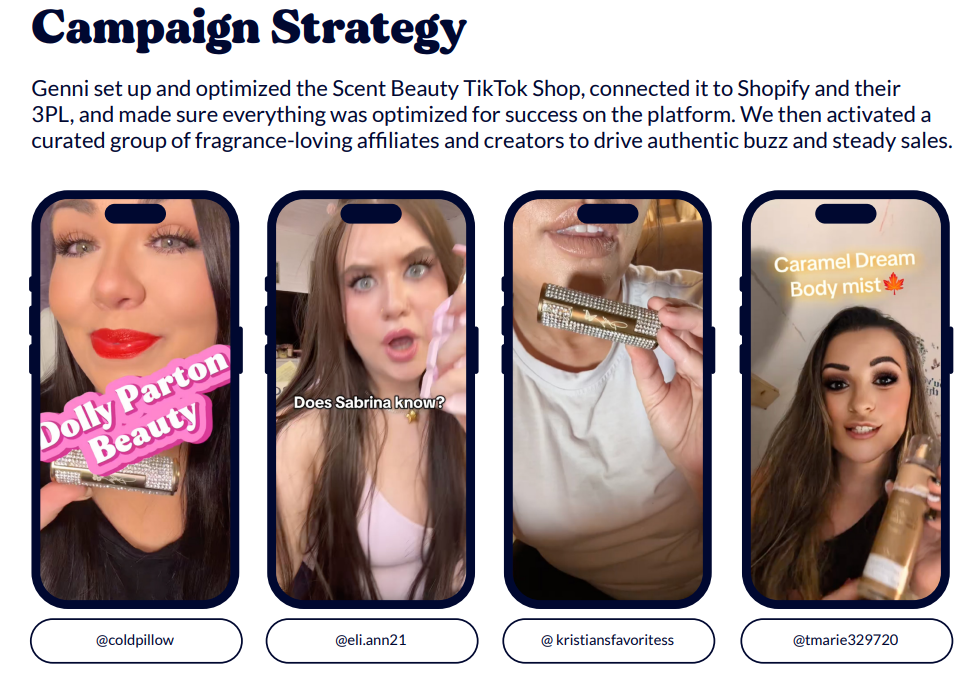
The brand was later invited to TikTok’s Beauty Besties Event, connecting with more than 200 top creators. Dolly Parton’s team subsequently worked with Genni to launch her fragrance, “Scent From Above,” through the same shop.
The process behind those numbers is methodical. Genni begins by narrowing a brand’s assortment to a small set of SKUs, a step Itai says is often underestimated. “Some companies have massive assortments, and you need to figure out exactly what to focus on at first because you can’t focus on everything.” In the first month, Genni seeds 30 to 40 products to creators. By the second month, that scales to 80 or 100. Creators who posted in month one are re-engaged in month two, because they already have the product and will keep featuring it.
The team then analyzes every video for commercial performance, examining hook, format, length, and opening shot to identify which archetypes drive revenue. Those patterns become templates for scaling. Promotional placements on TikTok itself, including invite-only activations that Genni’s relationships with platform reps help unlock, layer on top.
“There are activations that are visible to almost every seller on the platform,” Itai explains. “Others are kind of secret, and you have to know exactly who to tap for them.”
Authentic Content Starts With an Honest Brief
Itai worked alongside artists and talent for years before moving into brand marketing. That experience informs how he thinks about the brief, the single document most likely to determine whether a campaign feels genuine or manufactured.
His diagnosis of most brand briefs is blunt. Every brand says it wants authentic content, then hands creators a three-page document full of required talking points and stages three approval rounds.
Genni’s approach is to replace written-only briefs with example videos. “Do this video, but focus on the selling points of one, two, three,” he says. “We prefer working with example videos rather than a written-only brief.” The goal is to communicate tone and format without restricting the creator’s own voice.
He also argues that brands systematically misread what creators actually contribute. Most companies understand that creators distribute content. Fewer recognize that creators carry market intelligence. “Creators can help brands find better alignment with audiences, unique selling points, and more relevancy,” Itai says. “They can help you understand what your product means to people, not just what it means to you and your company.”
On Platform Risk: Malls Have Been Closing for Years. Brands Still Open Stores.
TikTok’s regulatory situation in the U.S. has been volatile lately, with potential bans and political pressure creating genuine uncertainty for anyone building on the platform. Itai’s response to that risk is pragmatic rather than dismissive.
“Malls have been closing down for years now,” he says. “Companies still open stores in malls. No platform is for sure going to be around forever.” Meta, he notes, could suffer a catastrophic data breach tomorrow, and advertisers might leave. That possibility does not change the value of a presence there today.
The practical hedge he recommends is straightforward: own the customer data, and keep it out of TikTok’s systems. Treating TikTok Shop as a customer acquisition channel while routing data back to a brand-owned CRM means the relationship survives platform disruption even if the channel does not.
The Operating System for What Comes Next
Itai sees creator marketing expanding well beyond its current footprint. Owned AI avatars of creators, he predicts, will sit inside social commerce and partnerships departments within a few years. Content clipping, using existing creator material for secondary distribution, will become standard practice. Video analytics, as LLMs improve at pattern recognition, will grow into dedicated internal functions.
He also draws a parallel that captures his view of where creator marketing sits in the broader algorithmic field. Brands spent the early 2020s trying to sell to the algorithm rather than to customers, treating distribution as the end goal. The next iteration, selling to AI agents, strikes him as the same mistake in new form. “The AI agent is just the same as selling to an algorithm,” he says, “only that the AI agent has a credit card on it.”
Genni’s long-term aspiration is to become what Itai calls “the operating system” for creator marketing, a layer that handles execution complexity so brand teams can focus on strategy.
“Maybe your team is growing, maybe you’re just looking to plug a hole, maybe you’re looking to build something in-house, but you’re not quite there yet,” he says. “That’s what we hope and aim to do, just making all those difficult things really easy for you and your brand.”
Subscribe to Our Newsletter
Check Out Our Podcast