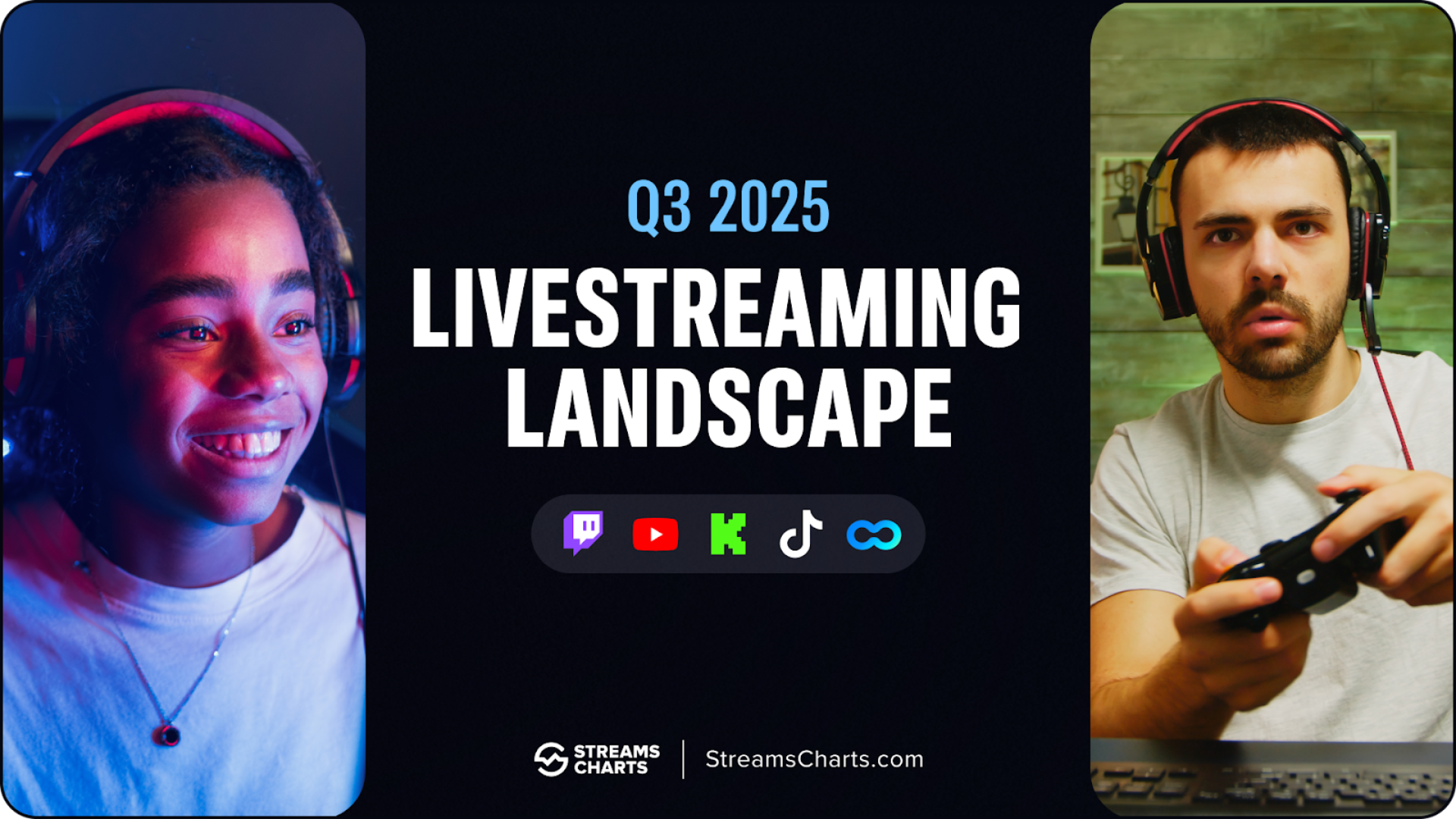
The livestreaming industry is undergoing homogenization, with major platforms increasingly resembling one another in terms of features, creator bases, and content offerings. This convergence is reshaping strategies for creators, agencies, and brands, according to Stream Charts’ “Q3 2025 Global Livestreaming Landscape” report.
For the first time in years, YouTube’s market share has fallen below the 50% threshold, dropping to approximately 45% in Q3. Despite generating 13.25 billion hours watched, the platform saw a 10.6% decline from the previous quarter while maintaining its position as the industry leader. This shift coincides with significant gains by competitors, notably TikTok Live, which expanded by 14.9% to reach 9.2 billion hours watched, capturing 31.2% of the market share compared to 27% in Q2.
“YouTube continues to be the top streaming platform in the industry, though its dominance slipped a bit in Q3,” the report states. “Additionally, YouTube’s share of total viewership across all platforms fell to about 45%, marking the first time in a long while that it has dipped below the 50% mark.”
Kick demonstrated even more dramatic growth, surging 55% to 1.7 billion hours watched, twice the amount recorded in Q1 2025. Meanwhile, Twitch maintained its third-place position with 4.3 billion hours watched, despite experiencing a 6.2% quarterly decline, described as one of its weakest quarters in recent years.
The overall industry remains stable despite fluctuations on individual platforms. Total hours watched across all platforms reached 29.45 billion in Q3, representing just a 0.5% quarterly decline that mirrors a similar pattern from Q2. This stability amid shifting market shares suggests viewers are migrating between platforms rather than reducing overall consumption.
A primary driver behind platform convergence is the erosion of creator exclusivity, accelerated by Twitch’s policy allowing creators to multistream across platforms. This change has transformed how content circulates through the ecosystem, with major creators simultaneously broadcasting to audiences on multiple services.
“Many top streamers, especially community casters in esports, now broadcast simultaneously across three or four services at once,” the report observes. “Services are losing their uniqueness – both in terms of exclusive content and exclusive creators.”
This policy shift has particularly impacted gaming content distribution. While Twitch continues to see declining gaming streams, platforms like YouTube, TikTok, and Kick are experiencing steady growth in gaming and esports viewership, a pattern that has remained consistent since early 2025. The report explicitly attributes this redistribution to Twitch’s decision to allow multistreaming, creating an environment where platforms share rather than exclusively control creators and their audiences.
The case of Darren “iShowSpeed” Watkins Jr. illustrates how the boundaries of content categorization are simultaneously blurring. The American streamer, who frequently appears in YouTube’s rankings, conducted his European travels and U.S. marathon tour entirely under YouTube’s Gaming category despite delivering primarily IRL (In Real Life) content with minimal gaming elements. This cross-categorization demonstrates how established content distinctions are becoming increasingly flexible as platforms converge.
Feature Mimicry and Content Blending Accelerate
Beyond creator sharing, platforms continue to adopt successful features from competitors, further reducing differentiation. “Platforms keep borrowing ideas from one another, from interface features to AI integrations,” the report states. “With each passing year, they’re becoming more alike – and at this rate, a few years from now, their main difference might just be the color of their logo.”
This feature convergence is accompanied by similar shifts in content distribution. Twitch, historically the gaming-focused platform, has seen gaming streams “steadily declining – a pattern seen in both Q1 and Q2 this year.” Meanwhile, its IRL content has remained flat, gaining share only because “the platform’s overall numbers are going down.”
In contrast, YouTube, TikTok, and Kick show “steady growth in gaming and esports viewership,” despite IRL content maintaining a significant presence on these platforms. This bidirectional movement suggests platforms are converging toward similar content mixes rather than maintaining specialized identities.
The evolution of platform content categories reflects this convergence. YouTube’s top categories saw Sports break into the top five in Q3, driven by football season coverage and the FIFA Club World Championship, with Brazilian streamer Casimiro “CazéTV” Miguel leading this category. TikTok Live continues to dominate in Chats, Fashion, and Outdoors categories, while Roblox leads its gaming content, slightly outperforming esports titles such as Garena Free Fire and Mobile Legends: Bang Bang (MLBB).
Tentpole Events Transcend Platform Boundaries
Major creator events generate substantial viewership spikes regardless of platform, demonstrating how creator-driven content increasingly transcends platform identity. These events now serve as the primary drivers of engagement metrics rather than day-to-day platform loyalty.
On Twitch, Spanish streamer Ibai “Ibai” Llanos broke platform records with his boxing event “La Velada del Año V,” attracting more than 14 million concurrent viewers. His personal channel reached 9.3 million viewers during the event, “a figure roughly equivalent to the population of a medium-sized European country like Sweden or the Czech Republic.” Similarly, American streamer Kai Cenat dominated Twitch in Q3 with his 30-day “Mafiathon 3.0,” accumulating nearly 82.5 million hours watched and becoming the platform’s most-followed streamer.
Regional platforms show the same event-driven pattern. CHZZK reached a new peak of 538,000 concurrent viewers for the League of Legends grand final at the Esports World Cup 2025. Even SteamTV, which saw a 38% quarterly decline in hours watched, benefited significantly from the “Battlefield 6” beta.
The success of these events across diverse platforms indicates that creator-driven tentpole moments are becoming platform-agnostic, with audience attention following content rather than platform affiliation. For creators and marketers, this suggests event programming may offer more consistent returns than platform-specific strategies.
While major platforms converge globally, regional services demonstrate how this homogenization extends to localized markets, albeit with unique competitive dynamics. The relationship between South Korean platforms SOOP Korea and CHZZK particularly illustrates how regional competition mirrors global patterns.
SOOP Korea maintains overall leadership among smaller platforms with 326.3 million hours watched despite a 5.6% quarterly decline, while CHZZK grew 2.7% during the same period. Their competition centers increasingly on content rights rather than platform features, with CHZZK capturing 27.6% of Esports World Cup 2025 viewership compared to less than 1% for SOOP Korea.
“SOOP Korea still dominates community casting, but CHZZK has been drawing larger audiences thanks to partnerships with major tournament series like the EWC – an event notably absent from SOOP Korea’s coverage,” the report notes. This shift from platform-based to content-rights-based competition echoes the broader industry trend toward content-centric rather than platform-centric engagement.
Other regional platforms demonstrate how specialization without adaptation leads to decline. Rumble has continued its gradual audience decline since December 2024, when it experienced explosive growth during U.S. presidential election coverage. The platform “is mostly known for political and news streams, but viewers appear to be growing tired of that kind of programming.” This decline suggests that even specialized platforms must diversify content offerings as the broader industry converges.
NimoTV exemplifies the severe challenges facing platforms that fail to adapt to convergence trends. Its performance has plummeted throughout 2025, with total hours watched and average viewership decreasing threefold since January, while the number of active channels dropped from more than 30,000 to fewer than 13,500 by September. The platform “nearly stopped broadcasting esports altogether,” despite esports being hugely popular among its Vietnamese audience, indicating a disconnection from content trends driving engagement elsewhere.
Seasonal Patterns Persist Amid Structural Changes
While platform convergence represents a structural shift in the industry, seasonal viewing patterns continue to influence performance across all services. YouTube Live experienced a four-month consecutive decline in hours watched starting in June, attributed to summer seasonality: “during the summer, people tend to spend less time on their devices and engage less with live streams, favoring IRL activities instead.”
This seasonality affects different content categories in varied ways. Gaming and esports viewership on YouTube peaked in August, “coinciding with the start of the summer stages of LCK (League of Legends Champions Korea) and LEC (League of Legends EMEA Championship),” while the “MLBB Mid-Season Cup 2025” final also contributed to this spike. Meanwhile, platforms focusing on outdoor and IRL content tend to see different seasonal patterns, creating opportunities for creators to strategically time content across platforms.
Kick’s month-to-month data reveals how these seasonal trends interact with platform growth trajectories. Despite its impressive 55% quarterly growth, the number of hours watched “gradually fell from 616 million in July to 511 million in September,” reflecting both seasonal patterns and “big events and marathons on competing platforms.” This indicates that while convergence may be homogenizing platform features and content, seasonal rhythms continue to provide strategic opportunities for creators to maximize engagement.
Implications for Creator Economy Professionals
For creators, agencies, and brands operating in this increasingly converged ecosystem, success requires adapting strategies as platform boundaries blur. According to the report, cross-platform distribution has become the norm, rather than a specialized approach, with content increasingly flowing across platforms regardless of its original destination.
Content that transcends traditional categorization, such as iShowSpeed’s travel streams under the gaming category, demonstrates how rigid content distinctions are dissolving. Creators who leverage this flexibility can maintain consistent branding while reaching diverse audiences across platforms.
The maturation of the livestreaming industry suggests a future where platform differentiation continues to decrease while competition for market share intensifies. This convergence simplifies content strategy by reducing platform-specific requirements while complicating platform relationships by requiring more sophisticated approaches to maximize reach and engagement across an increasingly homogenized ecosystem.
As the report concludes, platforms may eventually differentiate themselves primarily through aesthetic rather than functional differences: “at this rate, a few years from now, their main difference might just be the color of their logo.”
Image credit: Stream Charts The full report is available here
Dragomir is a Serbian freelance blog writer and translator. He is passionate about covering insightful stories and exploring topics such as influencer marketing, the creator economy, technology, business, and cyber fraud.
















The livestreaming industry is undergoing homogenization, with major platforms increasingly resembling one another in terms of features, creator bases, and content offerings. This convergence is reshaping strategies for creators, agencies, and brands, according to Stream Charts’ “Q3 2025 Global Livestreaming Landscape” report.
For the first time in years, YouTube’s market share has fallen below the 50% threshold, dropping to approximately 45% in Q3. Despite generating 13.25 billion hours watched, the platform saw a 10.6% decline from the previous quarter while maintaining its position as the industry leader. This shift coincides with significant gains by competitors, notably TikTok Live, which expanded by 14.9% to reach 9.2 billion hours watched, capturing 31.2% of the market share compared to 27% in Q2.
“YouTube continues to be the top streaming platform in the industry, though its dominance slipped a bit in Q3,” the report states. “Additionally, YouTube’s share of total viewership across all platforms fell to about 45%, marking the first time in a long while that it has dipped below the 50% mark.”
Kick demonstrated even more dramatic growth, surging 55% to 1.7 billion hours watched, twice the amount recorded in Q1 2025. Meanwhile, Twitch maintained its third-place position with 4.3 billion hours watched, despite experiencing a 6.2% quarterly decline, described as one of its weakest quarters in recent years.
The overall industry remains stable despite fluctuations on individual platforms. Total hours watched across all platforms reached 29.45 billion in Q3, representing just a 0.5% quarterly decline that mirrors a similar pattern from Q2. This stability amid shifting market shares suggests viewers are migrating between platforms rather than reducing overall consumption.
Cross-Platform Broadcasting Erases Content Exclusivity
A primary driver behind platform convergence is the erosion of creator exclusivity, accelerated by Twitch’s policy allowing creators to multistream across platforms. This change has transformed how content circulates through the ecosystem, with major creators simultaneously broadcasting to audiences on multiple services.
“Many top streamers, especially community casters in esports, now broadcast simultaneously across three or four services at once,” the report observes. “Services are losing their uniqueness – both in terms of exclusive content and exclusive creators.”
This policy shift has particularly impacted gaming content distribution. While Twitch continues to see declining gaming streams, platforms like YouTube, TikTok, and Kick are experiencing steady growth in gaming and esports viewership, a pattern that has remained consistent since early 2025. The report explicitly attributes this redistribution to Twitch’s decision to allow multistreaming, creating an environment where platforms share rather than exclusively control creators and their audiences.
The case of Darren “iShowSpeed” Watkins Jr. illustrates how the boundaries of content categorization are simultaneously blurring. The American streamer, who frequently appears in YouTube’s rankings, conducted his European travels and U.S. marathon tour entirely under YouTube’s Gaming category despite delivering primarily IRL (In Real Life) content with minimal gaming elements. This cross-categorization demonstrates how established content distinctions are becoming increasingly flexible as platforms converge.
Feature Mimicry and Content Blending Accelerate
Beyond creator sharing, platforms continue to adopt successful features from competitors, further reducing differentiation. “Platforms keep borrowing ideas from one another, from interface features to AI integrations,” the report states. “With each passing year, they’re becoming more alike – and at this rate, a few years from now, their main difference might just be the color of their logo.”
This feature convergence is accompanied by similar shifts in content distribution. Twitch, historically the gaming-focused platform, has seen gaming streams “steadily declining – a pattern seen in both Q1 and Q2 this year.” Meanwhile, its IRL content has remained flat, gaining share only because “the platform’s overall numbers are going down.”
In contrast, YouTube, TikTok, and Kick show “steady growth in gaming and esports viewership,” despite IRL content maintaining a significant presence on these platforms. This bidirectional movement suggests platforms are converging toward similar content mixes rather than maintaining specialized identities.
The evolution of platform content categories reflects this convergence. YouTube’s top categories saw Sports break into the top five in Q3, driven by football season coverage and the FIFA Club World Championship, with Brazilian streamer Casimiro “CazéTV” Miguel leading this category. TikTok Live continues to dominate in Chats, Fashion, and Outdoors categories, while Roblox leads its gaming content, slightly outperforming esports titles such as Garena Free Fire and Mobile Legends: Bang Bang (MLBB).
Tentpole Events Transcend Platform Boundaries
Major creator events generate substantial viewership spikes regardless of platform, demonstrating how creator-driven content increasingly transcends platform identity. These events now serve as the primary drivers of engagement metrics rather than day-to-day platform loyalty.
On Twitch, Spanish streamer Ibai “Ibai” Llanos broke platform records with his boxing event “La Velada del Año V,” attracting more than 14 million concurrent viewers. His personal channel reached 9.3 million viewers during the event, “a figure roughly equivalent to the population of a medium-sized European country like Sweden or the Czech Republic.” Similarly, American streamer Kai Cenat dominated Twitch in Q3 with his 30-day “Mafiathon 3.0,” accumulating nearly 82.5 million hours watched and becoming the platform’s most-followed streamer.
Regional platforms show the same event-driven pattern. CHZZK reached a new peak of 538,000 concurrent viewers for the League of Legends grand final at the Esports World Cup 2025. Even SteamTV, which saw a 38% quarterly decline in hours watched, benefited significantly from the “Battlefield 6” beta.
The success of these events across diverse platforms indicates that creator-driven tentpole moments are becoming platform-agnostic, with audience attention following content rather than platform affiliation. For creators and marketers, this suggests event programming may offer more consistent returns than platform-specific strategies.
Regional Dynamics Reflect Broader Convergence Trends
While major platforms converge globally, regional services demonstrate how this homogenization extends to localized markets, albeit with unique competitive dynamics. The relationship between South Korean platforms SOOP Korea and CHZZK particularly illustrates how regional competition mirrors global patterns.
SOOP Korea maintains overall leadership among smaller platforms with 326.3 million hours watched despite a 5.6% quarterly decline, while CHZZK grew 2.7% during the same period. Their competition centers increasingly on content rights rather than platform features, with CHZZK capturing 27.6% of Esports World Cup 2025 viewership compared to less than 1% for SOOP Korea.
“SOOP Korea still dominates community casting, but CHZZK has been drawing larger audiences thanks to partnerships with major tournament series like the EWC – an event notably absent from SOOP Korea’s coverage,” the report notes. This shift from platform-based to content-rights-based competition echoes the broader industry trend toward content-centric rather than platform-centric engagement.
Other regional platforms demonstrate how specialization without adaptation leads to decline. Rumble has continued its gradual audience decline since December 2024, when it experienced explosive growth during U.S. presidential election coverage. The platform “is mostly known for political and news streams, but viewers appear to be growing tired of that kind of programming.” This decline suggests that even specialized platforms must diversify content offerings as the broader industry converges.
NimoTV exemplifies the severe challenges facing platforms that fail to adapt to convergence trends. Its performance has plummeted throughout 2025, with total hours watched and average viewership decreasing threefold since January, while the number of active channels dropped from more than 30,000 to fewer than 13,500 by September. The platform “nearly stopped broadcasting esports altogether,” despite esports being hugely popular among its Vietnamese audience, indicating a disconnection from content trends driving engagement elsewhere.
Seasonal Patterns Persist Amid Structural Changes
While platform convergence represents a structural shift in the industry, seasonal viewing patterns continue to influence performance across all services. YouTube Live experienced a four-month consecutive decline in hours watched starting in June, attributed to summer seasonality: “during the summer, people tend to spend less time on their devices and engage less with live streams, favoring IRL activities instead.”
This seasonality affects different content categories in varied ways. Gaming and esports viewership on YouTube peaked in August, “coinciding with the start of the summer stages of LCK (League of Legends Champions Korea) and LEC (League of Legends EMEA Championship),” while the “MLBB Mid-Season Cup 2025” final also contributed to this spike. Meanwhile, platforms focusing on outdoor and IRL content tend to see different seasonal patterns, creating opportunities for creators to strategically time content across platforms.
Kick’s month-to-month data reveals how these seasonal trends interact with platform growth trajectories. Despite its impressive 55% quarterly growth, the number of hours watched “gradually fell from 616 million in July to 511 million in September,” reflecting both seasonal patterns and “big events and marathons on competing platforms.” This indicates that while convergence may be homogenizing platform features and content, seasonal rhythms continue to provide strategic opportunities for creators to maximize engagement.
Implications for Creator Economy Professionals
For creators, agencies, and brands operating in this increasingly converged ecosystem, success requires adapting strategies as platform boundaries blur. According to the report, cross-platform distribution has become the norm, rather than a specialized approach, with content increasingly flowing across platforms regardless of its original destination.
Content that transcends traditional categorization, such as iShowSpeed’s travel streams under the gaming category, demonstrates how rigid content distinctions are dissolving. Creators who leverage this flexibility can maintain consistent branding while reaching diverse audiences across platforms.
The maturation of the livestreaming industry suggests a future where platform differentiation continues to decrease while competition for market share intensifies. This convergence simplifies content strategy by reducing platform-specific requirements while complicating platform relationships by requiring more sophisticated approaches to maximize reach and engagement across an increasingly homogenized ecosystem.
As the report concludes, platforms may eventually differentiate themselves primarily through aesthetic rather than functional differences: “at this rate, a few years from now, their main difference might just be the color of their logo.”
Image credit: Stream Charts
The full report is available here
Subscribe to Our Newsletter
Check Out Our Podcast