




Technology
From Platform Monetization To Inbox Reality: Why Austin Chen Is Rebuilding The Deal Layer Of The Creator Economy

After more than a decade building creator monetization and discovery tools inside some of the world’s largest technology platforms, Austin Chen is now focused on a less visible, but increasingly critical part of the creator economy: the inbox.
Austin is the co-founder and CEO of Marlo, an AI-native deal desk designed for talent management and creator teams. Founded in January 2025, Marlo sits directly inside email workflows and helps managers turn inbound brand interest into structured, prioritized, and ultimately signed deals. The product does not replace managers or automate judgment. It maintains deal context, linking creator rates, previous buyers, and results, and thus enabling talent managers to operate swiftly with nuance.
Marlo reflects a shift in Austin’s career from platform-side monetization to creator infrastructure. Before founding the company, Austin served as Director of Product Management for creator monetization at TikTok, and previously as Head of Product at Apple’s Platoon, an artist-focused division. Earlier, he co-founded Asaii, a machine-learning platform for artist discovery that Apple acquired in 2018. Across those roles, Austin gained deep insight into creator monetization and repeatedly observed how deal execution becomes fragmented once interest moves off-platform.
“There are millions in creators’ inboxes that are just being lost,” Austin says. “Even a mid-sized creator can get hundreds of inbound messages a day. A lot of it is noise, but buried in there are real opportunities that never get surfaced.”
Why the Inbox Became the Bottleneck
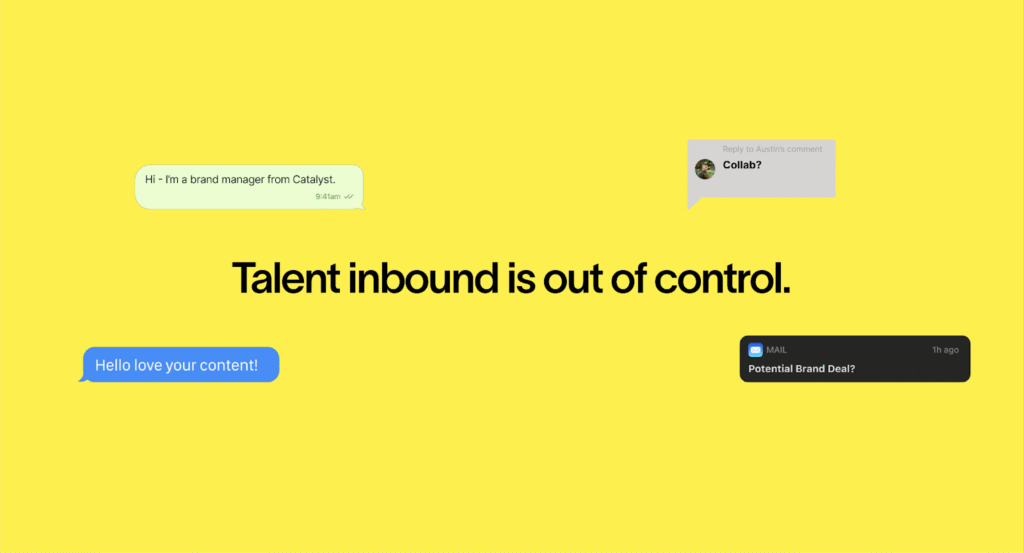
The core problem Marlo addresses for talent managers is capacity. As the creator economy has matured, inbound brand interest has exploded across email, DMs, and PR outreach. Yet most deals are still handled manually.
Austin says that during his time at TikTok, particularly while working on creator monetization and the early U.S. rollout of TikTok Shop, he and his team closely examined how creators and managers actually handle inbound.
“We were talking with creators and managers about how they manage DMs and emails and just thought, ‘Oh my God, this is chaos,’” he says. “Creators are overwhelmed, managers are overwhelmed, and yet this is where the business lives.”
Those observations led Austin and his co-founder, Nishi Kaza (formerly a product manager at Apple working on DJ Mixes), to a clear conclusion: traditional CRMs (Customer Relationship Management) and generic AI assistants were not built for the realities of creator dealmaking. Deals are bespoke, relationship-driven, and context-heavy. Losing track of a past gifting campaign, a prior rate negotiation, or an expiring media rights clause can directly impact revenue.
What Marlo Does and What It Does Not
Marlo positions itself as an intelligence layer rather than a simple inbox tool. Once connected to a manager’s Gmail account, the system begins learning from historical email threads, identifying buyers, categorizing inbound into brand deals, gifts, events, or noise, and understanding how that manager typically negotiates on behalf of different creators.

“Marlo sits on top of the inbox and understands who wants to work with which creator, which deals close, and how those negotiations actually play out,” Austin explains. “Over time, Marlo reminds managers when a deal should be revisited, when media rights are expiring, or when it’s worth following up again.”
Importantly, he adds, Marlo does not replace human decision-making. Managers still approve drafts, set strategy, and most importantly, maintain relationships. The value lies in surfacing priorities and institutional memory – something Austin notes is nearly impossible when people receive thousands of emails per week.
“When you’re drowning in emails, you don’t even know what happened yesterday,” he points out. “You don’t have time to step back and see patterns. That’s what we unlock.”

Early Signals From Managers
In conversations with managers during Marlo’s early development, Austin noted a consistent theme: capacity constraints were limiting growth. Many talent managers told him they were turning away from signing new creators, not because of a lack of demand, but because they could not manage additional inbound without sacrificing quality.
“Managers kept saying, ‘We’d love to work with more talent, but we just don’t have the bandwidth,’” Austin says. “Brand deals are still the starting point for building a creator’s career, and that work is incredibly time-consuming.”

Among Marlo’s early adopters are large talent management companies overseeing hundreds of creators. At that scale, inbox volume becomes a structural constraint rather than a workflow inconvenience. Managers often spend more than half their time coordinating brand deals, limiting the time available for long-term strategy and career development.
“Inboxes take up so much of a manager’s day-to-day that it can be difficult to build enduring businesses with creators,” he says. “A manager might spend more than 50% of their time on brand deals. Now they have that time back to actually strategize with their creators.”
Data, Memory, and the Next Phase of the Creator Economy
Since launch, Austin reports that Marlo has processed more than 1 million inbound opportunities, providing the company with a growing dataset on how brand deals are initiated, negotiated, and closed. He says the aggregate trends challenge some popular narratives.
“People say brand deals are dead, but that’s not what we see,” Austin says. “They’re volatile, yes, but very much alive. A creator might make $500,000 one year and $100,000 the next, and that feels like a collapse. But it’s all about building a healthy revenue mix.”
This perspective informs Marlo’s longer-term roadmap. Beyond inbox management, Austin envisions the platform helping managers assess roster health, identify under-supported creators, and eventually inform broader business decisions, from affiliate strategies to product & IP launches.
“We want to help talent managers understand which parts of their roster are over-indexing and which need more support,” he says. “That’s information you just can’t surface manually.”

Backing and Outlook
Marlo is backed by Penny Jar Capital, an early-stage firm investing in founders using AI to address practical, real-world problems, and Andreessen Horowitz (a16z) through its “Speedrun” program. Austin says that support has allowed the team to focus on refining the product alongside managers.
Looking ahead, Austin says the company’s immediate focus is on deepening relationships with existing clients and onboarding new managers in Los Angeles and New York. In his view, the quieter first quarter of the year, traditionally a planning period for talent managers, is when Marlo’s intelligence layer becomes most valuable.
“Q1 is when everyone wants to understand what actually happened last year,” Austin says. “That’s where we can help the most.”
For Austin and Nishi, the motivation remains consistent with their earlier work across music, media, and platforms: helping creators build sustainable businesses.
“The inbox is just the starting point,” he concludes. “If we can make brand deals sustainable and predictable, creators and managers can spend their time building everything else.”
Photo source: Marlo
Checkout Our Latest Podcast