




Talent Collectives
From Advocacy To Agency: How Gallaher Group Supports Impact-Driven Creators And Brands

Influence in the creator economy is often discussed in terms of reach and visibility, but for Kayley Gallaher, it has always been about responsibility. After more than a decade working across influencer marketing, nonprofit advocacy, and global campaigns, Kayley founded Gallaher Group in 2023 to support creators whose platforms are built around social impact, community engagement, and long-term change rather than short-term commercial appeal.
“We don’t need more noise,” Kayley says. “We need thoughtful and intentional action.”
Based in Canada, Gallaher Group is a social-impact-first talent and advisory agency that works with activists, nonprofit founders, and thought leaders operating in an industry largely optimized for lifestyle, entertainment, and consumer commerce. The firm supports its clients through brand partnerships, speaking opportunities, and strategic advisory work, helping them translate influence into programs that align with both their values and the goals of the organizations they partner with.
Kayley’s decision to launch the agency emerged from years spent straddling both sides of the creator economy. Early in her career, she worked in travel and influencer marketing as Instagram began reshaping how audiences connected with content. She later moved deeper into advocacy and nonprofit work, including senior roles supporting global initiatives at Global Citizen.
Across those experiences, she began to notice that creators working in climate, equity, health, and human rights were increasingly sought out by brands and institutions, yet often lacked the structural support, representation, and long-term strategy afforded to more commercially established creator categories.
“There are a lot of remarkable people doing meaningful work,” Kayley says, “but they don’t always have the infrastructure behind them to navigate partnerships, funding, and growth.”
Defining the Problem
At the core of Gallaher Group’s thesis is a belief that the creator economy doesn’t suffer from a lack of talent, but from an imbalance in how resources are distributed.
Kayley points to what she describes as a capital-concentration problem, in which a small percentage of creators capture the majority of brand budgets. She believes that dynamic is particularly acute in social impact spaces, where creators may command highly engaged audiences, but lack access to consistent funding, long-term partnerships, or representation that understands both advocacy and brand strategy.
“There’s not a talent problem,” she says. “There’s a funding challenge.”
For Gallaher Group’s clients, the challenge isn’t audience relevance, but translation: helping brands understand how impact-driven voices fit into broader marketing, communications, and cultural strategies.
A Social-Impact-First Agency Model
Unlike traditional management firms organized around verticals like fashion, beauty, or lifestyle, Gallaher Group defines its niche simply: impact.
The agency works with social impact leaders across categories, supporting them with brand partnerships, speaking engagements, and long-term strategic planning. It also advises traditional agencies, athletes, and organizations looking to develop or expand social impact initiatives, but lacking internal expertise.
That work is intentionally selective.
“We focus on alignment versus volume,” Kayley explains. “We’re working closely with a small number of brands and partners, rather than executing dozens of deals a month.”
This approach applies to everything from client selection to campaign structure. Kayley notes that Gallaher Group conducts extensive due diligence on brand partners, ensuring that values, messaging, and intent align with the causes their creators represent.
“We don’t work with a lot of popular brands,” Kayley says, “because sometimes their impact work doesn’t match up with what we’re trying to do.”
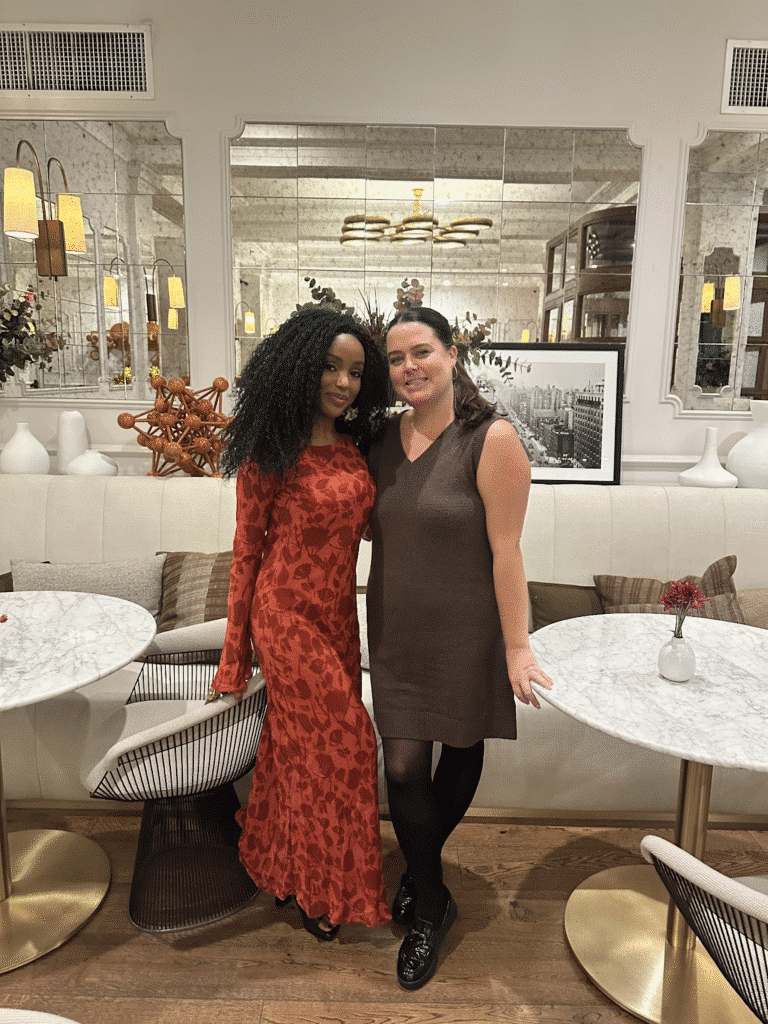
Photo: Kayley Gallaher & Wawa Gatheru, a Kenyan-American climate activist
What ‘Success’ Looks Like
Word-of-mouth referrals remain the agency’s primary source of new business due to Kayley’s prioritizing of trust and long-term relationships over outbound promotion. She describes herself as an “empathetic leader,” emphasizing consistent communication, face-to-face time, and attention to emotional nuance as core parts of her management style.
“We’ve kept our roster really small,” she says. “I don’t know how you maintain real relationships with a list of 100 people.”
For partnerships, Kayley says that renewal is the key signal of success. When collaborations extend over multiple years, become new initiatives, or lead to introductions to other aligned partners, she sees this as evidence that the work is resonating.
Impact in this context isn’t measured by engagement alone, but by action.
“It’s not just ‘click my link,’” Kayley says. “It’s signing a petition, making a donation, showing up for something bigger.”
Working With Brands Without Diluting the Message
One of the most persistent misconceptions Kayley encounters is that social impact creators are inherently “too political” for brand partnerships. While she acknowledges that many issues intersect with policy and power, she argues that audiences increasingly expect brands to engage meaningfully with the world around them.
“People want real conversations,” she says. “They want community. They want to know how to show up.”
For brands, Gallaher Group’s pitch centers on diversification of voice and perspective. The agency often pushes clients to think beyond traditional creator archetypes, asking who’s missing from panels, campaigns, or storytelling efforts, and why.
When brands do commit, Kayley emphasizes collaboration and creative freedom. Over-controlling messaging, she points out, is one of the fastest ways to undermine credibility with audiences who are deeply attuned to authenticity.
“If it doesn’t sound like the person you’re used to hearing from,” she notes, “people tune out.”
Boutique Agencies in a Scale-Driven Industry
Operating as a solo founder, Kayley has intentionally resisted quick scaling. While she plans to add support strategically, particularly around PR and partnership operations, she has no ambition to build a large, roster-heavy firm.
That restraint, she believes, is a competitive advantage. “Boutique agencies can move faster,” she says. “If we have an idea, we can act on it.”
As the industry grapples with trade-offs between scale and depth, Kayley sees growing opportunity for smaller, specialized firms that can offer hands-on, nuanced support, especially as brands reevaluate what sustainable creator partnerships entail.
Offline Community and Long-Term Value
In 2026, Kayley’s priorities center on deepening the work Gallaher Group is already doing. That includes exploring new ways to bring creators together across disciplines, investing more heavily in in-person gatherings, and continuing to build infrastructure that supports impact-driven collaboration.
“There’s something really powerful about being in a room together,” she says.
For Gallaher, the most promising development in the creator economy is the steady arrival of new perspectives and ideas. “If you’re willing to work really hard,” she says, “there are a lot of really cool things you can do alongside the people you work with.”
She pauses, then adds a note that feels emblematic of her approach to business and impact alike:
“It’s exciting and terrifying at the same time, but the possibility of what could be done makes it worth it.”
Subscribe to Our Newsletter
Check Out Our Podcast