






Platform
Spotify’s AI Pivot Signals A New Phase For Creator Discovery

Spotify closed 2025 with record user growth and its strongest profitability profile to date. Alongside those results, management outlined a broader strategic shift: positioning the company as an AI-powered interface between creators and audiences, supported by expanding margins and disciplined reinvestment.

Record Growth, Expanding Margins
Spotify reports adding 38 million monthly active users (MAUs) in the fourth quarter of 2025, its highest net addition in company history, bringing total MAUs to 751 million. Premium subscribers rose 10% year over year to 290 million.
Revenue reached €4.53 billion in Q4, up 7% year over year, or 13% on a constant currency basis. Operating income climbed 47% to €701 million, with operating margin expanding to 15.5%. Full-year free cash flow totaled €2.9 billion.
Gross margin improved to 33.1%, driven in part by gains in the ad-supported segment. Ad-supported gross margin rose to 19.5%, up 441 basis points year over year.
On the earnings call, co-CEO Alex Norström described the quarter as a strong finish to what Spotify had dubbed its “Year of Accelerated Execution.” CFO Christian Luiga signaled further margin improvement in 2026.
These results alter Spotify’s strategic posture. With consistent cash generation and expanding margins, the company has room to invest in product development while maintaining profitability. That financial flexibility underpins its next priority: reshaping discovery through AI.
Building an AI-Native Discovery Layer
Artificial intelligence featured prominently in management’s framing of Spotify’s future.
In a press release, founder and Executive Chairman Daniel Ek described Spotify as “a technology platform for audio – and increasingly, for all the ways creators connect with audiences.” Co-CEO Gustav Söderström reiterated that the company considers itself “the R&D department for the music industry.”
Executives cited several AI-driven features already on the market. Spotify’s Interactive DJ has been used by about 90 million subscribers, generating more than 4 billion hours of listening time. Prompted Playlist allows Premium users to generate playlists using natural language inputs, drawing from listening history and cultural signals.
Söderström described Spotify’s development of a “language to music” dataset – mapping natural-language prompts to personalized listening outcomes. Rather than relying solely on static genre tags or predefined categories, the system reflects behavioral data across hundreds of millions of users.
For creators, this suggests a shift in how visibility may function. Playlist placement remains influential, but conversational interaction introduces another layer. Songs, podcasts, and audiobooks increasingly compete in environments where user intent is expressed directly through prompts.
Management framed AI not as a threat to streaming economics, but as a mechanism to strengthen them. Spotify reiterated that its subscription-plus-advertising model remains intact. Norström linked personalization to engagement, engagement to retention, and retention to lifetime value. In that sequence, AI supports margin expansion by deepening user commitment.
The company also highlighted AI-driven productivity internally. Söderström described tools that allow engineers to generate and test code through conversational systems, accelerating product development. That operational efficiency reinforces Spotify’s ability to iterate quickly without compromising financial targets.
Multi-Format Expansion Reinforces the Flywheel
Spotify’s AI push coincides with expansion across content formats.
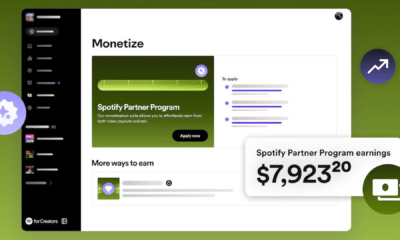
Video podcast consumption has increased more than 90% since the launch of the Spotify Partner Program, with more than 530,000 video podcast shows now available on the platform. Audiobooks in Premium expanded to additional Nordic markets in Q4.
In 2025, Spotify reports paying out more than $11 billion to the music industry, with independent artists and labels accounting for half of royalties. The company says it also helped artists generate more than $1 billion in ticket sales through integrations with ticketing partners.
This multi-format expansion serves more than diversification. As users engage with music, video podcasts, and audiobooks within a single ecosystem, Spotify accumulates broader behavioral signals. Those signals enhance personalization, which in turn supports retention and monetization across formats.
Advertising benefits as well. Improved ad-supported margins and a rebuilt ad stack position Spotify to capture greater yield as engagement rises. Management expressed confidence that advertising growth would improve in the second half of 2026.
For the first quarter of 2026, Spotify forecast 759 million MAUs and 293 million Premium subscribers, with revenue growth expected to accelerate to approximately 15% year over year. Pricing adjustments are projected to drive ARPU growth of 5-6% in Q1.
What This Signals for the Creator Economy
Spotify framed 2026 as the “Year of Raising Ambition.” The phrase reflects both its financial position and its product roadmap.
Three themes define the shift:
- Structural profitability: Expanding margins and free cash flow provide room for sustained reinvestment
- AI-native personalization: Conversational discovery tools position Spotify to mediate how audiences find and engage with creator content
- Format convergence: Music, podcasts, video, and audiobooks increasingly operate within a unified system that compounds data and engagement
For creators, discovery mechanics may continue changing toward intent-driven interaction. Metadata, narrative framing, and contextual clarity could influence how effectively content surfaces in conversational environments.
For brands and agencies, Spotify’s strengthened advertising economics and growing cross-format engagement suggest a platform with both reach and stability.
The central question is not simply whether Spotify can grow its user base. It is whether conversational AI becomes a primary interface for media consumption and how creators and marketers adapt if discovery shifts from passive browsing to direct dialogue.
Subscribe to Our Newsletter
Check Out Our Podcast