
Influencer
Creators Figured Out Algorithmic Leverage First. 3 Lessons for Brands Still Paying for Attention

Most companies get built in the same sequence: figure out the problem, then the product/service, then finally the marketing plan to sell that product/service to people. Because marketing comes last, it is assumed to be the least important thing, and the first to cut in downturns. That assumption made sense as long as reach could be bought in bulk and turned on and off by adjusting the media budget. It no longer can be.
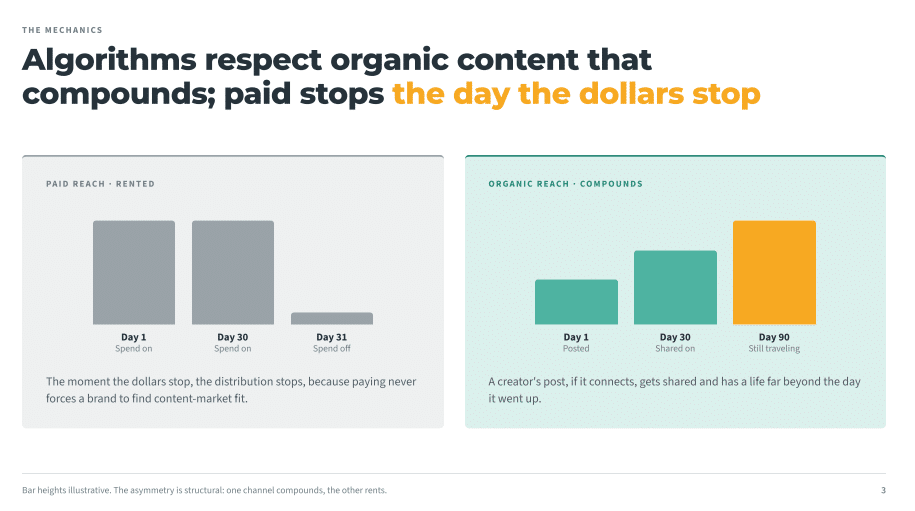
The social algorithms do not respect paid the way they respect organic content that compounds. A creator’s post, if it connects, gets shared and has a life far beyond the day it went up. Ads work the other way: the moment the dollars stop, the distribution stops, because paying never forces a brand to find content-market fit. Creators run the company-building sequence in reverse. The audience comes first and the product comes last, arriving only after the audience has shown what it wants.
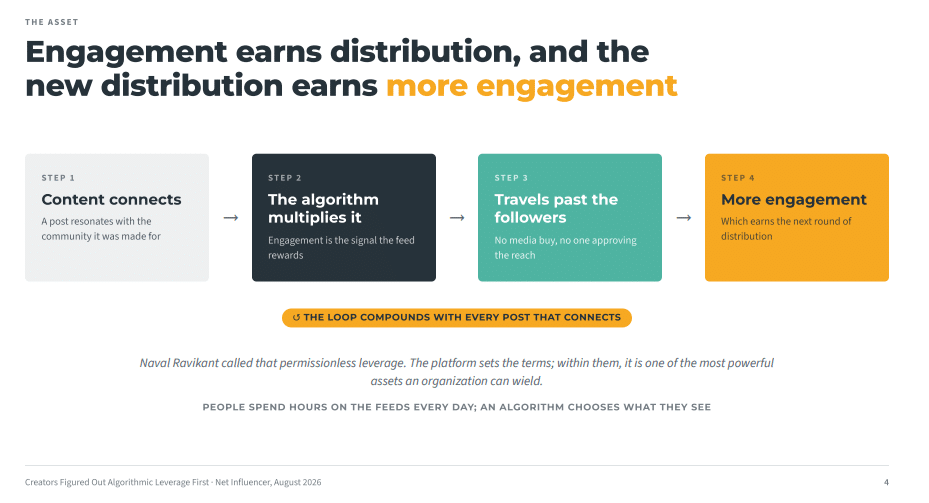
People spend hours on the feeds every single day, and an algorithm chooses what they see there. When content connects, the algorithm multiplies it. Engagement earns distribution, the new distribution earns more engagement, and the post travels far past the people who follow the account, with no media buy and no person explicitly approving the reach. Naval Ravikant called that permissionless leverage. On social media it is not entirely permissionless, the platform sets the terms. But within those terms, it is one of the most powerful assets an organization can wield.
That leverage changes what a marketing budget is supposed to answer. The old question was the cost of reach: what a CPM buys and what to spend to get in front of an audience. The new question is whether a community exists that the company knows how to resonate with, and whether the content it makes will be shared. Nobody could follow a commercial in the nineties. People can follow a brand, and the creators and ambassadors it creates. The machinery underneath is content-market fit: a way of producing attention on demand.
The Audience Is the Constant, the Product Is the Variable
“If you understand your audience and you understand what they’re looking for, you can very quickly launch products without any real barriers.”
— Danielle Pederson, Amaze
Companies that understand this new reality hold an advantage over companies that approach things the old way. No longer constrained by the costs and timelines of research panels and beta tests, they can roll out content to learn where and how their audiences are experiencing pain or need, then quickly develop products and messaging that connect, reading where they get engagement and where they do not in near real time.
The audience can test the product itself, before launch. Izaac Grimoldby of Slide, asked how he would launch a clothing brand: “I would try and build a community… send those samples out to people within that community to get honest feedback… then you give them early access and then you launch it to the world.” Feedback, then early access, then the public launch: demand is confirmed before inventory is ordered. This is content-market fit in full: finding the audiences that respond to the content, and the content the audiences respond to, until the two lock. Companies pay research firms for a worse version of what an owned audience volunteers daily. The marketing department that holds one becomes the company’s cheapest source of product truth, sitting in a function the org chart still files under promotion.
This algorithmic leverage shows up on the spend side as well. Ryan Hashemi of Snowball, an agency that builds organic audiences for brands: “With organic, the distribution compounds over time. It becomes cheaper over time. And it’s extremely powerful competitive advantage because you have an owned audience and a community.” Paid moves in the opposite direction. Every competitor bidding on the same customers makes the next impression more expensive, so the same budget buys less reach each year, and the ads stop the day the spend stops. The post that connected keeps traveling, on shares and on distribution the algorithm grants rather than sells.
Compounding has an end state, and Essentially Sports, a sports media publisher, is at it: more audience accumulated than the company can build products for. Suryansh Tibarewal: “there [are] audiences that we already have just waiting for us to launch because we just couldn’t build so many newsletters quickly.” The constraint is no longer finding customers for products; it is shipping newsletters fast enough for readers already assembled. Paid reach cannot be stored, at any spend level. The audience gets built before the quarter that needs it, because it cannot be bought in the quarter that needs it.
Every Objection but One
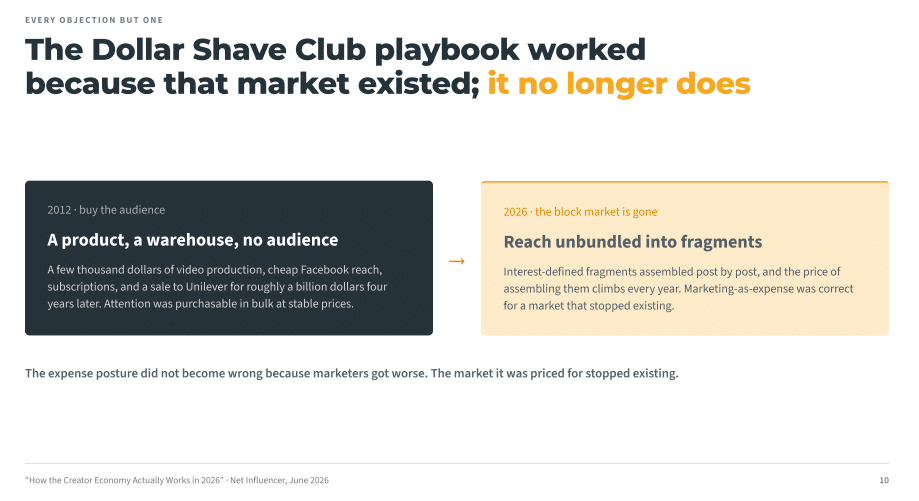
The obvious objection is that none of these people had a board, a fiscal year, or an existing P&L. In 2012, Dollar Shave Club had a product, a warehouse, and no audience at all. It bought one: a few thousand dollars of video production, cheap Facebook reach, subscriptions, and a sale to Unilever for roughly a billion dollars four years later. Attention in that era was purchasable in bulk at stable prices, the same way it had been for the fifty years of television before it, and marketing-as-expense was the correct posture for that market. As we argued in June, the block market is gone. Reach unbundled into interest-defined fragments assembled post by post, and the price of assembling it climbs every year. The expense posture did not become wrong because marketers got worse. The market it was priced for stopped existing.
The market that replaced it is riskier to hold. The audience a company builds sits on platforms it does not control, and an algorithm change can erase it overnight. Josh Stein of Attention Capital, which lends money to creators against the value of their audiences: “audiences are moody. One algorithm change [and] the whole thing can disappear overnight.” Ali Eklund of Tripoli Ranch built “multiple revenue streams because I never wanted my entire business dependent on one platform or the algorithm.”
The platform risk has a counterweight: the dependence runs both ways. The feed’s business is keeping users on the platform, which requires a constant supply of content people stay for, share, and save. A company that reliably supplies it is not at the algorithm’s mercy; it is one of the algorithm’s suppliers.
Staying a supplier is a production problem. No single concept survives long, and the platforms themselves push for refreshing. Steven Cravotta of Posted: “You always have to be iterating, you always have to be testing, you always have to be trying new angles, new faces, new creators.” Testing only works at volume, and volume requires a system. At Fabulate, an agency that builds creator campaigns for brands, most incoming clients still manage content “over WhatsApp or in emails or on spreadsheets without any kind of formulated system or process”; the ones that build the process cut campaign turnaround from twenty business days to three to five. A brand producing and testing at that speed learns what the algorithm wants faster than the algorithm changes.
One objection survives: time. Joe Pulizzi of The Tilt: “It’s going to take 18 to 24 months minimum in most cases to really drive a significant amount of revenue.” That timeline is precisely the proposal a CFO exists to kill.
The Lessons, as the Creators Learned Them
The timeline is easier to defend when someone else has already made the mistakes. Creators spent the last half decade building immense influence by understanding algorithmic leverage, and their careers are the record: which part of an audience is real, what it will and will not carry, and where it becomes owned. Three lessons, learned in public.
1.) Followers v. Fans
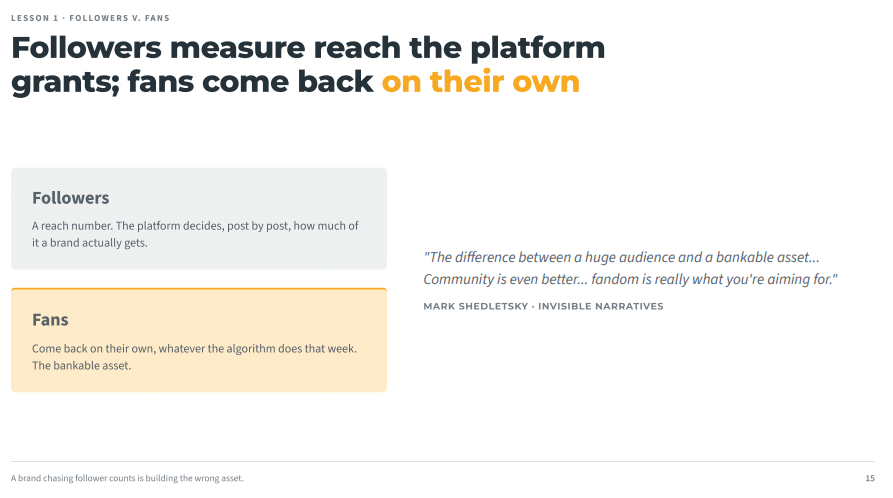
Followers and fans are not the same asset. Follower count measures reach, and the platform decides post by post how much of that reach a brand actually gets. Fans come back on their own, whatever the algorithm does that week. Mark Shedletsky of Invisible Narratives: “The difference between a huge audience and a bankable asset… Community is even better… fandom is really what you’re aiming for.” A brand chasing follower counts is building the wrong asset.
2.) Transfer
An audience only cares about what it signed up for. People follow an account for something specific, and posts outside that specific thing get ignored. Paid media lets a brand put any message in front of any audience. Organic does not work that way. Being ignored is the cheap failure; the expensive one is losing the audience’s trust. Mitchie Nguyen, a creator: “The highest paying deal promoting somebody else’s brand can also be the most expensive to your brand if it teaches your audience not to trust you.” Every campaign a company puts in front of its own audience either builds trust or spends it, and the spending never shows up in the campaign report.
3.) Conversion
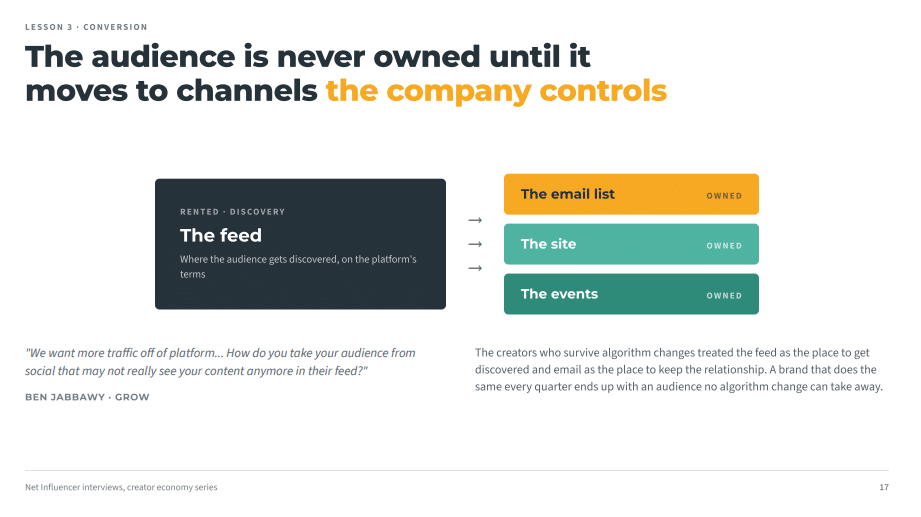
The audience on the platform is never fully owned. The fix is moving people somewhere the company controls: the email list, the site, the events, the channels the company actually owns. Ben Jabbawy of Grow, who works with brands on exactly this: “we want more traffic off of platform… How do you take your audience from social that may not really see your content anymore in their feed?” The creators who survive algorithm changes treated the feed as the place to get discovered and email as the place to keep the relationship. A brand that does the same every quarter ends up with an audience no algorithm change can take away.
The Ledger Decides
The finance world has already decided the asset is real. Lenders now make loans to creator businesses with the audience as the security. Investors get pitched creator media companies as businesses with revenue attached to the audience. That is the answer to the eighteen months: an asset a bank will lend against is an asset a company can budget for.
This does not fit every company. Audience-building works where the hard part is finding customers and the business can afford a slow build: media, services, expertise, consumer products in crowded markets. It waits where the hard part is the product itself, regulatory approval, or the upfront cost; no audience de-risks a drug trial. For everyone else, the question at budget time is simple: not what the CPM was, but what the marketing dollar leaves behind. Every quarter’s spend either rents reach one more time or buys a relationship the company keeps, and only one of those compounds.
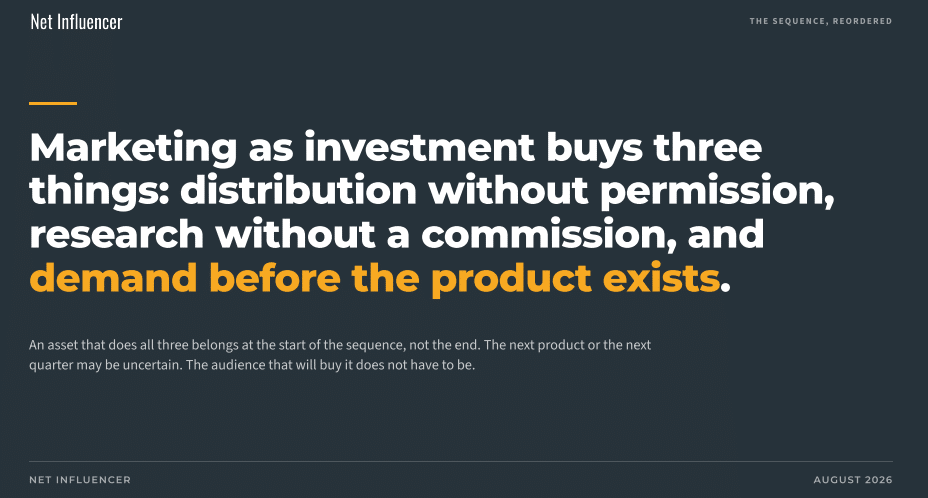
The creators got here first because they had no choice: no budgets, so renting reach was never an option. They spent the decade building the asset instead, and the companies studying them now are not learning a content trick. They are learning what marketing looks like when it is run as investment rather than rent, and what the investment buys is the leverage Ravikant named: distribution the company does not ask permission for, market research it does not commission, demand waiting before the product exists. An asset that does all three belongs at the start of the sequence, not the end. Marketing stops being the last thing a company invests in the moment connecting with an audience becomes the hard part, and that moment already happened. The next product or the next quarter may be uncertain. The audience that will buy it does not have to be.
Subscribe to Our Newsletter
Check Out Our Podcast