




Tech
COY Creator’s Matt Silk Presents Case for Creator-Owned Media Businesses

Most creators with millions of followers don’t own them. Their audiences live on platforms they don’t control, governed by algorithms they can’t see, subject to shutdowns they can’t predict. Matt Silk has been making that argument for four years. The recent threat of a U.S. ban and potential forced sale of TikTok finally made people listen.
As the founder and CEO of COY Creator, an Austin-based technology platform launched in May 2024, Matt and his team help creators build branded, white-labeled websites as the central hub for their content, community, and monetization. The company operates as what he calls an “anti-platform”: no COY branding appears on client sites, no “Powered by COY” attribution. The creator’s name is the only one on the door.
The distinction is deliberate, and it goes beyond aesthetics. “The key customer is the brands, and the creators are the product,” Matt says of the broader creator marketing ecosystem. “COY is squarely focused on the creators themselves.”
COY currently offers eight different monetization tools, including subscriptions, live streams, courses, one-on-one bookings, and pay-to-unlock content. The company recently launched Channels, a group messaging feature that enables community members to interact with one another rather than just receive content from the creator.
But Matt frames all of it as infrastructure for something larger: helping creators transition from just being content creators into long-term media businesses.
The TikTok Moment That Changed Everything
For four years, Matt and COY told creators they were building on rented land, but most weren’t persuaded.
The TikTok near-ban changed the conversation. When the platform faced a potential U.S. shutdown in early 2025, creators with millions of followers suddenly had to ask what would happen if that audience disappeared overnight. “People started asking, ‘What if my 5 million followers go away?'” Matt recalls. “Maybe that Matt guy wasn’t crazy.”
The scare coincided with a second shift: significant capital arriving in the space. According to Matt, MrBeast’s reported $200 million raise at a $5 billion valuation, Dude Perfect’s $100 million round, and Publicis’s acquisitions of Influential and Captiv8 signaled that the Creator Economy had crossed into institutional capital territory. “You needed those billion-dollar tags for people to take this space seriously,” Matt says.
Together, the two developments validated COY’s thesis. “I don’t need to convince anyone that the creator economy is real,” Matt says. “The market is starting to embrace a lot of the stuff that we’ve been saying for a while. I feel like we’re now coming into our own.”
The Difference Between a Creator and a Media Empire
COY does not serve every creator. Matt and his team target those who have already started professionalizing, not those experimenting with audience growth.
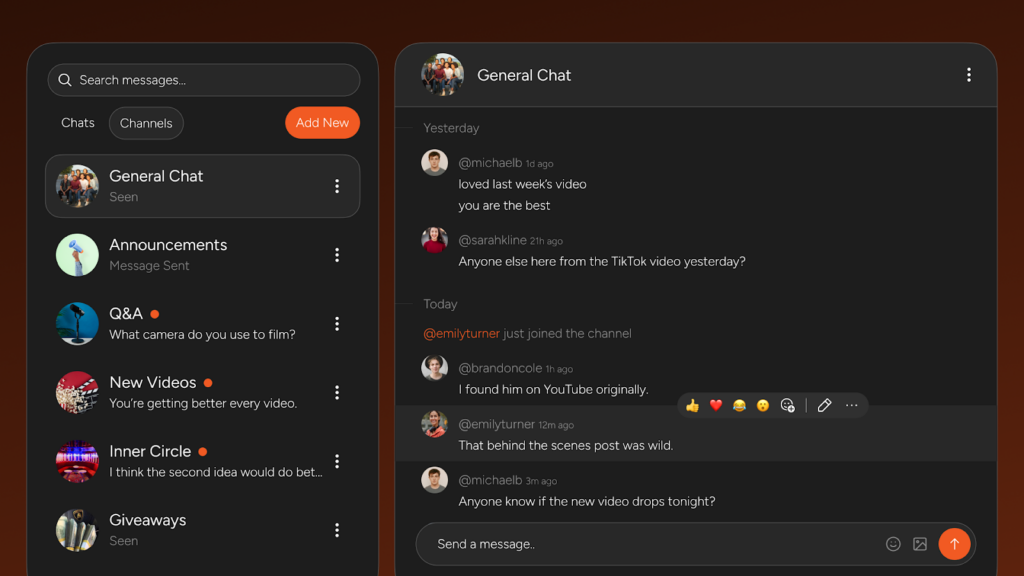
COY Channels
“Have they hired their editor already? Have they hired their operations person? Are they starting to act like a business?” Matt says, describing how his team identifies prospects. “If they haven’t done some of that stuff, it’s probably too early for us to talk to them.”
COY’s ideal client has around 500,000 followers, has made its first hires, and is beginning to think about removing key-man risk from the operation. “Creators below that threshold are likely better served by focusing on Instagram/TikTok/YouTube until they develop a value proposition and subscriber acquisition motions,” Matt says.
The distinction between creators who are just content producers and those who want to become media businesses is key, according to Matt. The former may be content and able to sustain a career on ad revenue and brand deals without owning their data or infrastructure. The latter, however, realize they need to build a solid foundation, not on rented land.
“How do I take my content business and my followers and leverage that distribution for other lines of business? That’s the mental switch,” he says. “I want to start acting like Netflix, like Paramount+, like some of these big media brands.”
Why Brand Deals Alone Won’t Hold
One of Matt’s more pointed arguments is that the Creator Economy’s current revenue structure is more fragile than it appears.
Approximately 80% of creator income currently comes from brand sponsorships, according to his estimate. And, he believes that share will compress. Campaign management platforms can now coordinate thousands of micro-creators for the budget of a single major deal. “You can go out and get a thousand creators into a $5,000 campaign rather than doing one mega creator campaign,” Matt says. “With AI, with all the tools in the space, those same dollars are going to get squeezed down.”
For creators who haven’t diversified their revenue, the math can turn instantly. The platform revenue that feels stable today, Matt argues, is not guaranteed. “Creators are caught in a false sense of security,” he says. “They’re doing pretty well. They like their brand deals. But, that next one is not guaranteed, and brands are getting smarter about follower counts not translating to action.”
COY’s answer is to give creators a recurring-revenue mindset. Matt pushes creators to think like SaaS businesses, building subscription-based income that doesn’t depend on algorithm performance or brand budgets. “As long as you keep doing what you promised your customers you’re going to do, there’s no reason why you lose that million dollars a month,” he says. “Now, you can layer on top of that solid foundation into adjacent spaces where your brand will resonate.”
The First-Party Advantage
Central to COY’s value proposition is the difference between third-party reach and first-party data.
As Matt notes, a creator with 5 million followers on Instagram, TikTok, or YouTube might reach 1% to 2% of that audience on any given post, subject to algorithmic throttling. A creator with 50,000 registered users on their own site has something different: direct, unmediated access to their most engaged fans.
“Those 50,000 people are your super fans,” Matt says. “Those are people that are going to see every single one of your posts, show up to buy your merch, show up to your events.”
That concentration has commercial implications beyond direct monetization. A creator with verified first-party data can approach a brand partnership differently. Instead of selling a sponsored post to an opaque audience of algorithmic followers, they can offer access to a segmented, behavior-defined community. “If you want to do a Coca-Cola takeover ad and turn your entire site red for a week, you can do it because it’s your site!” Matt says.
COY’s tactical entry point is often a windowing strategy or re-positioning rather than a wholesale content overhaul. A podcaster producing three episodes per week, for example, may post one episode on their site only, or post all three episodes on their site three days earlier. Social channels stay intact as top-of-funnel. The owned site becomes the destination for super fans willing to pay for early access or exclusives.
“You do not stop posting on Instagram, TikTok, and YouTube after you launch your site with COY,” Matt says. “You just make the mental switch that posting on those platforms is your top-of-funnel activity.”
AI as Operator, Not Creator
COY spent its first three years building a competitive feature set. 2026, Matt says, is about using AI to help creators run it.
The vision he returns to is what he calls “Jarvis,” a nod to the AI assistant from Iron Man. “When a creator logs on, they should be talking to Jarvis,” Matt says. “Hey, how’d that new post do? And Jarvis should come back and say that post killed it, but it got a ton of traffic on Tuesday night between 10 p.m. and 3 a.m., we should look into that.”
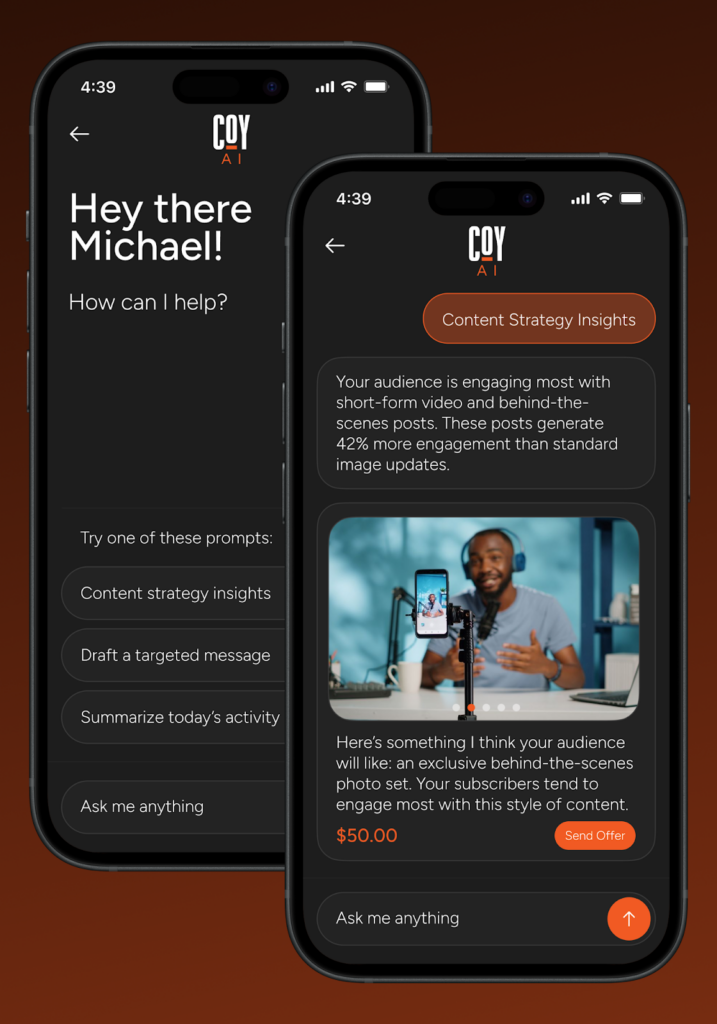
COY AI
In practice, COY’s near-term AI work centers on surfacing insights from within the platform: which monetization tools are underused, what content patterns drive conversions, and when to introduce a course or live stream to an audience that’s ready for it.
The company has a customer success team. “Mike is the guy that runs our CS team and the AI assistant should be like Mike, with you 24/7,” he says. “And, by the way, there’s also a button to click if you want to talk to Mike and his team.”
On AI creators specifically, Matt is agnostic. COY’s tools are designed to build and engage audiences. Whether the personality running a site is human or synthetic is, in his view, secondary. “To us, it’s all about how I build an audience and how I engage with my audience. Who that personality is could be an AI.”
What the Creator Economy Looks Like When Creators Own It
Matt’s long-run prediction is that the term “Creator Economy” eventually becomes redundant. The category, in his view, will be absorbed into how marketing works.
“Five years from now, this is just going to be the marketing department,” he says. “This isn’t going to be, ‘Oh, let me talk about the 10% of my budget focused on creators and influencers.’ This is going to be the marketing and engagement strategy.”
He also expects a wave of M&A as creator-led businesses collide with traditional industries. MrBeast’s acquisition of Step Financial is one early signal. “Can MrBeast pour some serious gas on that and go from 3 million subscribers to 10 million much faster?” Matt asks. “You’re going to see a shake-up of a lot of traditional worlds.”
For COY, the near-term priorities are tightening existing tools and deepening AI integration. A B2B product for media companies that want to offer creator monetization under their own brand is in development, though Matt declines to discuss specifics. “We’ll have to save that for a future call when we’re ready,” he says.
The company’s underlying bet remains unchanged. “We’re going to set you up to make a million dollars a month for the next five years,” Matt says. “Slowly, methodically. That’s the foundation for everything else you want to do.”
Subscribe to Our Newsletter
Check Out Our Podcast