



Influencer
Maverick Maltin Is Running a Multi-Channel Media Business From One Creator Account

The fourth video Maverick Maltin ever posted reached one million views on TikTok. He had found a similar concept already circulating, identified two specific problems with it, and rebuilt it in his own voice. The result, he says, was not a surprise.
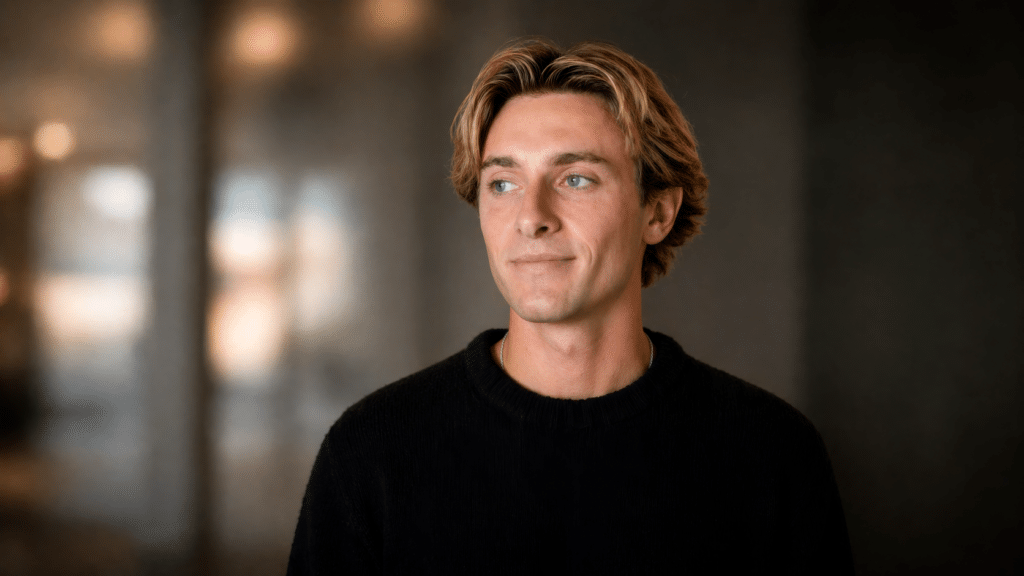
That analytical approach now underpins a creator operation spanning four platforms, a newsletter with more than 200,000 subscribers, and over 100 brand partnerships, including collaborations with OpenAI, Starbucks, and Canva. Maverick started posting AI education content in the summer of 2025 while a student at Arizona State University with no team, only his willingness to study what already worked. The structure he has built for MavGPT, which he calls a media business, is his most developed product.
“MavGPT is essentially the media company I’ve built around my social media, my Instagram, my Facebook, my TikTok, that teaches people in a simple way how to use AI to improve everything in their day-to-day lives,” he says.
The framing matters to him because it runs against the metric the Creator Economy most prizes. His skepticism is direct. “I don’t think followers matter as much as people say they do,” he says. “I don’t think that is a relevant metric, especially when you’re trying to figure out how much money a creator’s making.”
Fixing Other People’s Videos Before Filming His Own
Maverick attributes the virality of his fourth video to a specific methodology for studying what was performing and executing against it.
He found a creator covering a similar AI concept whose video had accumulated around 300,000 views. Watching it, he identified exactly two problems: the pacing was too slow, and the hook was too weak. The hook read something like “this AI use case is cool.” He rebuilt the concept with a stronger opener. “The differences between those two voices are astronomical to people,” he says. The million views followed.
The practice he calls “idea scraping” involves searching relevant keywords on Instagram, saving viral videos, and analyzing the component decisions. “This person had a really good hook, this person had a really good story, this person had a really great call to action,” he says. “How can I take all three of their things that they were good at and mash them into one video?” He is less interested in what performed than in why it stopped short of performing better.
From a $1,200 Video to a Formal Rate Card
Maverick’s first brand deal paid $1,200 for one video. That matched what he had made over the previous 60 days trying to sell a digital product. The numbers reoriented him fast. Inbound from brands had already been piling up; he simply had not been replying to his email.
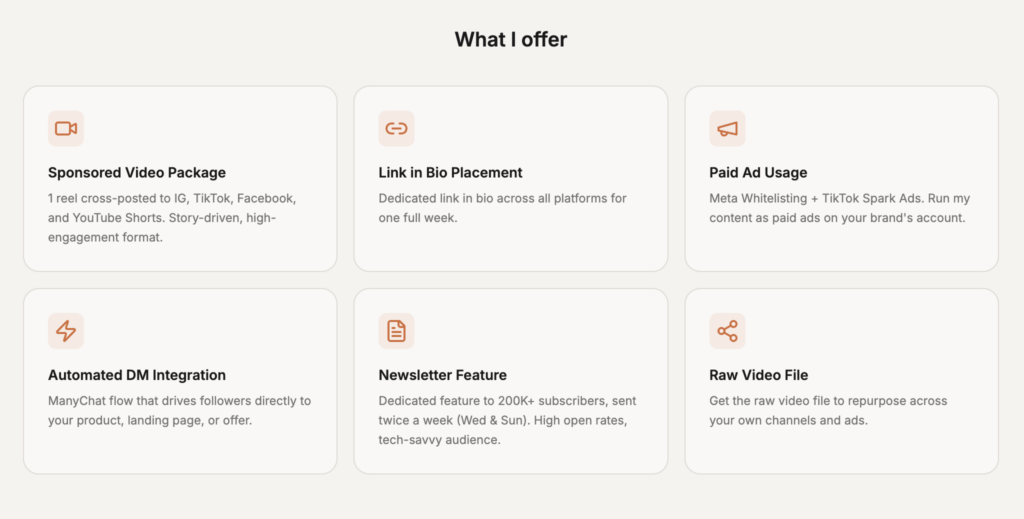
What developed over the months he spent managing partnerships alone is a formal structure that extends well beyond a single deliverable. The base is a sponsored video cross-posted across platforms to a combined following in the millions. Layered on top: newsletter placement to more than 200,000 subscribers, licensed raw footage for brands to repurpose as ad creative, and platform amplification options.
“Some creators just post the video and move on,” he says. “That company’s paying you for your time and for your distribution. You want their campaign to do as well as possible. So that’s why I think stuff like the raw file and ad usage are things you can pull into the negotiation.” He acquired management two months ago, having built the full offering himself in the interim.
According to Maverick, brands get multiple content choices if they use the raw file. The newsletter converts differently than a social video. Making those options available is, in his framing, simply doing the job.
Brands Don’t Always Know What to Order
Maverick’s sharpest argument about how brands approach creator partnerships is about sequence. They arrive with the format already chosen. A short-form video. A sponsored post. He considers this a structural error.
“If they came to me and said, ‘We want to drive the most amount of conversions,'” Maverick says, “I would probably just be like, you should be in my newsletter.” He knows which channel converts better for his specific audience. The brand does not. His analogy is a restaurant. “Would you rather have the person who makes all the food, the chef who actually understands what they’re making, pick the food for you?” he says.
Maverick recommends brands let the creator define the terms of the engagement. “Let the creator sell you on what their leverage is,” he says.
Speed compounds the problem in the AI niche specifically. “If you’re not running at the same pace as these AI companies are running at, you’re done,” Maverick says. For brand managers trying to identify which companies are actively spending on creator partnerships, he offers a concrete tactic: search the brand name followed by “partner” as a keyword on Instagram. Every sponsored video surfaces. “If there’s a ton recently, you’re like, this company’s clearly spending,” he says.
He Tried the Paywall Once
Before brand deals became his primary revenue, Maverick ran a digital product. The feedback was largely positive. What ended it, however, was a minority of buyers who emailed to say they could not afford it, and those emails were enough. “I just hated getting people who would email me and say, ‘I can’t afford it,'” he recalls.
He removed the paywall and put everything on the site for free: prompts, workflows, tool guides, no charge.
From Maverick’s perspective, audience trust is what brand deals pay for, and trust built on paywalled content is structurally weaker. But the motivation behind going free, he says, predates the business logic. “I get enjoyment out of the education around it, and I want to educate everyone,” he says. “This turned into a business. It was never meant to become that.”
The same standard applies to what he promotes. “I’ve had gambling companies reach out. I don’t really care how much they pay me. I’m never going to promote that,” he says. “How is that relevant to my audience in any way?”
What the Follower Count Does Not Show
Maverick’s Instagram crossed one million followers in early July. He says he sat with the number for a while, not from shock but from a kind of expectation fulfilled.
What he has also seen coming is the ceiling. The revenue difference between 100,000 followers and a million is huge, he argues. Beyond that, the returns shrink. “You need to stop thinking about that and think more about how you expand,” he says. For him, expansion means YouTube, which he acknowledges he has underdeveloped, and adding new channels rather than accumulating more followers on existing ones.
The harder version of that problem lives inside the niche itself. “Mostly everything I talk about is probably not going to exist in a year from now,” he says, without apparent concern. The technology moves faster than the content. His answer is to stay ahead of the use cases, to be the person who surfaces what is new before it becomes standard. The goal on his website, to teach 10 million people about AI, he describes as aspirational.
“The goal is to help people use AI,” he says. “The followers just come with that goal in mind.”
Subscribe to Our Newsletter
Check Out Our Podcast