






Brand
From Followers to Shelf Space: Bonkers Toys’ Lisa Berlin Wright on What Creator Licensing Actually Requires

The toy aisle has always been a lagging indicator of culture. By the time a character appears on a shelf at Target, the underlying fandom is already years deep. Bonkers Toys has spent the last decade trying to close that gap, building a business around a simple, but operationally demanding premise: digital audiences, if chosen correctly, can become retail franchises.
Lisa Berlin Wright, Head of Licensing at the San Diego-based company, is the executive leading the licensing efforts that identify which creators and new media brands make that leap. With more than two decades of experience, Lisa joined Bonkers Toys in 2023 to lead IP acquisition and partner relationships across platforms such as YouTube, Roblox, and TikTok.
“My background spans traditional entertainment licensing as well as gaming and social media creators,” says Lisa. “This experience provides a unique perspective on how licensing has evolved from studio-driven franchises to creator-led brands.”
At Kidscreen Summit 2026, she participated in the “Licensing Challenge” session, where five emerging kids entertainment properties pitched licensing potential to a panel of industry executives. Between deliberations, Lisa joined host Steven Ekstract of Global Licensing Advisors for a broader conversation about digital-first licensing and where the category is heading.
Creator Brands Are Now the Franchise Pipeline
Bonkers Toys built its early reputation on two properties that looked unconventional at the time: slither.io, a mobile snake game with over 35 billion plays, and “Ryan’s World,” a YouTube channel built around a child unboxing toys. Both became major toy lines. Both validated a thesis that the company has since applied to properties such as “Skibidi Toilet,” “PrestonPlayz,” “Unspeakable,” “Lankybox,” “Aphmau,” “Moriah Elizabeth,” and “Genevieve’s Playhouse.”
More recently, Bonkers has extended into adjacent formats. The company launched a toy line based on “Warrior Cats,” a New York Times bestselling book series with a significant Roblox game, and announced a global licensing deal with “Gorilla Tag,” currently one of the world’s most popular VR games.
“What stands out most is how decentralized innovation has become,” Lisa says. “Breakout kids’ brands can now emerge from virtually anywhere, powered by passionate communities rather than traditional distribution channels.”
She adds that the implication for licensing is structural. In a studio-driven model, IP moved through predictable pipelines: film or television production, broadcast distribution, and retail. That sequence no longer applies.
“The next generation of licensable IP will likely emerge from a broader range of creators and formats, supported by direct relationships with audiences rather than traditional gatekeepers,” Lisa notes. “To me, that is very exciting and offers an opportunity to many more people.”
Speed and Durability Are in Tension
Creator licensing operates on a different clock than studio licensing, according to Lisa. In traditional entertainment, retail planning often began years before a film’s release. Physical product development, manufacturing lead times, and retailer buying cycles were built into those longer timelines. Creator audiences are a different story.
“In the Creator Economy, success can scale almost instantly,” Lisa explains. “Licensing strategies must therefore be far more agile, capable of responding to rapid audience growth while still supporting long-term brand building.”
The risk is licensing a brand at peak virality and watching the audience shift before the product hits shelves. “Balancing speed with durability is one of the defining challenges of digital-first licensing,” Lisa says. “It is one of the things that sets Bonkers apart.”
Retail Operates on a Timeline Creators Often Underestimate
From Lisa’s perspective, the gap between digital popularity and shelf readiness is wider than most creators expect. Online content can be published and iterated in hours. Consumer products require design, tooling, safety testing, manufacturing coordination, and retailer placement, often across a development window of 18 months or more.
“Creators and digital-first studios often underestimate how much time it takes to build a robust retail program with a large product range,” Lisa says. “The biggest adjustment is understanding the timing differences in development between digital content and physical products.”
That mismatch has practical consequences. A creator whose audience is growing fast today may face a retail market shaped by audience preferences from two years ago by the time the product ships.
“Bridging those timelines successfully is one of the central challenges in translating digital brands into physical products,” Lisa says, adding that strong digital engagement is necessary but insufficient. Properties that hold up under retail scrutiny tend to demonstrate consistent audience growth, recognizable character identity, and the capacity to remain relevant across multiple years, not just multiple upload cycles.
Cross-platform distribution strengthens that case. “Today’s audiences discover content across multiple platforms, and successful digital brands that have licensing potential tend to meet fans wherever they are rather than relying on a single channel,” Lisa says. A creator dependent on one platform’s algorithm is a licensing risk. A brand present on YouTube, Roblox, TikTok, and in book form is a franchise.
Production Perfection Is the Wrong Instinct
One of the most persistent misconceptions Lisa encounters involves where investment should go. Traditional production culture prizes polish: big budgets, long development cycles, technically refined output before any public release. The Creator Economy has run a decade-long experiment proving the opposite often works better.
“Let go of production perfection,” Lisa says. “The kid next door is uploading shorts from his phone every day and building a massive fan base. Over-spending with big budgets and long timelines to get everything perfect before hitting ‘publish’ is a big mindset shift for those of us whose early careers were in the studios and big production companies. It’s a new world.”
The underlying logic is that audience connection, built through consistent output and direct community engagement, outperforms infrequent, highly produced launches as a franchise-building strategy. “The most successful digital franchises typically build momentum through sustained interaction with fans rather than waiting for a single ‘perfect’ launch,” Lisa notes.
For licensing executives evaluating properties, that reframe changes what signals matter: not production quality at launch, but community depth over time.
Kidscreen and the Broadening of the Franchise Ecosystem
Kidscreen Summit gave Lisa a read on how traditional industry players are currently assessing digital IP. Her takeaway was cautiously optimistic about the direction, if not the pace.
“There was clear recognition that franchise building for licensing executives now requires a broader perspective,” she says. “Traditional studios and entertainment properties remain critical, but digital platforms and creator ecosystems are increasingly integral to long-term strategy.”
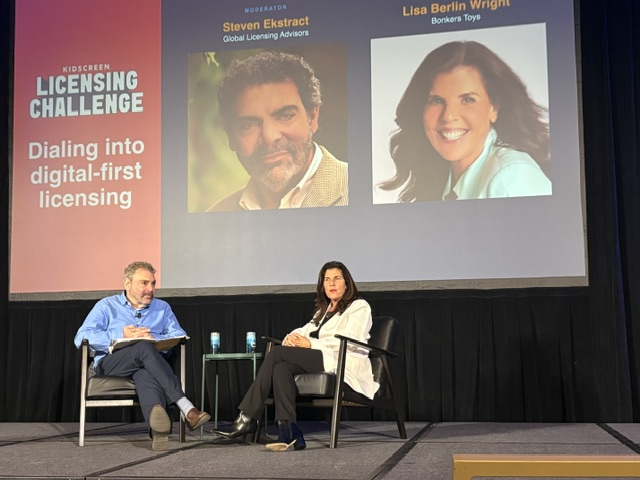
Photo: Steven Ekstract & Lisa Berlin Wright at Kidscreen Summit 2026
The “Licensing Challenge” session was indicative: live pitches of emerging kids entertainment IP, judged by executives from Spin Master, Moose Toys, Dekel Brands, Mad Engine, and WildBrain CPLG.
“I am a big champion of in-person events,” Lisa says. “Events like Kidscreen are invaluable because they bring together the entire ecosystem. Creators, studios, retailers, licensors, and manufacturers. That cross-industry dialogue is essential for understanding where the market is heading and identifying potential collaborations.”
The Category Is Still in the Early Innings
Where creator-led licensing goes from here depends largely on whether the industry can operationalize what it has learned from early successes. Lisa’s view is that the foundational shift has already happened. The question is execution.
“Increasingly, children encounter new franchises through digital platforms rather than traditional broadcast channels,” she says. “The most important signal from Kidscreen is that valuable kids’ IP can originate from a far wider ecosystem than in the past. While major film and television franchises will continue to dominate certain segments, digital platforms are increasingly important in producing globally recognized brands.”
For Bonkers Toys, that direction reflects continuity more than pivot. “This is what we have pursued for years,” Lisa says. “Identifying promising new-media properties early and helping translate them into successful toy brands for fans.”
The next two years, she argues, will be defined by properties that build franchise momentum through direct community relationships rather than waiting on traditional gatekeepers to validate them first.
Subscribe to Our Newsletter
Check Out Our Podcast