B2B companies have watched creator marketing transform consumer brands for a decade. Most are still on the sidelines. That window is closing.
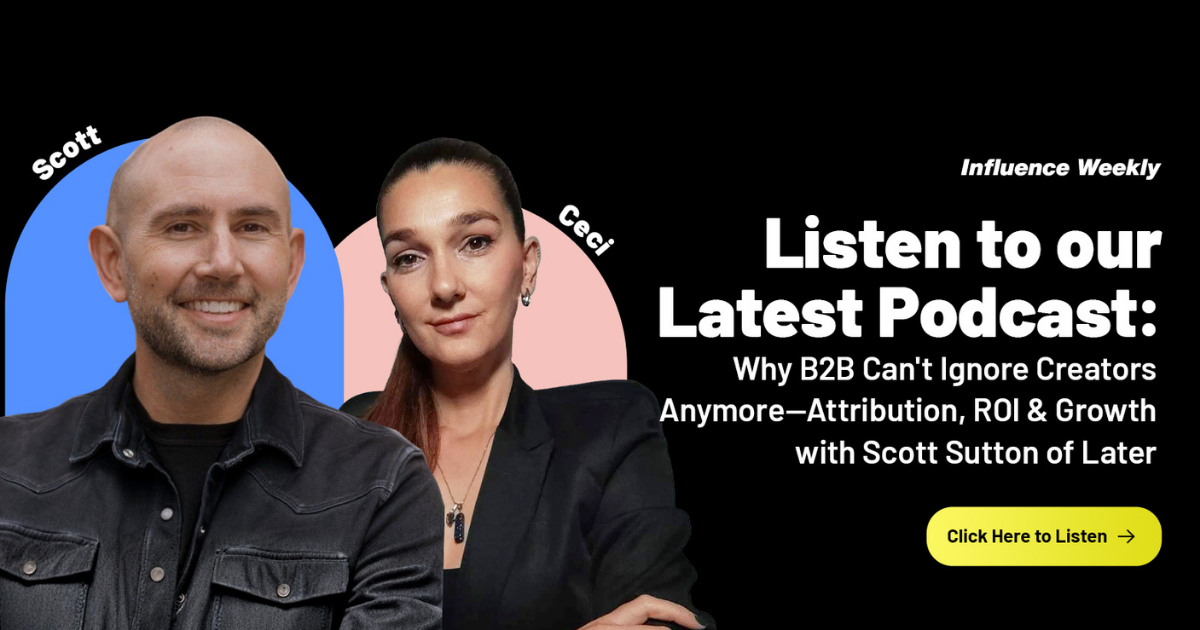
Scott Sutton, CEO of Later, sat down with Net Influencer Senior Editor Ceci Carloni to discuss why B2B brands are finally entering creator marketing and what it takes to do it right. Scott leads Later, the Influencer Marketing and social media management platform serving Fortune 5000 brands, including Walmart, Mastercard, and Procter & Gamble. Before Later, he was Chief Business Officer at ZoomInfo, where he helped grow the business from $150 million to over $1 billion in ARR.
The conversation covered why B2B lagged behind, how attribution technology changed the equation, and what enterprise brands risk by waiting.
1. B2B Decision-Makers Are Now the Social Generation
B2C brands moved first because they had to follow consumers wherever they went. B2B held back. The reasons were structural, not strategic.
The people signing enterprise contracts are now the same people scrolling LinkedIn, watching YouTube, and following niche creators in their industries. B2B companies that ignore this are making a demographic bet they’re likely to lose.
2. Attribution Technology Finally Closed the ROI Gap
For years, B2B marketing teams couldn’t tie creator spend to revenue. That excuse is gone.
Scott described working with a large client in the creative software space. “We can hire a creator, have them make a post, share a link, someone can click that link. We can then track the install of their app, and with the interconnectivity to their subscription billing software, we can actually see what subscription, and then their LTV (Lifetime Value), tie it all the way back to the CAC (Customer Acquisition Cost).”
He called it “the first time that’s been able to happen in this B2B SaaS paradigm.” Full-funnel attribution, from creator post to customer lifetime value, is now a reality. B2B’s traditional demand for proof of return no longer disqualifies the channel.
3. There Are Now Creators for Every B2B Niche
The Creator Economy is no longer just lifestyle, beauty, and entertainment. Specialized creators have built audiences in accounting, AI, marketing, and agency operations.
“It’s not just the MrBeast of the world,” Scott said. “There are creators for everyone now.”
The most interesting pairings are emerging from unexpected places. MrBeast has partnered with Salesforce. Brooke Monk holds a standing relationship with Adobe. And humor-driven accounts like Ross Corporate (Ross Pomerantz, also known as Corporate Bro) and Natalie (Corporate Natalie), which satirize corporate life, are becoming effective B2B distribution channels.
“If Corp Bro is going to suggest a product, you probably know he believes in it because he roasts most everything else,” Scott explained. Authenticity built through criticism carries more weight than conventional endorsement.
4. One-Off Campaigns Are a Waste of Budget
Most brands approaching creator marketing for the first time treat it as a campaign. That framing is the first mistake.
“If I pay one creator and the post doesn’t work, all of my budget is gone and I don’t have results,” Scott said. He advocates for working with 10 or more creators simultaneously, arguing the distribution of outcomes follows a normal curve. Scale reduces risk.
The mature model looks different: an always-on ambassador program, an affiliate layer for sales acceleration, tent-pole activations around product launches or seasonal moments, and a UGC track that licenses organic content from creators already talking about the brand. Scott pointed to Rivian’s strategy, combining experiential presence at South by Southwest and Coachella with continuous social content, as an example of how this works in practice.
5. The Measurement Standard Is ROAS, Not Engagement
When Scott defines success for a creator program, the benchmark is revenue. “Our gold standard is simply ROAS,” he said. “We pride ourselves on actually being able to measure dollars into actual sales.”
For upper-funnel work, CPE, CPM, and brand lift studies round out the picture. But the through-line is always attribution. Later worked with TransUnion and major retailers to benchmark creator marketing performance against fully loaded costs across channels. “The Creator Economy is the most effective in terms of the raw stats when you look at fully loaded costs,” Scott said.
B2B marketers fighting for internal budget need that proof. First-touch and last-touch attribution via trackable links gives them something concrete to bring to leadership.
6. The Biggest Obstacle Is Internal, Not External
Most enterprise companies already know they need to do something with creator marketing. The confusion is in execution.
“In the sea of options, there are so many providers, from creator networks and affiliate platforms to UGC platforms and influencer agencies,” Scott said. “People are looking for clarity.”
His advice to CMOs: find a competent partner who can map the options to your specific go-to-market motion, then start with lower-risk entry points to build early wins. “As a CMO, if you can find those early wins, the high-ROI campaigns, you’re going to get more runway to build out bigger and larger scale programs.” Proving the channel internally is a prerequisite to scaling it.
7. Creators Are the Humanity Layer B2B Brands Can’t Build Themselves
B2B companies have a structural problem with brand personality. Investor expectations, legal review cycles, and risk-averse cultures make it hard to be interesting.
“Most B2B companies only talk about themselves. They only talk about their money and only talk about work,” Scott said. Creators solve this. “Creators are often that voice in the window to bring a little more humanity, a little more connection, a little more levity and humor to B2B businesses.”
The Creator Economy, Scott noted, is also the most cost-efficient marketing channel available. Ideation, production, distribution, and talent come bundled. “Nowhere else can you have an entire post put out in the same day from a creator and start to see results.” As creator ad spend moves from $37 billion toward a projected $200 billion by 2030, the brands building programs now will have the advantage of established relationships, tested playbooks, and compounding audience trust.
The infrastructure argument, that the Creator Economy isn’t ready for serious enterprise investment, no longer holds. Social platforms have opened measurement APIs. Attribution tools now close the loop from post to purchase. The consolidation of major players has given brands reliable partners to work with.
For B2B companies still treating this as an experiment, Scott’s framing is direct: “You’re just going to be operating in a less efficient way and maybe not realizing the full growth potential.” The companies already leaning in are winning. The question is how long the holdouts can afford to watch.
Listen to the full conversation on “The Big Three” podcast.
Dragomir is a Serbian freelance blog writer and translator. He is passionate about covering insightful stories and exploring topics such as influencer marketing, the creator economy, technology, business, and cyber fraud.
















B2B companies have watched creator marketing transform consumer brands for a decade. Most are still on the sidelines. That window is closing.
Scott Sutton, CEO of Later, sat down with Net Influencer Senior Editor Ceci Carloni to discuss why B2B brands are finally entering creator marketing and what it takes to do it right. Scott leads Later, the Influencer Marketing and social media management platform serving Fortune 5000 brands, including Walmart, Mastercard, and Procter & Gamble. Before Later, he was Chief Business Officer at ZoomInfo, where he helped grow the business from $150 million to over $1 billion in ARR.
The conversation covered why B2B lagged behind, how attribution technology changed the equation, and what enterprise brands risk by waiting.
1. B2B Decision-Makers Are Now the Social Generation
B2C brands moved first because they had to follow consumers wherever they went. B2B held back. The reasons were structural, not strategic.
That’s changing because the buyer profile has changed. “B2B decision-makers are largely millennials,” Scott said. “It’s the first generation with huge spending power that grew up with social in their college-plus era.”
The people signing enterprise contracts are now the same people scrolling LinkedIn, watching YouTube, and following niche creators in their industries. B2B companies that ignore this are making a demographic bet they’re likely to lose.
2. Attribution Technology Finally Closed the ROI Gap
For years, B2B marketing teams couldn’t tie creator spend to revenue. That excuse is gone.
Scott described working with a large client in the creative software space. “We can hire a creator, have them make a post, share a link, someone can click that link. We can then track the install of their app, and with the interconnectivity to their subscription billing software, we can actually see what subscription, and then their LTV (Lifetime Value), tie it all the way back to the CAC (Customer Acquisition Cost).”
He called it “the first time that’s been able to happen in this B2B SaaS paradigm.” Full-funnel attribution, from creator post to customer lifetime value, is now a reality. B2B’s traditional demand for proof of return no longer disqualifies the channel.
3. There Are Now Creators for Every B2B Niche
The Creator Economy is no longer just lifestyle, beauty, and entertainment. Specialized creators have built audiences in accounting, AI, marketing, and agency operations.
“It’s not just the MrBeast of the world,” Scott said. “There are creators for everyone now.”
The most interesting pairings are emerging from unexpected places. MrBeast has partnered with Salesforce. Brooke Monk holds a standing relationship with Adobe. And humor-driven accounts like Ross Corporate (Ross Pomerantz, also known as Corporate Bro) and Natalie (Corporate Natalie), which satirize corporate life, are becoming effective B2B distribution channels.
“If Corp Bro is going to suggest a product, you probably know he believes in it because he roasts most everything else,” Scott explained. Authenticity built through criticism carries more weight than conventional endorsement.
4. One-Off Campaigns Are a Waste of Budget
Most brands approaching creator marketing for the first time treat it as a campaign. That framing is the first mistake.
“If I pay one creator and the post doesn’t work, all of my budget is gone and I don’t have results,” Scott said. He advocates for working with 10 or more creators simultaneously, arguing the distribution of outcomes follows a normal curve. Scale reduces risk.
The mature model looks different: an always-on ambassador program, an affiliate layer for sales acceleration, tent-pole activations around product launches or seasonal moments, and a UGC track that licenses organic content from creators already talking about the brand. Scott pointed to Rivian’s strategy, combining experiential presence at South by Southwest and Coachella with continuous social content, as an example of how this works in practice.
5. The Measurement Standard Is ROAS, Not Engagement
When Scott defines success for a creator program, the benchmark is revenue. “Our gold standard is simply ROAS,” he said. “We pride ourselves on actually being able to measure dollars into actual sales.”
For upper-funnel work, CPE, CPM, and brand lift studies round out the picture. But the through-line is always attribution. Later worked with TransUnion and major retailers to benchmark creator marketing performance against fully loaded costs across channels. “The Creator Economy is the most effective in terms of the raw stats when you look at fully loaded costs,” Scott said.
B2B marketers fighting for internal budget need that proof. First-touch and last-touch attribution via trackable links gives them something concrete to bring to leadership.
6. The Biggest Obstacle Is Internal, Not External
Most enterprise companies already know they need to do something with creator marketing. The confusion is in execution.
“In the sea of options, there are so many providers, from creator networks and affiliate platforms to UGC platforms and influencer agencies,” Scott said. “People are looking for clarity.”
His advice to CMOs: find a competent partner who can map the options to your specific go-to-market motion, then start with lower-risk entry points to build early wins. “As a CMO, if you can find those early wins, the high-ROI campaigns, you’re going to get more runway to build out bigger and larger scale programs.” Proving the channel internally is a prerequisite to scaling it.
7. Creators Are the Humanity Layer B2B Brands Can’t Build Themselves
B2B companies have a structural problem with brand personality. Investor expectations, legal review cycles, and risk-averse cultures make it hard to be interesting.
“Most B2B companies only talk about themselves. They only talk about their money and only talk about work,” Scott said. Creators solve this. “Creators are often that voice in the window to bring a little more humanity, a little more connection, a little more levity and humor to B2B businesses.”
The Creator Economy, Scott noted, is also the most cost-efficient marketing channel available. Ideation, production, distribution, and talent come bundled. “Nowhere else can you have an entire post put out in the same day from a creator and start to see results.” As creator ad spend moves from $37 billion toward a projected $200 billion by 2030, the brands building programs now will have the advantage of established relationships, tested playbooks, and compounding audience trust.
The infrastructure argument, that the Creator Economy isn’t ready for serious enterprise investment, no longer holds. Social platforms have opened measurement APIs. Attribution tools now close the loop from post to purchase. The consolidation of major players has given brands reliable partners to work with.
For B2B companies still treating this as an experiment, Scott’s framing is direct: “You’re just going to be operating in a less efficient way and maybe not realizing the full growth potential.” The companies already leaning in are winning. The question is how long the holdouts can afford to watch.
Listen to the full conversation on “The Big Three” podcast.
Subscribe to Our Newsletter
Check Out Our Podcast