





Technology
Why GigaStar’s Recent Raise Proves Creators Are Becoming An Investable Asset Class

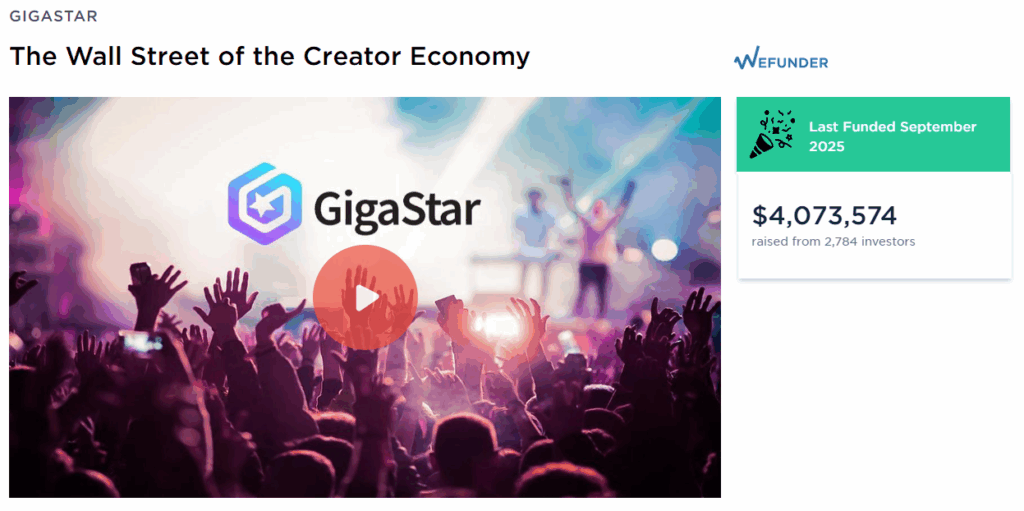
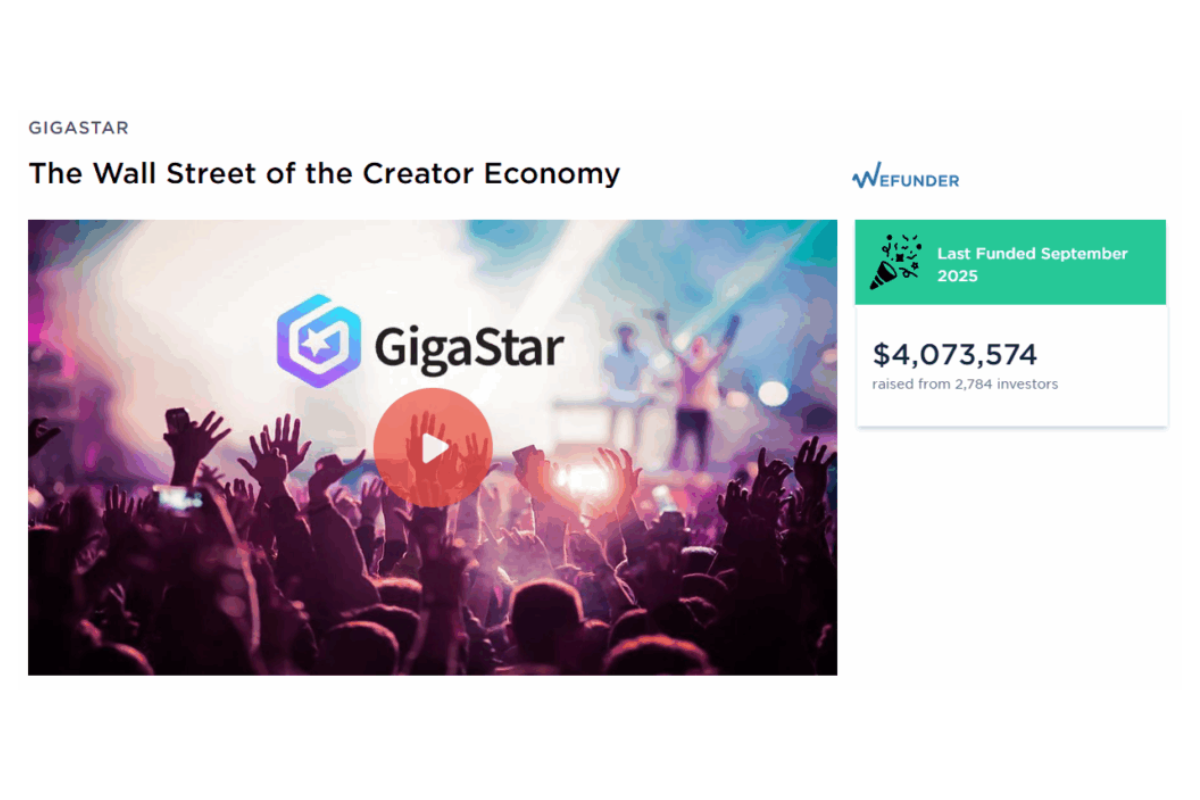
The creator economy has lacked something essential that traditional industries take for granted: a regulated financial infrastructure that allows investment in creator businesses. GigaStar’s record-breaking $4M+ community raise – which attracted 2,700 investors and hit $1.5 million in just 12 hours – demonstrates that Wall Street and Main Street alike now recognize YouTube channels as legitimate investable assets.
The platform, which enables creators to securitize portions of their YouTube AdSense revenue, set the record for the fastest 2025 raise on WeFunder.
“What we’re building is the first financially regulated platform to invest in the creator economy,” explains Hazem Dawani, co-founder and CEO of GigaStar. “We’re not trying to build a small company – we’re trying to build a company that is going to change the creator economy.”

Andy Faberlle, VP of Partnerships at GigaStar, who brings 15 years of experience in the creator economy, including time at Maker Studios (later acquired by Disney), views this as the industry’s moment of legitimization.
“GigaStar is the first company to essentially legitimize the industry by doing it in a regulated way, allowing creators, entrepreneurs, and founders of these companies to go public,” he says. “This is celebrating 20 years of building, when a lot of people didn’t believe it would be around.”

The Raise: A Validation of Market Demand
GigaStar initially allocated $1.2 million of its planned $10 million Series A for community investors through WeFunder. The overwhelming response prompted the company to expand the community allocation, ultimately closing at over $4 million from 2,700 investors.
“We left it open because we didn’t want to say no to our community wanting to participate,” explains Hazem, whose background includes successfully building and selling two venture-backed fintech startups before co-founding GigaStar.
This response wasn’t just about GigaStar’s platform; it revealed strong investor appetite for exposure to creator economy assets. As Hazem shares, comments from investors ranged from “this is my retirement” to plans of leaving the investment to grandchildren, demonstrating both short-term and long-term confidence in creators as a viable asset class.

From Fan Support to Fan Investment
What makes GigaStar’s model particularly interesting is how it transforms the creator-audience relationship from one that is purely supportive to one that is mutually beneficial.
“Not only are fans going to give money to the creators, but they’re going to get something in return,” Hazem explains. “They’re going to invest, they’re going to get a return on their investment.”
This alignment of interests creates powerful momentum for both creators and investors. “They’re getting a reminder every month when they get paid, along with the creator from YouTube ad revenue, that they have invested in this creator, that they should continue supporting the creator,” says Hazem. “Now it’s not them doing a favor to the creator – they’re actually helping themselves as well.”
The Financial Infrastructure for Creator Investment
Creating this new asset class required considerable groundwork in regulatory matters. GigaStar reports spending two years and millions of dollars securing the necessary approvals from the U.S. Securities and Exchange Commission (SEC) and Financial Industry Regulatory Authority.
The company now operates GigaStar Market, an SEC-registered crowdfunding portal, while its subsidiary GigaStar Securities LLC has approval to operate as a broker-dealer and Alternative Trading System for Digital Asset Securities tied to creator revenue.
The platform uses blockchain technology, a necessity for making creator shares tradable and transparent. “We’re leveraging blockchain as the technology infrastructure. Otherwise, this vision is not feasible,” Hazem notes.
GigaStar has also formalized its relationship with YouTube by becoming a Creator Services Provider, ensuring proper integration with the platform where its creators operate.
Real-World Impact Across the Creator Spectrum
GigaStar’s model delivers different benefits, depending on a creator’s scale and ambitions, with the most notable impact occurring among mid-tier creators who earn between $100,000 and $500,000 annually from AdSense.
“This would allow them to get one to two years of that revenue up front,” Andy explains. “If you’re making $200,000 a year, you might be able to quit your other job, hire a full-time editor, and get a small studio. That’s the most impactful.”
The company’s success stories include Mr. Hand Pay, whom Andy describes as “the poster child” for their model. After initially raising $1.3 million to expand his operation and increase fan engagement, Mr. Hand Pay returned three months later for an additional $1.3 million raise. He now has more than 2,500 individual investors backing his channel.
“As their channel grows and the revenue grows, they can come back and raise more money. They put that money to work and grow the business, and then they keep coming back and growing the business just like public companies do,” Andy says.

The Secondary Market
The next major milestone for GigaStar is the launch of a secondary market later this year, which aims to transform creator investments from initial fundraising vehicles into tradable securities.
“By launching the secondary market, we now have a complete end-to-end solution,” Hazem says. “It positions YouTube channels as an investable asset that can be traded on a market just like the New York Stock Exchange or NASDAQ.”
Beyond providing liquidity for investors, the secondary market will establish market-driven valuations for creator channels. Hazem references a public debate about MrBeast’s channel valuation to illustrate this point: “MrBeast was arguing they got an offer of $1 billion to buy his YouTube channel. He said, ‘No, my channel is worth 5 billion.’ People didn’t believe him.”
With GigaStar’s marketplace, “even if MrBeast listed just 1% of his future revenue with us and the market prices his channel at $5 billion, that’s what he should expect if somebody wants to invest or buy his YouTube channel,” Hazem explains.
Why Now? Market Maturity
The timing of GigaStar’s emergence follows the growth of the creator economy. As Hazem and Andy note, after two decades, the ecosystem has reached sufficient scale, stability, and professionalization to support formal investment structures.
“The creator economy is one of the fastest-growing sectors in the U.S., yet there’s no financial infrastructure for it,” Hazem points out. “There’s no way for investors to come and participate in this growth.”
This gap between economic reality and financial infrastructure created the opportunity that GigaStar is now addressing. Unlike earlier stages of the creator economy when business models were still forming, today’s established creators operate sophisticated enterprises with diverse revenue streams and predictable growth trajectories – exactly the characteristics investors seek.
Challenges in Creator Education and Adoption
Despite the promise, GigaStar faces the challenge of educating creators about financial concepts that many find unfamiliar. Andy notes two main creator archetypes: “We have the creator who has started as an entrepreneur, who believes this is amazing and has no problems talking to their fans, [and] understands the economics. Then you shift to the other side, which is the creator that might have started in their college dorm or grandmother’s basement, not financially savvy.”
Common concerns include creators worrying fans will think they’re desperate for money, or hesitating about the long-term nature of securities issuance. GigaStar addresses these through education, comparing creator fundraising to how established companies like Apple and Meta raise capital to grow.
“A company like Apple raises money. A company like Meta raises money. Every company and product you probably use that’s public has raised money to get to where they’re at,” Andy says to creators who don’t yet see themselves as business owners.
The Future: Creators in Investment Portfolios
Both Hazem and Andy envision creator channels becoming standard components of investment portfolios. “In five years, investors are going to look differently at the creator economy,” Hazem predicts. “I want to see BlackRock in their retirement plans for their investors, including shares in YouTube channels.”
He imagines specialized investment products grouping creator channels by category: “If I want to invest in gaming channels, I go and pick the top 30 gaming channels. If I want finance channels or lifestyle channels, I can invest in them.”
Andy’s prediction is worth highlighting: “In five years, my gut tells me that creators will start their channels to list on GigaStar,” he says, suggesting that listing on the platform will become an aspirational goal for new creators, similar to how entrepreneurs today launch with dreams of eventually going public on traditional exchanges.
Subscribe to Our Newsletter
Check Out Our Podcast