



Agency
Source Golf Is Building a YouTube Creator Network to Chase Premium TV Ad Budgets

Television ad budgets are large, structured, and still built around premium audiences. Top YouTube channels already have those audiences. What they have lacked is a way to collectively go to market on a television scale.
Solving for that opportunity is the premise behind Source Golf, the first company launched by Bentonville, Arkansas-based Source Media Group. Ethan Rosenbaum, co-founder of Source Golf, describes the new company as premium golf television for the streaming era, an aggregation of top golf channels on YouTube into a unified inventory that brands can buy at television scale.
Shortly after leaving The Forest Road Company, where he acquired entertainment businesses and financed feature films, Ethan partnered with Steve Strand and Owen Leimbach, whose backgrounds in network distribution and talent operations completed his investment experience. As viewing habits shifted from cable television toward YouTube, the group recognized that creators like Bryson DeChambeau and Grant Horvat were building regular golf audiences outside the traditional broadcast schedule. What stood out was not just the audience size. It was the commercial gap.
“There is a revenue stream that the Creator Economy does not tap into today, which is premium television ad budgets,” Ethan says.
Source Golf’s announced roster includes DeChambeau, who has more than 2.6 million YouTube subscribers, Horvat with more than 1.7 million, and the Bryan Bros with more than 850,000, with additional creators pending announcement. Combined, the network generates millions of views per day, according to Ethan.
The Soros Fund Buying ‘Hot Ones’ Changed the Calculus
Ethan’s decision to move from investing in traditional entertainment to building in the creator space traces to a specific signal. When Soros Fund Management acquired “Hot Ones,” the long-running YouTube interview series, the implication was clear: institutional capital had started treating creator IP with the same seriousness it reserved for conventional media assets.
“All of a sudden, people are buying these IPs the way they would any other traditional IP,” Ethan recalls.
That acquisition coincided with a thesis he had been developing. Sports content, in particular, was drawing engagement at levels broadcast television hadn’t seen before, and creators were no longer just entertainers. They were first-party distributors of their own audiences.
“Content creators became not just the entertainers, but the distributors,” Ethan says. “YouTube is becoming Netflix, and these content creators are both talent and distributors to their own audiences.”
Golf fit the thesis unusually well. Historically, the sport’s media engagement had been concentrated on tournament weekends, which Ethan describes as a highly lumpy viewing experience. YouTube transformed golf into a daily habit.
365 Days a Year vs. Weekend Broadcasts
The structural difference between Source Golf and traditional golf media isn’t primarily about reach. It’s about cadence. According to Ethan, PGA Tour coverage delivers concentrated but infrequent viewing. YouTube golf delivers consistent daily engagement, which is what television ad buyers actually need.
“We like to call ourselves ‘The Daily Golf Network,’ or ‘365 Days a Year,’” Ethan says. “If it’s a rainy Tuesday in January, you can go on, and there are still millions of people tuning into the channels that comprise Source Golf.”
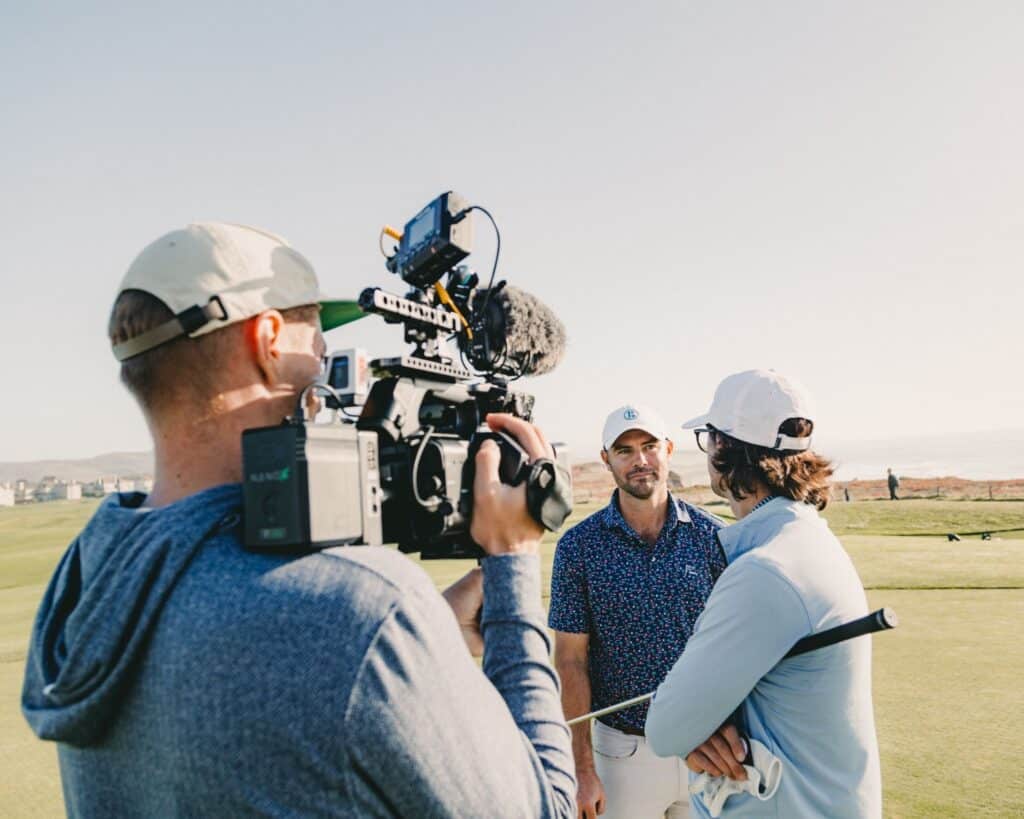
For Ethan, that consistency matters for how major ad campaigns are structured. Television buyers need not just scale but reliable inventory, a predictable volume of premium placements they can commit to across a quarter or a year. A single creator channel, however large, can’t reliably deliver that. A bundled network can.
Golf also benefits from unusual accessibility. Unlike most professional sports, amateur golfers play the same courses and use the same equipment as the creators they watch. That participatory quality deepens audience connection in ways that translate directly to advertiser value, particularly for the 18-to-49 demographic that Source Golf targets.
Creators Keep Their Channels. Source Sells the Bundle.
Source Golf’s operating model functions as a commercial layer rather than a content operation. “Creators retain full creative control,” Ethan says. “Their voice and authenticity are exactly why brands want to work with them, so preserving that is critical. We’re building the commercial layer around what they already do successfully.”
What Source provides is access to a category of brand spending that individual creators cannot reach on their own: television-style media budgets. These are structured differently from standard influencer sponsorships. They operate like national television campaigns, with consistent inventory commitments, brand safety standards, and formal measurement.
Source is also explicit about its relationship to existing talent managers. The company does not compete with them. It works alongside them.
“We’re not a talent management agency,” Ethan says. “We partner with the existing managers, helping them unlock a net new revenue stream.”
What Was Missing Wasn’t the Audience
Ethan emphasizes that no comparable product existed in YouTube golf before Source because building one required bridging two markets that operated in entirely separate modes. Television ad buyers expect structured negotiations, consistent inventory, and guaranteed brand safety at scale. Creator channels operated individually, with brand deals negotiated case-by-case.
Ethan traces the gap to the structural dynamics of any emerging market. Participants grow into their own silos. Bridging them requires sustained effort across multiple counterparties, not just a single negotiation.
“If you want to find a premium brand-safe curated network of top YouTube golf content, that’s what was missing,” he says. “It wasn’t there.”
Legacy Studios Have a Distribution Problem They Haven’t Solved
Ethan is measured when discussing traditional entertainment companies, having spent years working alongside some of the industry’s more disciplined investors. But he is direct about the structural challenge those companies now face.
The problem, as he sees it, is that talent has become the distribution. Legacy studios built their value around controlling pipelines, owning platforms, and routing content through them. Creators built audiences directly, making them simultaneously the talent and the broadcaster.
“They’re used to working with talent in traditional frameworks,” Ethan says of major studios. “And now talent is the distribution. It’s not so straightforward how the traditional players are going to adapt.”
Consolidation compounds the challenge. The larger legacy companies become, the harder it is to build ground-up models that treat creators as distribution endpoints rather than talent to be cast. The standard playbook, bring talent in and put them through existing pipes, doesn’t work when those creators already own their distribution.
“It’s really going to require ground-up innovation for how to build next-generation studios out of these creators,” he says. “How that comes together is TBD.”
Year One Looks Like Delivering for the Creators in the Network
Source Golf is currently in conversations with launch brand partners across several categories, with announcements expected later in 2026. Ethan declines to name specific partners but describes the pipeline as active, with brands seeking multi-year commitments across the network.
Success, in his framing, is straightforward. Deliver net new revenue to the creators. Everything else follows.
“We have an incredible roster,” Ethan says. “Success looks like continuing to work every single day to deliver value and deliver net new revenue for our creators. That’s really what it comes down to.”
The broader opportunity, he argues, extends beyond golf. The same aggregation and monetization model applies wherever premium YouTube creators have built consistent, brand-safe audiences in a definable niche. Golf is the starting point because its demographics, engagement patterns, and advertiser interest align unusually well.
“This is a television network,” Ethan says. “And it’s just the beginning for what we can do across the bundle.”
Subscribe to Our Newsletter
Check Out Our Podcast