


Tech
Wes Elder On Why Creator Marketing Needs A Marketplace, Not Another Campaign Tool

For brands investing in creator marketing, the hardest part is rarely finding creators, according to Wes Elder. Instead, he says the friction shows up in pricing opacity, inefficient deal workflows, and the challenge of scaling partnerships without endless negotiation or inbox-heavy coordination.
That gap is what Wes set out to fill with Creatorspace, a creator marketing marketplace designed to make pricing, availability, and deal structures visible upfront. Creatorspace 2.0, which launched in early 2026, reflects nearly two years of iteration shaped by direct work with creators, talent agencies, and Fortune 500 brands navigating the operational realities of creator-led campaigns.
“We’ve tried to create the singular hub where you can partner with creators in all the different ways that are possible,” Wes says. “Not just campaign submissions. Not just one-off brand deals. Everything.”
Unlike campaign-driven influencer platforms, Creatorspace is built around creator-set rates and opt-in inventory, allowing brands to browse, compare, and transact directly with creators and rosters, whether for standard social posts, product-for-content exchanges, or larger creative projects. The goal, Wes says, is to reduce friction on both sides by making pricing and expectations explicit from the start.
That focus on infrastructure is rooted in Wes’s own background. Before founding Creatorspace, he worked as an actor, filmmaker, and producer, including producing “The Matchbreaker,” one of the earlier feature films to cast YouTube creators in leading roles. “I’m a creator myself,” Wes says. “I’m an actor and filmmaker. I have a theater degree. I’ve always been creative, even if I didn’t fully identify as a ‘creator’ in the way we think about it today.”
The idea for Creatorspace emerged while producing “Gutted,” a brand-funded show featuring influencers, where sponsorship, creative ambition, and scale had to coexist.
“We had produced two seasons of a show funded by brands,” Wes explains. “We wanted to do more of that, and the question became, ‘How do you do this at scale? How do you build tech around it?’”
Early Traction, Early Friction
Wes points out that the first version of Creatorspace worked, at least in one important way. It brought in clients. But, he says, the platform’s original positioning tried to do too much at once.
“We were trying to say it was built for TikToks to movies,” he says. “And the reality is, it was really built for big creative ideas; listing a movie pitch, a show idea, something like that.”
Despite that mismatch, Wes notes that the timing proved fortuitous. As brands began experimenting more seriously with creator-led strategies, Creatorspace found itself in the right place at the right time.
Since launch, the company has worked with brands including Colgate and Microsoft, often in partnership with major agency networks like WPP. That client work kept the company busy, allowing Wes to bootstrap rather than raise capital.
“As a founder, you either make revenue or you fundraise,” he says. “Revenue is always better.”
Becoming Bullish on the Creator Economy
If the early years of Creatorspace were about experimentation, the past two years have solidified Wes’s conviction that the creator economy is not a side channel. It’s the future of entertainment and advertising.
“I’ve become really bullish on it,” he says. “I have friends in traditional production – gaffers, grips, audio people – and they’re just not working right now. Meanwhile, creators are producing constantly.”
Wes points to both audience behavior and production economics as forces reshaping the industry. “It’s too easy to make entertainment now,” he says. “Anyone can do it with their phone. And the threshold for what audiences consider entertaining has lowered. I see it in myself. I spend more time watching TikToks than movies.”
Even as AI reshapes parts of the production industry, Wes believes creators remain resilient.
“These videos cost zero to a hundred dollars to make,” he says. “AI isn’t replacing that. It’s just making it easier.”
Where the System Still Breaks Down
Despite the growth of creator marketing, Wes sees persistent disconnects between creators, brands, and platforms.
Pricing is the most obvious one.
“Brand deal pricing is still the Wild West,” he says. “People either have no idea what to charge or they’re completely overcharging.”
But pricing isn’t the only issue. From Wes’s perspective, many creators struggle not because of talent, but because they don’t package themselves effectively.
“Sometimes, clients don’t have great imagination,” he says. “The creators who do best are the ones with clear portfolios, examples, case studies; things that help brands feel confident.”
He sees this most often in creators who previously worked in marketing or have long experience working with brands. They understand what decision-makers need in order to say yes.
“It’s not about having perfect analytics,” Wes says. “It’s about looking professional and making it easy to understand what you’re going to deliver.”
On the brand side, the gap is often cultural fluency.
“Agencies usually get it,” he says. “They understand social trends and online culture. The brand side often doesn’t, and there’s tension there.”
That tension, Wes adds, leads to longer approval cycles and conservative creative choices, especially within large organizations navigating legal and regulatory constraints.
Rethinking the Platform Entirely
By early 2025, Wes knew Creatorspace had reached a crossroads. There were two possible paths forward.
One option was to double down exclusively on high-end creator-led entertainment (movies, shows, large-scale projects) and strip away traditional brand deal messaging. The other was more ambitious: expand the platform to support all creator-brand transactions while retaining space for big creative ideas.
The team chose the latter.
“It was still early for branded entertainment,” Wes says. “The sales cycles were long, the economics were unclear. But brand deals, everyone understands those. They’re imperfect, but familiar.”
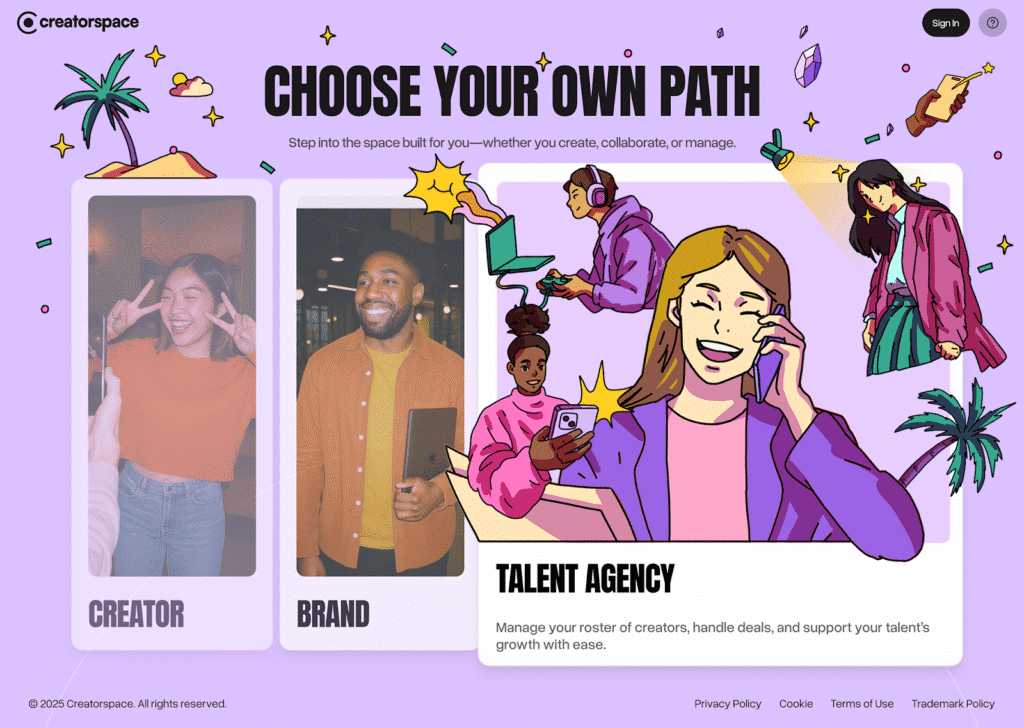
Creatorspace 2.0 reflects that decision. The platform has been rebuilt as a marketplace where creators set their own rates and list all available inventory, while brands browse, compare, and transact directly.
“This isn’t a data-scraped platform,” Wes says. “Every creator signs up and sets their rates themselves. If you see it, it’s real.”
How Creatorspace Works Today
Wes now describes Creatorspace as a one-stop shop for working with creators across any format. That includes traditional sponsored posts, YouTube integrations, product-for-content exchanges, and fully funded passion projects.
The goal is speed and transparency.
“Cut out the back-and-forth,” Wes says. “I want to see the rate. If it works, we move forward. If not, we negotiate.”
The platform operates on a subscription model rather than taking a commission on deals. Brands can transact on-platform or take relationships off-platform entirely, using their own payment systems and procurement processes.
Pricing tiers start at $19 per month and are designed for small businesses experimenting with creator marketing for the first time.
“That tier is for someone selling soap bars,” Wes says. “It might only cost them the product.”
At the enterprise level, Creatorspace is building functionality to support more complex workflows, including payment terms, legal requirements, and internal approvals.
Why Creators and Agencies Are Paying Attention
Since the launch of 2.0, feedback from creators and talent agencies has been overwhelmingly positive, according to Wes.
“For creators, it’s low effort,” he says. “You sign up, add your rates, and walk away. If a deal comes in, you get notified.”
Unlike campaign-driven platforms, Wes notes that creators and agents don’t have to constantly apply or refresh listings. The platform is designed to work passively in the background. Agencies, meanwhile, can use Creatorspace as a live media kit and roster tool, complete with updated analytics and portfolios.
“That alone makes it worth it for them,” Wes says.
He shares that creators are also responding to the ability to list larger creative ideas, not just brand deals.
“If someone normally charges $5,000 for a post but has a $30,000 idea, this gives them a place to find backing,” he says.
What’s Next?
Wes sees pricing transparency as the next major unlock for the industry. Hence, Creatorspace is exploring programmatic bidding on creator inventory, particularly for enterprise brands.
“Put numbers in front of people,” he says. “Some creators will make more. Some will make less. But it creates real market signals.”
Wes is clear that the goal isn’t a race to the bottom.
“We don’t want to be Fiverr,” he says. “We want healthy competition, like Airbnb. Different prices for different value.”
For Wes, the long-term ambition is straightforward: “I want Creatorspace to be a consistent source of income for creators. The way Airbnb helps people make money from their homes.”
He believes the creator economy doesn’t need more campaigns or buzzwords. It needs systems that reflect how people actually work.
“We’ve tried to make this easy, accessible, affordable, and fun,” Wes says. “Not just another platform, but one creators actually want to use.”
Subscribe to Our Newsletter
Check Out Our Podcast