





Technology
Ulkaa’s Rahul Gayakwad Believes AI Agents Could Solve Influencer Marketing’s Scaling Problem

When Rahul Gayakwad wanted to understand why influencer campaigns kept breaking down, he sent the same brief to 20 to 30 Influencer Marketing agencies across India. The strategy changed at nearly every handoff. The experiment convinced him the problem was not one agency’s execution, but the way the industry operates.
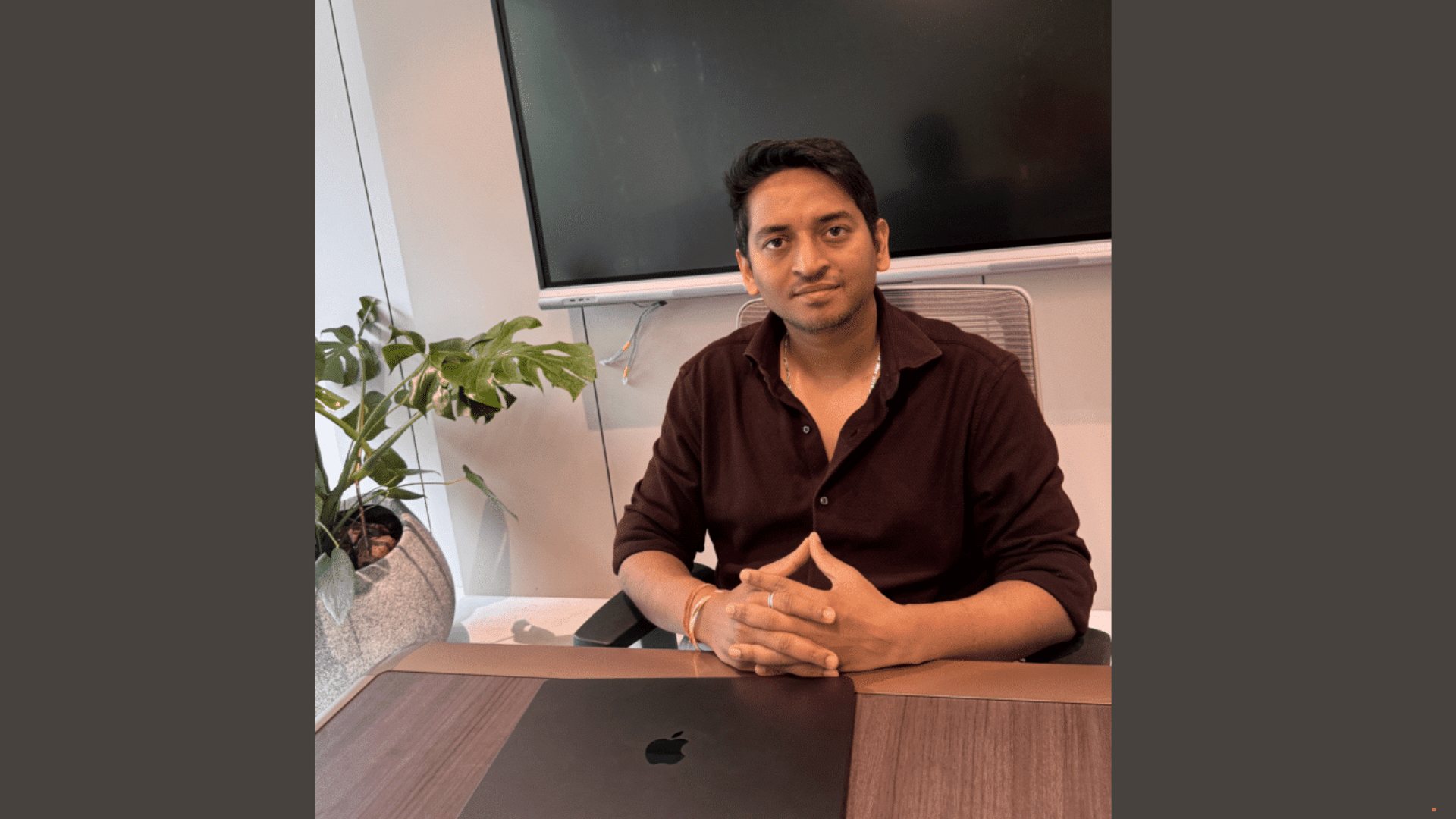
Rahul is the co-founder and CEO of Ulkaa, a Bengaluru-based company he co-founded with Bhawana Tiwari (CTO) that’s building an autonomous AI agent to run Influencer Marketing campaigns end-to-end, from creator discovery through payout. The company is a rebrand of ryme, the influencer marketplace Rahul founded in 2025 after leaving an engineering role at a blockchain-based sports betting startup, where he held a $100,000-a-month influencer budget, but couldn’t find a partner to deploy reliably.
“Every other solution helps your team execute Influencer Marketing. Ulkaa executes Influencer Marketing for your team, so you can scale campaigns without scaling your team,” he says. Rather than automating a single step, such as discovery or outreach, Ulkaa is designed to run the full operational workflow autonomously: discovery, outreach, negotiation, briefing, content review, compliance checks, and performance tracking, without a human required at each handoff.
The target customer is a direct-to-consumer brand already running at least 10 influencer collaborations a month, paid or bartered, across creator tiers from nano to mega. The product runs on Instagram only for now, with YouTube, LinkedIn, and X planned as each becomes viable in Rahul’s core India market. Ulkaa remains in private beta ahead of a public launch, so most of its claims are still being tested at a small scale.
Ryme AI Hit a Wall That More Process Couldn’t Fix
Ryme AI’s model was conventional for the category: an AI-assisted marketplace connecting brands with creators. The company onboarded 25,000 creators and worked with D2C and fintech brands on Instagram and YouTube, according to Rahul. The deeper problem, he says, showed up in execution, not sourcing.
“Influencer Marketing, at the end of the day, is people’s management and communication,” he says. “People management itself is a very hard problem to solve. And on top of that you put a communication layer, it becomes more difficult.”
The agency brief experiment reinforced that view: Rahul compared ryme AI’s own process against how established agencies handled an identical brief, and found the same distortions everywhere. That pattern led him to a specific diagnosis: Influencer Marketing cannot be reduced to a standard operating procedure. “You cannot create a standard operating procedure or a template which can solve Influencer Marketing,” he says. “Ryme taught us that bespoke execution does not scale with people.”
Three Trends Converged To Make the Timing Work
Rahul frames the rebrand’s timing around three shifts he says arrived together. Influencer Marketing remains a single-digit share of total digital marketing spend, he says, even as paid media costs keep climbing. Second, AI has made content production cheap, shifting scarcity toward distribution; creators, in his framing, are a complete package of both. Third, he points to a technical threshold he says only recently arrived: AI agents capable of executing complex, multi-step workflows autonomously rather than answering prompts in isolation.
“If we go back one year, ChatGPT was there, Claude was there. But the agentic execution or a complex workflow execution was not there,” he says.
That timing argument doubles as a hedge against a hype cycle Rahul has lived through before, at a blockchain-based sports betting protocol that raised close to $10 million, had strong technology and an engaged community, and stalled after launch. “You can have an elegant architecture, an excited community and plenty of attention, but if you’re asking customers to change their behaviour before you’ve solved a problem they feel every day, adoption becomes very difficult,” he says of that lesson.
Ulkaa Is Built as an Execution Engine, Not Another Point Tool
Rahul draws a sharp line between Ulkaa and the wave of AI point solutions marketed to the same industry. “An AI discovery tool finds creators, but someone still has to run outreach. An outreach tool contacts creators, but someone still manages negotiations, reviews content, tracks timelines, and keeps campaigns moving. The human remains the execution engine,” he says.
Ulkaa’s pitch is to remove that handoff by autonomously executing the entire Influencer Marketing workflow from discovery and outreach to negotiations, briefing, content review, compliance checks, and delivery tracking as one system.
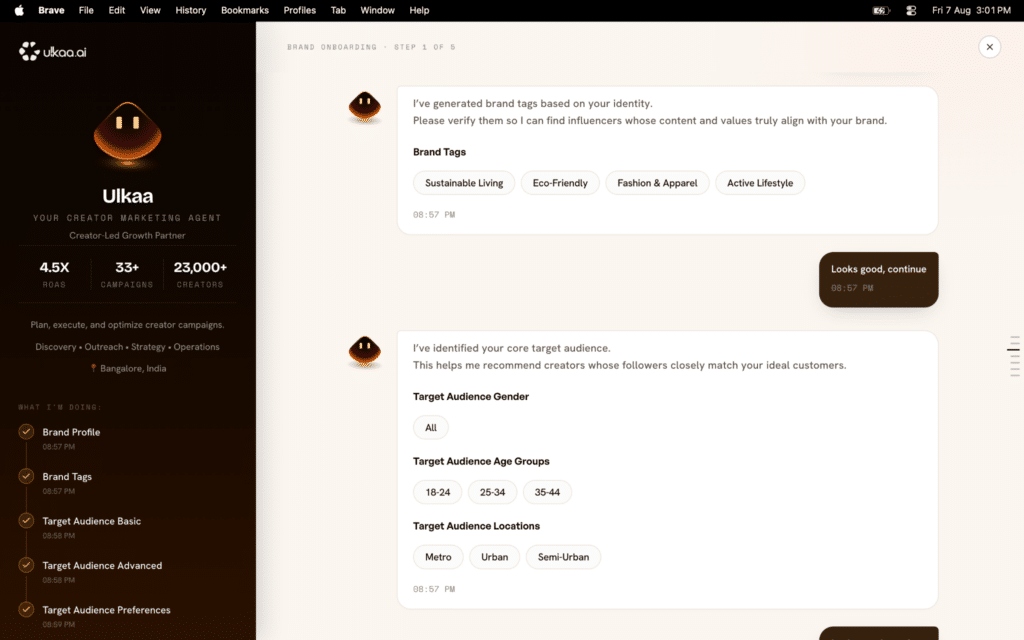
The mechanics start when a brand signs up and Ulkaa scans its website and social profiles to build what Rahul calls a “brand DNA”: target audience, tone and positioning. The agent proposes creator personas for feedback before a campaign launches, then fields and proactively sources applications, accepting or rejecting creators instantly rather than waiting on a marketer to review profiles.
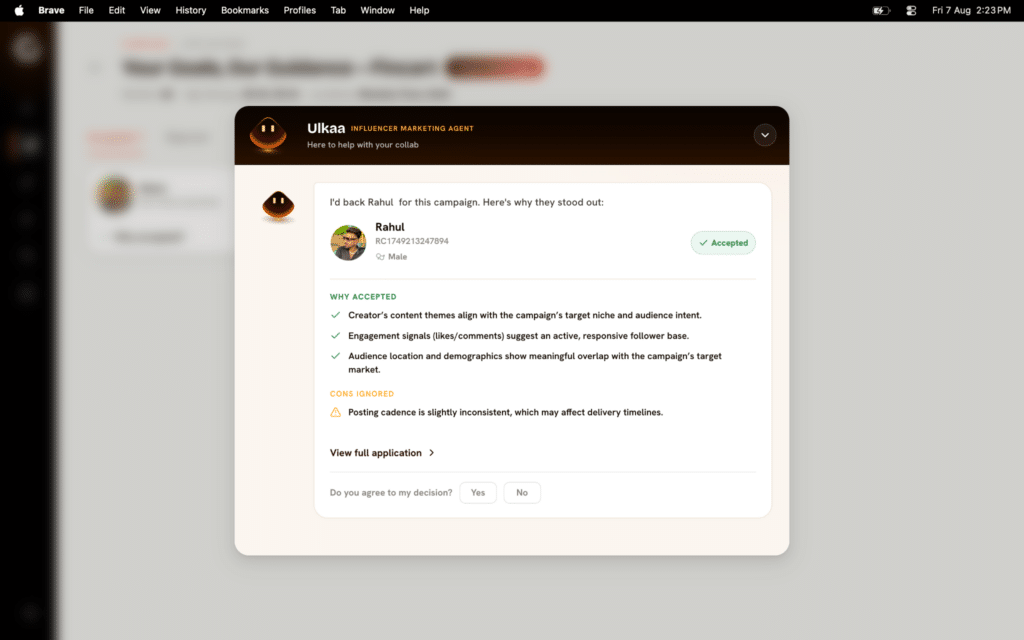
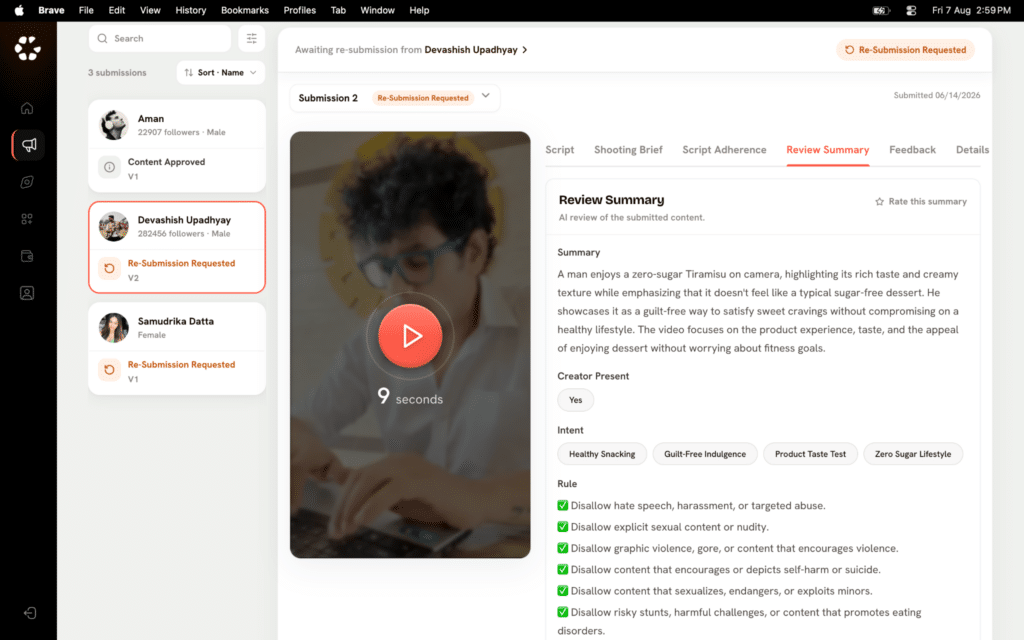
Content review works the same way. Creators upload drafts directly to the platform, and the agent flags brand-safety and compliance issues, including profanity, before a brand sees the material. “Most of the time, the content is good enough to go ahead because the AI agent has done most of the filtering work,” Rahul says. Once approved, the creator posts, and Ulkaa tracks performance in real time.
The Model Changes the Math on Small Creator Collaborations
Ulkaa charges a 20% take rate on paid campaigns and a tiered subscription, from 10 to 60-plus barter collaborations a month, for the barter side of the business, where a commission isn’t possible. Creators pay nothing to join.
Rahul argues the bigger shift is economic. A $100 collaboration and a $1,000 collaboration take a human team roughly the same effort, he says, which makes the smallest, best-performing deals the least profitable to run. “Nano and micro creators consistently deliver stronger engagement than larger tiers, and in India they already account for close to half of all campaigns,” he says. Removing that per-collaboration labor cost is what he says makes 200 nano collaborations as viable as 20 mid-tier ones.
Rahul applies the same logic to speed. Where a human team executes in sequence, Ulkaa negotiates with dozens of creators, reviews content from others, and settles prior payouts simultaneously, he says. “With ryme, doubling campaigns meant roughly doubling the team. With Ulkaa, campaign volume and headcount are unrelated numbers,” he says. That claim hasn’t been tested at scale, and the product remains in private beta with a small number of clients.
A Beta Campaign Hints at Upside, on a Small Sample
Ulkaa’s clearest example so far involves Panda Money, a remittance company serving non-resident Indians in the United States, United Kingdom, and Europe. Rahul says the agent built a brand profile for Panda Money, generated five or six creator personas, and tested a handful of paid collaborations, including one built around Telugu-speaking creators targeting the Telugu diaspora.
That single persona, he says, drove a jump in signups from roughly 100 a day to 1,000 a day within a week of one piece of content going live. Panda Money has since kept reaching out to that creator segment independently, and Rahul says the results have held.
The beta also surfaced early limits. Rahul says Ulkaa’s initial language models struggled to generate and validate Telugu-language scripts, requiring a switch to region-specific models, and that outreach messaging needed similar tuning. Nothing has gone wrong at what he calls a catastrophic scale, though the tuning process is ongoing.
The Bet Is Whether Marketers Actually Want the Time Back
Rahul says Ulkaa is on track for a public launch by the end of August or the first week of September, following the current private beta. His stated vision for two years out is a leaner marketing function. “Humans for creativity. Agents for intelligence and scale,” he says, arguing that if the model works, brand teams will spend less time coordinating collaborations and more time on ideas.
He extends the same logic to agencies, arguing they stand to benefit rather than lose ground, since their margins are constrained by headcount, not creative capacity. Ulkaa does not yet serve agencies directly, though Rahul says a product for them is planned.
By his own account, the open question isn’t whether AI agents will keep improving. It’s whether marketers will actually hand over operational work they now do by hand. “If brands take three years instead of one to cross that line, our volume assumptions are early even when they are right, and being early is indistinguishable from being wrong for longer than most startups survive,” he says.
Subscribe to Our Newsletter
Check Out Our Podcast