





Technology
RAD Intel’s Lickly Launches to Put Creator Decisions on Defensible Ground Before Brands Spend

RAD Intel introduced Lickly, its marketing decision intelligence company, at HubSpot UNBOUND in Boston last month. Lickly unveiled its new brand and expanded self-serve SaaS offering, powered by RAD Intel’s proprietary AI platform, RADZilla. The software helps brands and agencies discover audiences, evaluate creator partnerships, and forecast campaign performance before committing budget.
Co-founder Bradley Silver believes marketers need a clearer understanding of who their buyers are and what influences their decisions. For creator marketing, that means looking beyond experience and relationships to understand a creator’s audience, why their content resonates, and how well that audience aligns with a brand’s potential buyers.
The reasoning behind the platform, which Bradley co-founded with Jeremy Barnett in February 2026, traces to more than a decade of research into how language shapes audience behavior. At Atomic Reach, a Toronto-based content scoring company he ran until 2021, Bradley studied the relationship between content and audience response before RAD Intel acquired the company in 2020. What he found inside the agency’s decision process was consistent.
“Decisions were being based primarily on experience and subjective expertise without a data layer,” Bradley says. “A view of your audience that you potentially haven’t seen before.”
Nita Patel, who joined as Lickly’s CMO in April after senior roles at VANTIQ, ABBYY, and FireEye, came to the platform because the customer profile she would be selling to mirrors her own. “I’m selling to myself,” she says. “My persona that I sell into is CMOs, growth marketing officers, and demand gen marketers.” Lickly targets mid-market marketing teams and the agencies that service brands.
Audience Comes Before Creator
Even within a well-defined target market, according to Bradley, there are multiple distinct communities responding to different messages and carrying different relationships with different creators. Treating them as a single audience is the error that leads brands to over-invest in high-reach creators who do not move their customers. “It’s not about finding the biggest and the best creator,” Bradley says. “It’s about finding the creator that is best aligned with the needs of that particular audience.”
Those distinctions, he contends, are only visible with data. Creator selection was consistently driven by relationships and experience rather than information on how sub-groups behave, what motivates them to buy, or what kind of voice they already trust. “Small communities with the ideal set of creators deliver completely different results than what we were seeing in the past,” Bradley says, noting that audience fit is only measurable with data on who the audience actually is.

Three Layers, One Decision
Lickly structures its workflow across three connected modules: audience intelligence, creator matching, and content scoring.
The audience intelligence module starts when a brand inputs prompts describing its target market or uploads a creative brief. The platform independently ingests publicly available data across search, TikTok, X, LinkedIn, YouTube, and trend and news sources to build on that input. From those signals, it constructs sub-segments with demographic and behavioral profiles, purchase motivations, pain points, messaging preferences, and a competitive market read. “It shows gaps and opportunities relative to your competitors,” Bradley explains. “And based on those inputs, it then says, ‘We think this is the ideal messaging framework and objective for this particular campaign.’”
Creator matching follows from the audience analysis. The platform independently searches and analyzes creators, comparing their content and audience behavior to the target segment’s profiles, and surfaces a ranked list. Each creator’s profile includes a proprietary “Lickly score,” predictive CTR estimates, projected cost ranges, and messaging suggestions calibrated to that segment. “Based on that evidence is what the marketer can make a decision on,” Nita says. “We’re not saying the technology will tell you exactly what to do. It will provide you with enough data so that you could make an intelligent decision based on evidence that makes sense.”
The content module handles the creative review. Once a creator uploads their draft, a scoring engine evaluates it against how the target segment responds to information and returns feedback. “The feedback goes back to the creator,” Bradley says. “They decide if they want to make the adjustments or not.”
Why General-Purpose LLMs Fall Short
The technical case Lickly makes for itself rests on a proprietary reasoning engine it calls “M³VRTM,” or Multi-Model, Multi-Vector Reasoning, built to address the reliability problems that make general-purpose LLMs unsuitable for high-stakes marketing decisions.
Nita draws the comparison directly. “Every time you ask ChatGPT or Claude who the ideal creator is for my market, you’re going to get a different answer,” she says. “That’s not a way to build a marketing campaign.” Beyond inconsistency, she argues that general LLMs accumulate user-specific biases, producing outputs oriented toward what a user likely wants to hear rather than what the data shows.
Bradley’s explanation of M³VR is functional: different LLMs are better at different analytical tasks, and the layer assigns work to the models most capable of each task before running an additional validation and reasoning pass. External data sources and synthetic data are used to verify outputs before they surface to users. “We don’t just take the first answer and assume it’s right,” he says. “We verify it, validate it, and look at the evidence behind it before it gets surfaced to the marketer,” he says.
The audience for that claim is the marketer who needs to take a decision into a budget meeting. “How do I trust that the information is correct, because I’m making material investments based on it?” Bradley says, framing the question Lickly is designed to answer.
The Mid-Market Opening
Bradley argues that a structural change in the economics of data processing has unlocked a customer segment previously priced out of this level of audience intelligence. “Mid-market companies, CMOs at mid-market companies, now have the opportunity to get access to enterprise-grade tools at a price point that makes complete sense to them,” he says. “That dynamic has never existed before.”
His premise is that advances in LLMs have reduced the cost of large-scale data analysis enough to make sophisticated audience profiling viable as a self-serve SaaS product rather than a high-cost enterprise deployment.
Nita adds a second proposition for the same customer – control. She notes that brands routing influencer campaign decisions through agencies can bring that function in-house, with more data and direct ownership of the output. Lickly is also targeting agencies as a distinct customer segment, with the argument that data-backed creator recommendations make those recommendations easier to sell to brand clients.
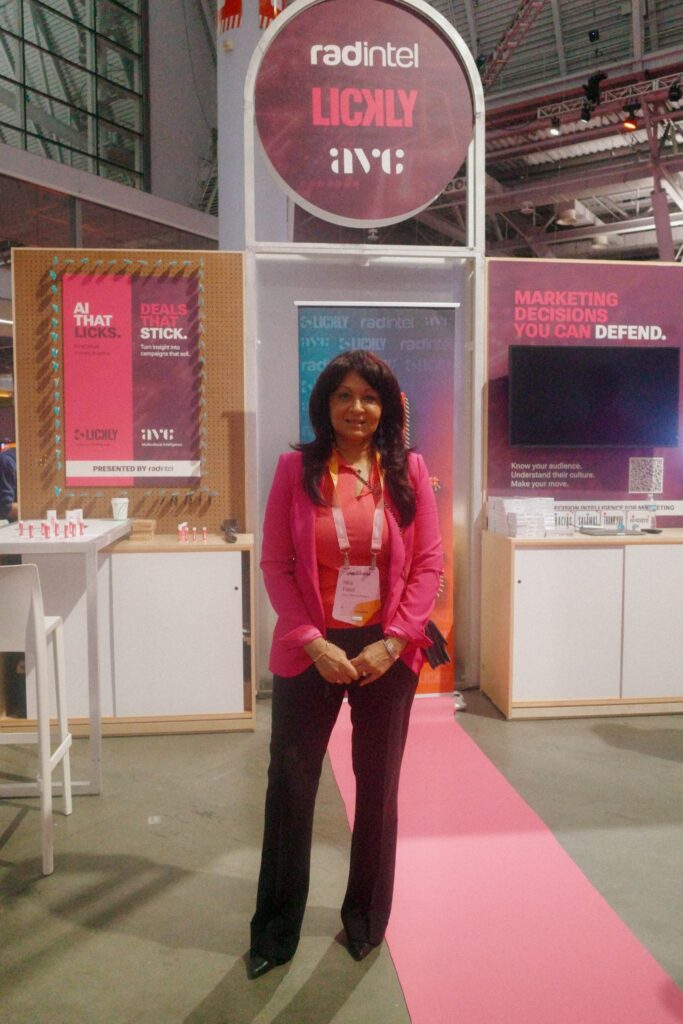
Photo: Nita Patel at HubSpot UNBOUND 2026
Where Creator Compensation Could Move
On creator payment, Lickly takes a neutral position. The platform suggests a fair market rate based on content type and historical engagement but leaves the actual negotiation between the brand and the creator. A communication layer built into the platform assists with that process.
Bradley extends the analysis with what he labels a “hot take” on where creator economics are heading as AI tools lower the cost of content production and automation becomes more widely adopted. He predicts creator compensation could converge toward the performance-based model that governs other paid media channels. “As long as it is authentic content, it has the creator sign-off, it really reflects who they are, I see an environment where they get paid for performance much like you do other forms of paid media,” he says.
Bradley acknowledges the prediction is speculative and contingent on how platforms, talent representation structures, and brand procurement models develop alongside AI-generated content.
The Answer to the Test Before It’s Given
Bradley’s clearest articulation of what success looks like is his account of what changes in a brand’s budget conversation if the platform works as intended. “Confidence,” he says. “We know the answer to the test before the test is given.” The promise is that a marketing team can enter a budget approval having already resolved much of the ambiguity that typically precedes a creator campaign launch (which segment to target, which creator fits, what the content should say, at what cost). “So much ambiguity and guessing is removed from the process, and so much reliability is ingested into the process,” Bradley says.
Nita describes the same value from the CMO seat. “I have to go to my founders and say, ‘This is why I want to spend the money,’” she says. “The platform gives me the evidence.”
Both see AI adoption as a near-term competitive necessity rather than an option. In Bradley’s framing: “Irresponsible use of AI is as damaging as responsible use of AI is impactful. Understanding where AI is reliable and trustworthy, and understanding what its limitations are, is a fundamental difference between the organizations that will succeed and those that will bump into challenges.”
Subscribe to Our Newsletter
Check Out Our Podcast